

Two nightstands on this site have two drawers, an open shelf and the same footprint. One is 19.7 inches tall, the other 19.9. The spec lines differ by one phrase: “MDF with a walnut finish” and “solid rubberwood with a walnut finish.”
That phrase decides what a scratch costs you in year five, and it is the one thing a product photo cannot show: the finish on a cheap panel is printed to imitate the wood it stands in for, grain included.
What the words actually promise
| Word on the listing | What it commits the seller to | What it leaves open |
|---|---|---|
| Solid + a species (“solid red oak”) | boards of that species, through the named parts | hidden panels, drawer boxes |
| “Solid wood,” no species named | boards, not panels | which species, how it was dried |
| MDF | wood fibre and resin, pressed into a sheet | there is no grain to see |
| “Engineered wood” | a panel, usually MDF or particleboard | which one, how it is joined |
| “Wood veneer” | a thin slice of real wood over a core | what the core is |
| “Wood-look finish” | a printed or laminated film | that it is wood at all |
The Wood Reserve, a furniture dealer, notes that a piece may resemble wood without being a wood veneer: “it might be a printed or laminated surface designed to imitate wood grain.”

Grain around the edge, and what it can’t tell you
The edge test is the one every guide gives, and it works. On solid wood the grain runs off the face and continues around the edge, because face and edge are the same board. On veneer the edge is usually a separate strip, and at the corner you see where the veneer stops. Nathan Home’s guide: “on furniture with veneer-over-MDF, corners often reveal the grey or brown composite core where the veneer ends.”
The catch: you run this test in person. Online you get six styled photos and a dimensions table. The pair above is MDF with a printed walnut finish — the fluting is milled, the grain is not.
Veneer thickness is the number almost no listing gives. One dealer puts it at “about 1/40 of an inch,” roughly 0.6 mm. Another gives 0.6 mm to 6 mm — a tenfold spread.

Open a drawer instead
If you can touch the piece, skip the top and pull a drawer out. Look at the sides and back of the box, the back face of the drawer front, and the end grain at a leg. Solid wood shows growth rings and pores that match the face; MDF shows a uniform fibrous edge with nothing in it. A box in a lighter, unfinished wood than the case is normal at every price. A box that looks like compressed cereal is the warning.
The weight test is backwards more often than you would think
Lifting a piece feels like evidence. One guide states it flatly: “Solid wood is substantially heavier than MDF or particleboard of equivalent dimensions.” A retailer that sells both says the opposite about the reasoning: “Many people assume heavier furniture is solid wood. That’s not always true.”
The numbers settle it. The Wood Database puts rubberwood at 37 lb/ft³ (595 kg/m³) at 12% moisture content, red oak at 43.8 lb/ft³ (700 kg/m³). Uniboard, a North American panel mill, lists a typical 790 kg/m³ — 49.5 lb/ft³ — for its Excel+ MAX MDF. That makes MDF about a third heavier than rubberwood per cubic foot, and heavier than red oak.
So a flat-pack MDF nightstand can weigh more than a solid rubberwood one of the same size. Weight tells you about panel density and hardware, not about what the panel is. One caveat: that MDF figure is one mill’s typical value for one product line, and density varies by grade.
How long each one lasts — the sources disagree
A dealer’s comparison table gives solid wood 50+ years, quality veneer over plywood 15 to 30, and veneer over particleboard or MDF 3 to 10, advising against veneer whenever the core is particleboard or MDF. The Wood Reserve reads the same material differently: “high-quality furniture has used beautiful wood veneers for centuries,” and veneer’s reputation problem comes from cheap construction, not veneer. A third source splits it: “Veneer and MDF aren’t always ‘bad’ — they’re just built for different goals.”
None of the three quotes a dataset you can audit. They describe construction quality while using a material label as shorthand, which is why the numbers diverge. What separates a three-year piece from a thirty-year one under the same label is how panels are joined, whether hardware has solid material to bite into, and whether water can reach an unprotected edge.
One point nobody disputes: surface damage is permanent. “A scratch through veneer exposes the core underneath, and there is no sanding your way out of it.”
What our own shop lists, word for word
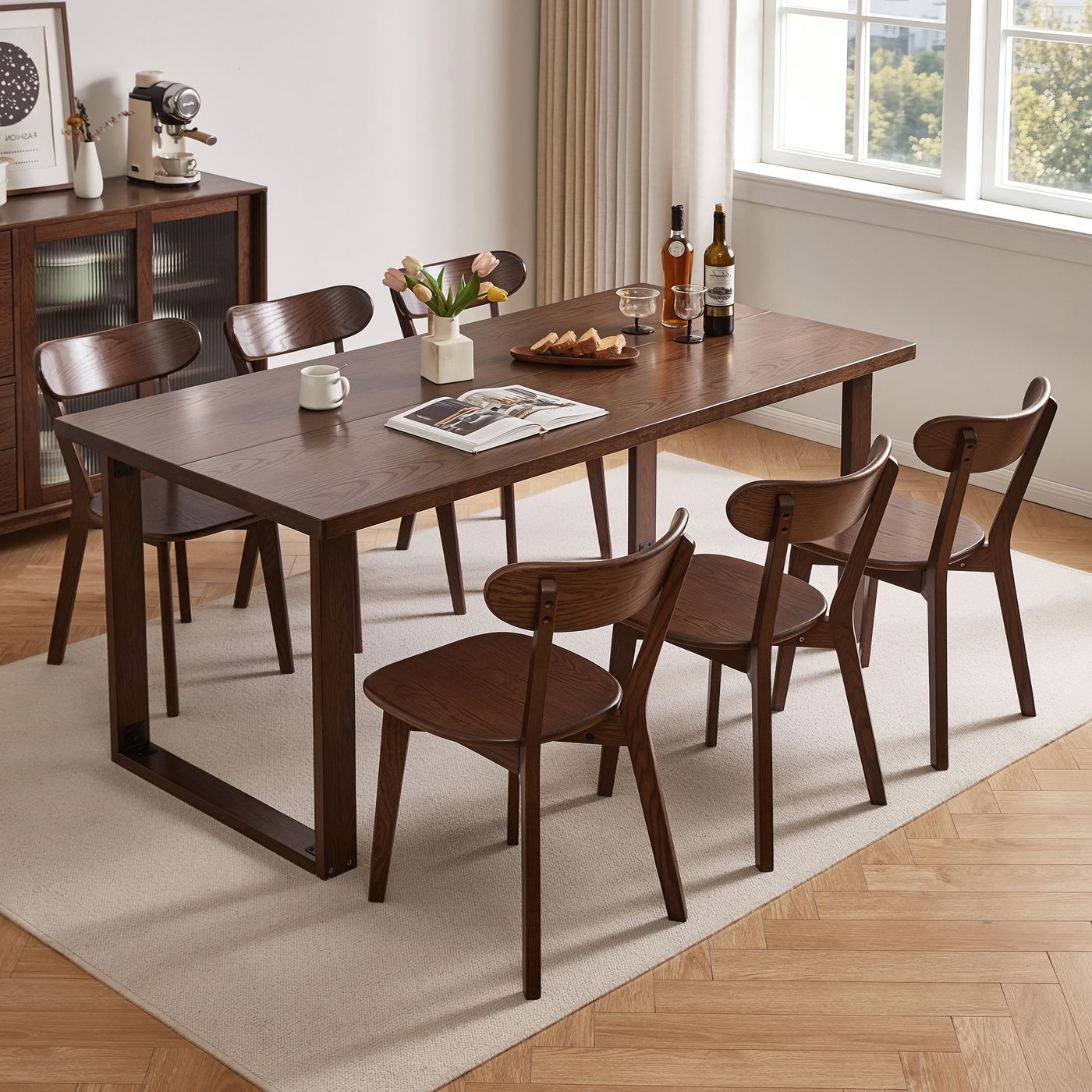
Of the 36 pieces here, four are MDF: both fluted nightstands at 11.8 × 15.8 × 19.7 in, and both charging-station side tables at 23.6 × 11.8 × 24.4 in with two USB ports and two outlets in the top. One is engineered wood, the Modern Bedside Tables, Set of 2 at 15.4 × 11.4 × 23.4 in. The other 31 name solid wood, solid rubberwood, solid red oak or beech — like the two-drawer rubberwood nightstand at 11.8 × 15.3 × 19.9 in, or the solid oak dining chairs at 18.1 × 14.6 × 29.9 in, sold as a pair.
The bad news differs by group. On the MDF pieces, a deep scratch into the fluted front will not sand out, and water reaching an edge seam swells the panel permanently. On the solid pieces, the wood moves with the seasons — a wide top changes dimension slightly between a humid July and a heated January. Neither is a defect; they are the terms.
Ask for the formaldehyde paperwork and you learn something
US formaldehyde limits on panel products come from 40 CFR 770.1, which covers composite wood products and “finished goods that contain composite wood products.” Section 770.3 defines the term: “Composite wood product means hardwood plywood made with a veneer or composite core, medium-density fiberboard, and particleboard.”
Solid lumber is not in that definition, and the rule exists because panels are bonded with resin. So ask any MDF seller whether the panel is TSCA Title VI compliant, and for the documentation.
Three questions that settle it before you pay
- Does the listing name the species? “Solid rubberwood” is checkable. “Solid wood” is not, and a listing that stops there is asking you to inquire.
- Which parts are panel and which are solid? An oak frame with MDF drawer bottoms is a normal, well-made piece. On a page that never says which parts, it is a maybe.
- What happens when it gets scratched? “Wipe it” means a film on a panel. “Sand and re-oil that spot” means wood.
Sources
- U.S. Government Publishing Office, eCFR — 40 CFR §770.1 Scope and applicability — https://www.ecfr.gov/current/title-40/chapter-I/subchapter-R/part-770 — accessed 2026-11-07
- U.S. Government Publishing Office, eCFR — 40 CFR §770.3 Definitions — https://www.ecfr.gov/current/title-40/chapter-I/subchapter-R/part-770 — accessed 2026-11-07
- The Wood Database — Rubberwood (Hevea brasiliensis) — https://www.wood-database.com/rubberwood/ — accessed 2026-11-07
- The Wood Database — Red Oak (Quercus spp.) — https://www.wood-database.com/red-oak/ — accessed 2026-11-07
- Uniboard — MDF Excel+ MAX technical sheet — https://uniboard.com/images/centre-de-documentation/ENG/Panels/Technical-Sheets/MDF/20230410_UNI23_001_SellSheet-MDF_Excel_MAX_EN_digital.pdf — accessed 2026-11-07
- CO Lumber & Real Wood Furniture — Solid Wood vs Veneer Furniture: Which Should You Buy? — https://columber.net/solid-wood-vs-veneer/ — accessed 2026-11-07
- The Wood Reserve — The Great Furniture Fake-Out: How to Tell Solid Wood From Veneer, MDF, and “Wood-Look” Furniture — https://www.thewoodreserve.com/blogs/news/the-great-furniture-fake-out-how-to-tell-solid-wood-from-veneer-mdf-and-wood-look-furniture — accessed 2026-11-07
- Nathan Home — How to Tell If Your Furniture Is Solid Wood or Veneer — https://nathanhome.co/blogs/journal/how-to-identify-solid-wood-and-veneer-furniture — accessed 2026-11-07
- Luke’s Furniture Company — How to Tell If Furniture Is Really Solid Wood (And Not Veneer or MDF) — https://www.lukesfurniturecompany.com/articles/how-to-tell-if-furniture-is-really-solid-wood-and-not-veneer-or-mdf — accessed 2026-11-07