
The heat comes on in October and stays on until April. Somewhere in the middle of that, Timber Ridge’s care guide says central heating can push indoor relative humidity “below 30%” — well under the 40–60% it says wood needs to stay stable.
Nothing dramatic happens next. The table you bought in July gets narrower — a few hundredths of an inch a week, until the joint that was tight in summer has a line in it you can catch with a fingernail.
Whether that line is a defect, a normal mark of solid wood, or the start of a real crack depends on two things, the wood and the joinery. Guides online only help with the first.
What the wood is doing while the heat runs
Wood settles at whatever moisture content the air around it implies; Table 4–2 of the Wood Handbook tabulates it. At 70°F:
| Relative humidity | Moisture content the wood settles at |
|---|---|
| 20% | 4.5% |
| 30% | 6.2% |
| 40% | 7.7% |
| 50% | 9.2% |
| 60% | 11.0% |
A table that spent the summer in a 50% room sits near 9.2%. Put it in a February room at 20% and it is heading for 4.5% — a five-point drop the wood takes weeks to make.
Nothing is wrong with it. It is doing the only thing it can do, in a room that changed.
The number that decides the movement isn’t 70.9
Our dining table is listed as 70.9 × 35.4 inches. Only one of those matters here.
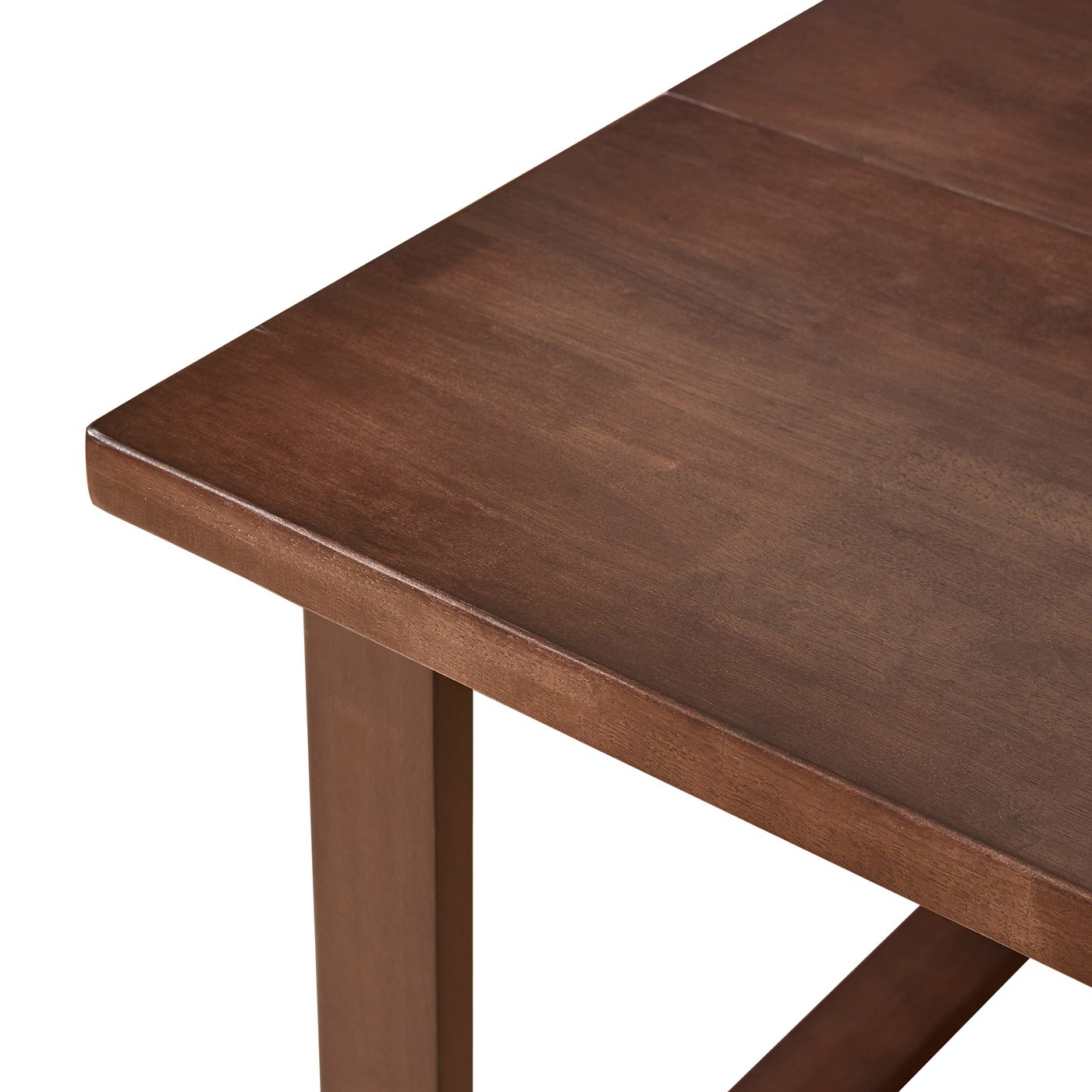
Wood moves across the grain and barely at all along it. On a table top the grain runs the long way, so the 70.9-inch length is nearly fixed and the 35.4-inch width is the dimension that opens and closes — a 70.9-inch top isn’t twice as risky as a 35-inch one.
How much depends on species. The Wood Database measures shrinkage from green down to oven-dry, separately for radial and tangential faces, which brackets how a board behaves depending on how it was sawn:
| Species | Radial | Tangential | Volumetric | T/R ratio | A 35.4-in top, 20% → 50% room |
|---|---|---|---|---|---|
| Rubberwood | 2.3% | 5.1% | 7.5% | 2.2 | 0.13 – 0.28 in |
| Red oak | 4.0% | 8.6% | 13.7% | 2.2 | 0.22 – 0.48 in |
The last column is my arithmetic, not a published figure: the shrinkage percentages spread across the roughly 30-point range from fibre saturation to dry, applied to 35.4 inches, scaled to the 4.7-point moisture gap between a 20% room and a 50% one. It’s an estimate for a flat panel.
Rubberwood moves about half as much as red oak — 5.1% against 8.6% tangentially, so oak moves 1.7 times as far. That is a real advantage in a house with a furnace, and it is not immunity. A quarter inch on a 35-inch top is enough to open a joint line and enough to make a top that sat flat in July rock slightly in February.
The T/R ratio is identical, 2.2 for both. That ratio describes how unevenly a board shrinks one way versus the other, so equal ratios mean rubberwood isn’t better behaved in shape, only smaller in size. It cups and bows the way oak does, just less.
The humidity range the guides can’t agree on
Search “humidity for wood furniture” and the numbers don’t match.
A-America, a US furniture manufacturer, recommends “an environment at or around 70º Fahrenheit with relative humidity between 40% to 50%,” plus ventilation. Timber Ridge puts the target at 40–60%. The EPA goes the other way: “do not humidify to indoor relative humidity levels exceeding 50 percent,” because higher levels “may encourage the growth of biological organisms in the home.”
The EPA is talking about mould, not furniture, which is the honest reason the ceiling exists — and it is why the three ranges overlap in exactly one place: 40 to 50 percent. Below 40 the wood keeps drying. Above 50 you buy almost nothing for the wood (9.2% rising to 11.0% for a ten-point jump) while feeding whatever grows in a damp corner.
Forty-five percent, held there, is what I’d set a humidifier to.
Checking is normal. A gap that stays open is not
Two things get called cracking, and the sources split on that line.
A-America describes the movement itself as normal: solid wood “will expand and contract with temperature and humidity changes. This movement is normal and appears as ‘checking’ (small surface cracks) and does not affect the structural integrity of this piece.” Checking is the short hairline that opens at the end grain, where the cut cells dry faster than the middle. On a table edge they run in from the ends.
Timber Ridge is describing something else when it warns that low humidity “causes cracks along the grain, warping in tabletops, and gaps at joints” — and that the problem “is reversible if caught early.”
The test is the calendar, not the width of the line. Checked end grain closes up when the house gets humid in June. A gap at a joint still open in August is movement the piece could not absorb, and that is a different conversation.
Here’s what I can’t tell you about our own tables. We publish length, width, height and species. We don’t publish the thickness of a top or how it is fastened to the apron, and those two details decide whether a top has room to move. I’m not going to guess. If it matters before you buy, ask us and we’ll look it up rather than print a number nobody verified.
Where our pieces sit
Cross-grain width is the number to compare:
| Piece | Listed size | Cross-grain width | Movement at 20% → 50% RH |
|---|---|---|---|
| Solid Rubberwood Dining Table, 71 in | 70.9 × 35.4 × 29.5 in | 35.4 in | 0.13 – 0.28 in |
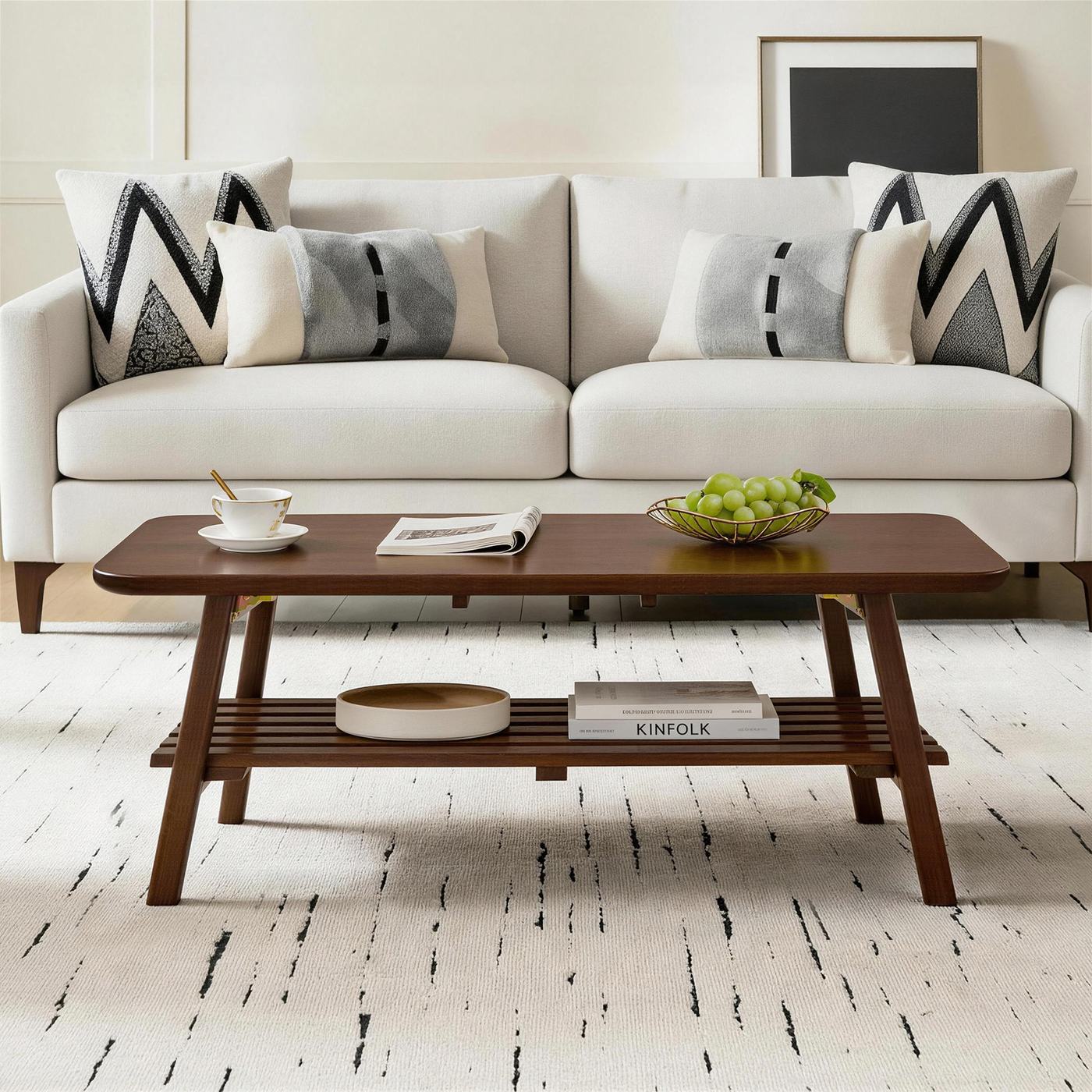
| Mid-Century Coffee Table with Storage | 47.2 × 23.6 × 17.7 in | 23.6 in | 0.09 – 0.19 in |
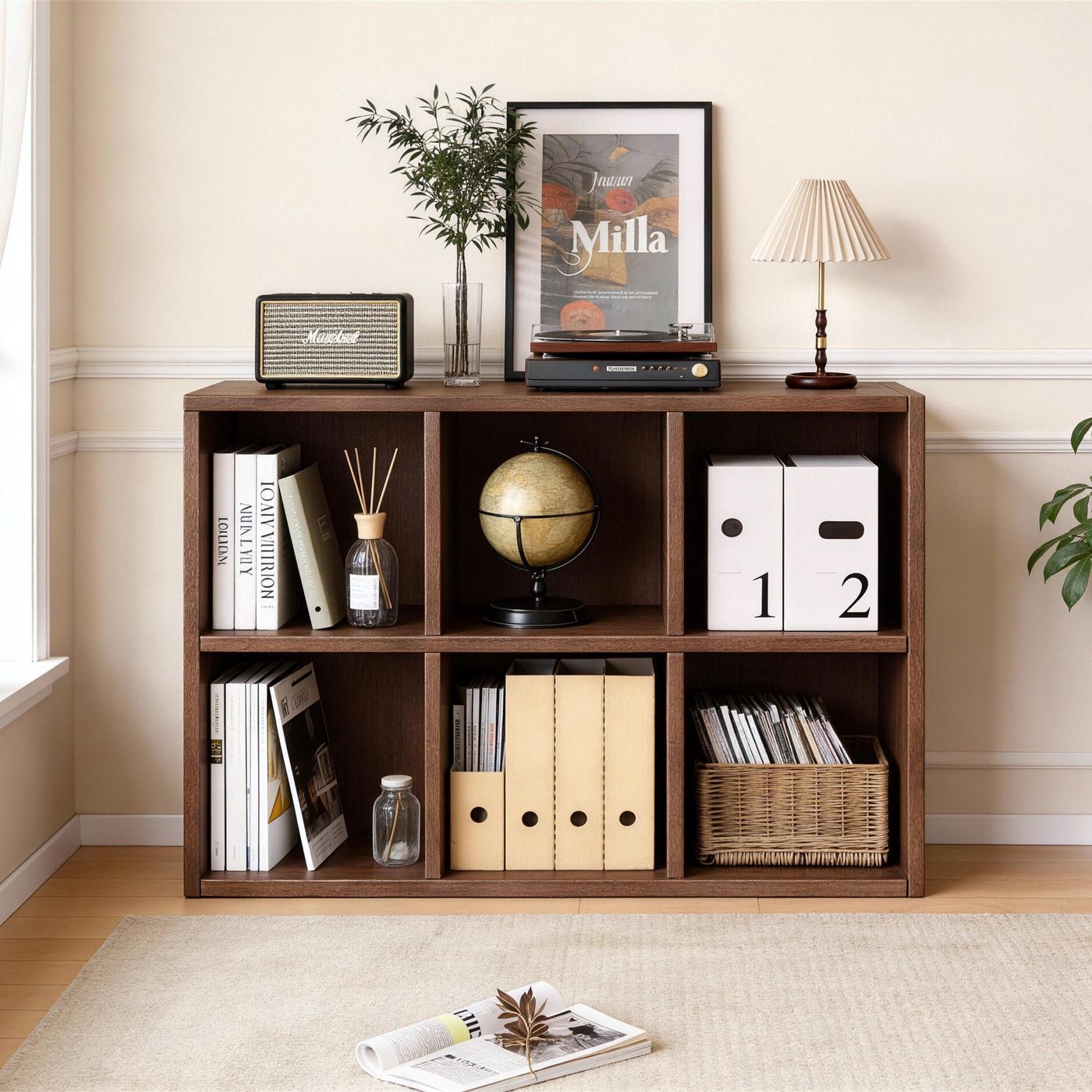
| Six-Cube Solid Wood Bookcase | 35.4 × 11.8 × 23.6 in | 11.8 in | 0.04 – 0.09 in |
| Solid Wood Side Tables, Set of 2 | 19.7 × 19.7 × 19.7 in | 19.7 in | 0.07 – 0.15 in |
| Two-Drawer Nightstand in Rubberwood | 11.8 × 15.3 × 19.9 in | 15.3 in | 0.06 – 0.12 in |
The dining table is the one to watch: its panel is the widest we sell, 35.4 inches across the grain. The bookcase, at 11.8 inches across the grain, is close to a non-issue — which is why small solid pieces last decades in bad houses while a big dining table is what people complain about.
The four MDF pieces in our range — both fluted nightstands and both charging side tables — don’t do this at all. Panels barely move with the seasons. Their failure mode is water at an unfinished edge, a different article and a different worry.
What actually helps
Get a hygrometer before you get a humidifier. A cheap one isn’t a lab instrument, so watch which way it moves over a week rather than chasing a single digit. Then:
- Hold the room at 40–50%. One room-sized humidifier where the wood lives beats a whole-house setting nobody checks.
- Keep the piece away from the heat itself. Timber Ridge names radiators, fireplaces and floor vents as drying a piece locally “faster than anything else.” A table 18 inches from a register has its own micro-climate.
Wiping oil into the surface and expecting it to hold moisture in doesn’t help either. Everything in that first table is about air, not finish. A finish handles spills and wear; the room sets the moisture content.
If a line does open
Photograph it with a ruler in the frame, same angle and light, and wait for the humid season to see whether it closes. A line that closes is the wood doing what the table says it does. A gap that stays open needs a conversation with whoever sold you the piece.
Our tables ship from a US warehouse and leave in three to five business days, so yours spends its first winter in your house, not in a container. Good for the wood — and the first dry month is when you find out what you bought.
Sources
- Aacer Flooring — Relative Humidity & Equilibrium Moisture Content Table (Table 4–2, moisture content of wood in equilibrium with stated temperature and relative humidity; from the Forest Products Laboratory Wood Handbook) — https://aacerflooring.com/wp-content/uploads/2014/08/29-Relative-Humidity-Equilibrium-Moisture-Content-Table.pdf — accessed 2026-11-08
- The Wood Database — Rubberwood and Red Oak (shrinkage, T/R ratio) — https://www.wood-database.com/rubberwood/ and https://www.wood-database.com/red-oak/ — accessed 2026-11-08
- A-America — Caring for Solid Wood Furniture — https://www.a-america.com/caring-for-solid-wood-furniture — accessed 2026-11-08
- Timber Ridge Furniture — Wood Furniture Care Guide — https://timberridgefurniture.com/wood-furniture-care-guide — accessed 2026-11-08
- US EPA — Use and Care of Home Humidifiers — https://www.epa.gov/indoor-air-quality-iaq/use-and-care-home-humidifiers — accessed 2026-11-08