
Set the two listings side by side and the numbers are identical: 18.1 × 20.7 × 63.0 inches, 28 pounds, solid wood frame, backed glass, freestanding without a bracket or a drill, two people to carry it and one to stand it up.
The two pieces are the 63-inch beech floor mirror in walnut and the same mirror in natural wood wash. One description line reads “solid wood frame with a walnut finish.” The other reads “solid wood frame with a natural wood wash finish.” That is the entire difference between them. So the question is not which one is built better. It is which color you want six feet of frame to be in your room, and what that color does after three summers of afternoon light.
Walnut finish is a color, not a species
The phrase is older than most of the furniture that wears it. A Federal Trade Commission interpretation printed at 16 CFR § 75.101 is blunt about how it works: when a wood name describes “the grain design and/or color of a stain finish” applied to something other than that wood, the name has to be presented as a description of color, and “unqualified phrases such as ‘walnut finish’ and ‘mahogany finish’ will not satisfy this requirement.”
Read that as a shopping instruction. Walnut finish means stained the color of walnut. On this mirror the wood underneath is beech — it’s in the product name, while the material line stops at “solid wood.”
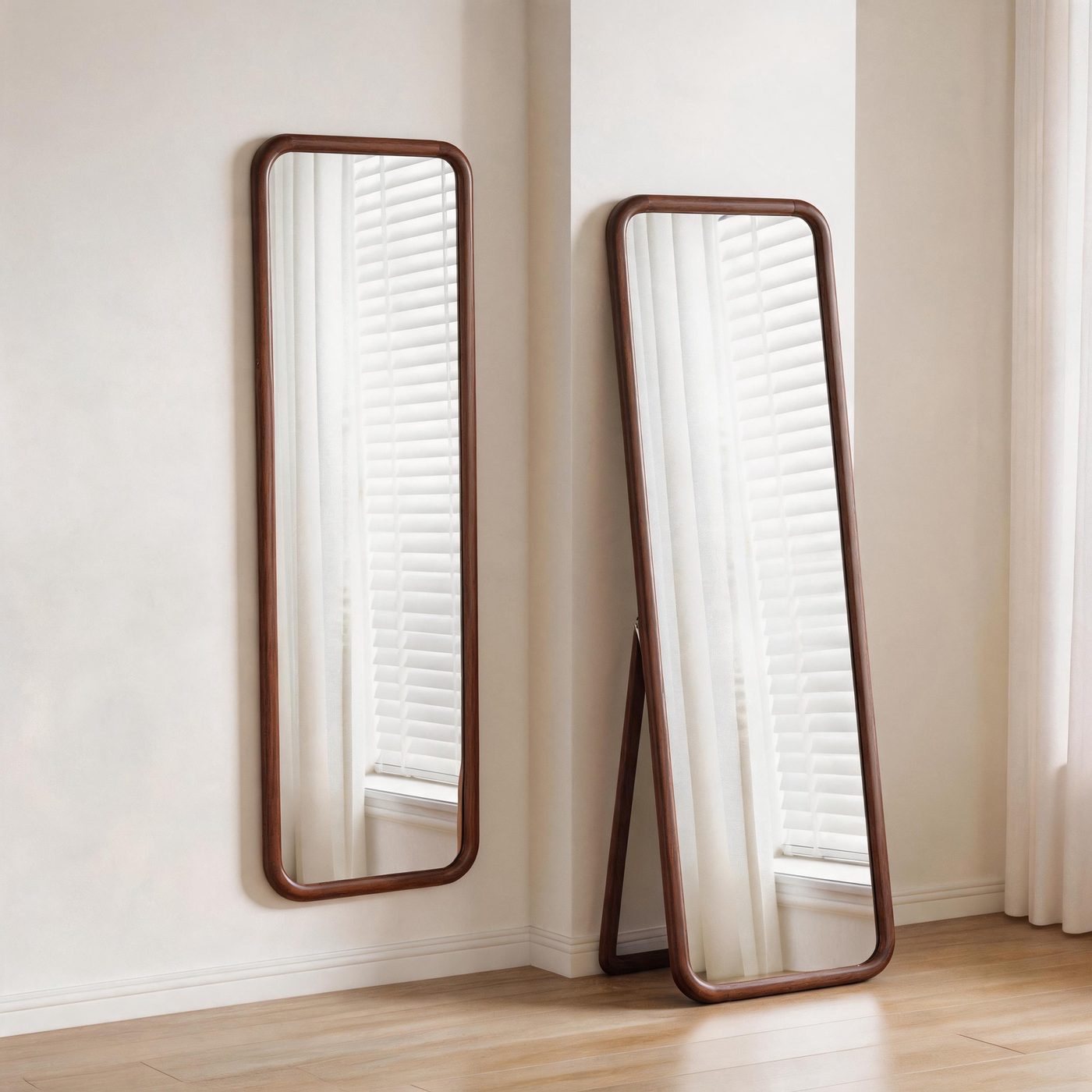
That matters less than it sounds, because beech is a quiet wood, and a narrow rail gives it very little room to be anything else. The frames on both mirrors show almost no figure. A dark stain doesn’t add grain to a plain wood; it takes contrast away from what little is there. In the photos the walnut frame reads as one continuous dark brown line, edge to edge.
Which is the bad news if you’re paying for wood character: at this width you’re buying a color, not a figure. A narrow rail isn’t where grain gets to perform.
What a wood wash does that a stain doesn’t
Finish makers use “wash” for a thin, translucent tint rubbed into the surface instead of built up on top of it. Osmo, a finish manufacturer, describes a wash effect as giving wood “a light, greyed, or whitewashed appearance while the wood grain remains visible,” and notes that the pad or cloth colors “primarily the rough parts and grain of the wood.”
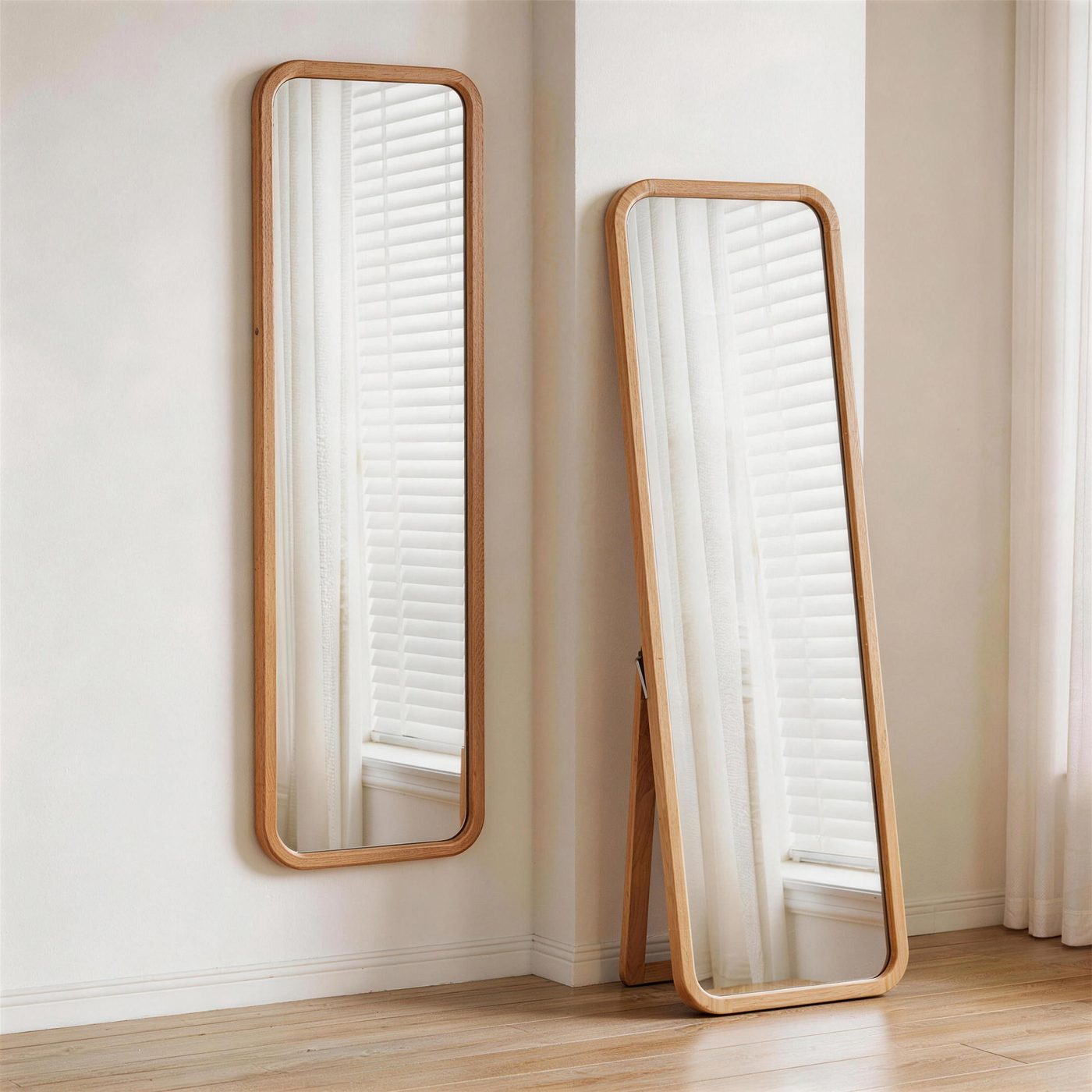
A wash leaves the wood’s own color in charge. Beech is pale — the study below describes native beech as “light white-gray color of the yellow tinge.” Under a wash you still see that, along with whatever variation the two frames in your shipment happen to arrive with.
A wash is thin, so the protection comes from a separate topcoat. Osmo’s own guidance is to finish a wash with a colorless coat, “as only a small amount of product is applied to the wood with a polished layer.”
And a warning about the word itself. On a lot of listings “natural” means sealer and clear topcoat with no pigment at all. This listing is more specific — natural wood wash — which means a light tint is there. Neither mirror page names the topcoat or says whether it includes a UV blocker. If a yellow shift is the thing that would bother you, that’s a question for the seller, not a word to read past.
The pale one will drift; the dark one mostly won’t
Beech moves in daylight. A 2022 study in Polymers exposed beech samples to sunlight for 36 months and measured what happened. Unsteamed beech — the “light white-gray color of the yellow tinge” — darkened to “a pale brown color of yellow tinge,” a total color difference (ΔE) of 13.0. Steamed beech, which starts deep brown-red, went the other way: it brightened to a pale brown, a ΔE of 7.1, a change 52.2% smaller than the unsteamed samples.
Two things follow. The pale mirror is the one whose color will visibly move, toward yellow-brown — that is what wood does, and it won’t look like damage. Which direction your frame drifts depends on whether the beech was steamed before finishing; the listing doesn’t say.
The walnut frame isn’t immune, it’s just already far from where the drift goes: a stain that starts dark brown-red and warms slightly looks like the same mirror in year three, while a frame within a few shades of bare beech does not. If the piece goes beside a window with afternoon sun, assume the light one will change and decide whether you’re fine with that before it ships.
Which finish, in which room
Compare the frame to the wood already in the room, not to the wall.
Pale oak or maple floors: the natural wash frame nearly disappears into them. In a small room that reads calm; in a large one it can read washed out. Mid-brown or warmer floors: the pale frame sits clearly on top of them, and the walnut frame blends.
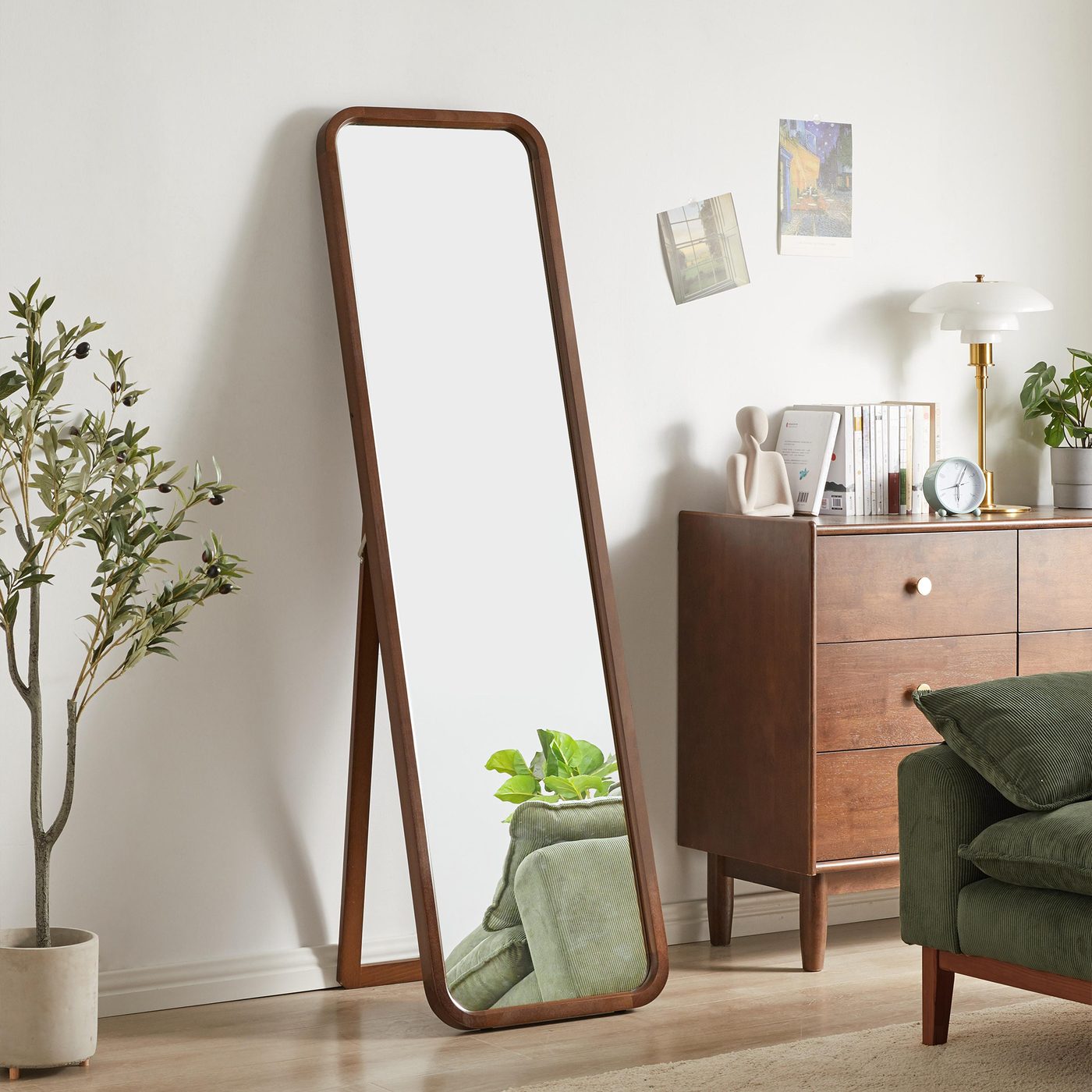
The second reference is furniture you already own. The walnut frame next to a mid-century walnut dresser looks like a set; the natural frame next to it looks like a decision. Both are legitimate; only one is what you meant.
A practical argument for the darker one, which cuts both ways. Dust, lint and pet hair are pale, so they show up on a dark frame; scuffs and dirt are dark, so they show up on a light one. Whichever mess your house produces more of, the other finish hides it better. That’s an observation from looking at both, not a test result.
What stays the same, and what to ask
None of this changes the height, the weight, the backed glass, or the folding stand in the photos — both models stand up on their own without a bracket or a drill. The walnut tone also carries across the catalog if you want a taller piece in the same color: the floor mirror with coat rack is 68.9 inches in the same walnut finish. The natural finish shows up on a rubberwood frame in the 360° rotating mirror, where the wood underneath is a different species and the pale color reads warmer.
Care is the same for both: a dry or barely damp cloth, nothing abrasive, no solvent cleaners, and no polish that builds a film you’ll later have to strip off. The site publishes that wipe-with-a-damp-cloth line on other pieces — the bedside table with the open shelf adds that its water-based finish will not yellow. Neither mirror page carries the equivalent sentence, which is the gap to close before ordering.
The last question is the one the listing can’t answer: what topcoat went on the pale one. Ask, if a shift toward yellow would bother you — because after three summers it isn’t a defect, it’s the wood doing what the study above measured.
Sources
- Federal Trade Commission interpretation, 16 CFR § 75.101, Interpretations (Household Furniture Industry trade practice rules; 31 F.R. 5069, Mar. 29, 1966) — unqualified “walnut finish” does not make clear that a wood name describes color or a simulated finish. https://tile.loc.gov/storage-services/service/ll/cfr/cf/r1/96/90/32/-T/16/CI/P7/6/cfr1969032-T16CIP76/cfr1969032-T16CIP76.pdf (accessed 2026-11-12)
- Osmo, Wash effect — a wash gives wood a light, greyed or whitewashed appearance while the grain stays visible; the tint colors mainly the rough parts and grain, and needs a colorless topcoat for protection. https://osmonederland.nl/en/knowledgebase/wash-effect/ (accessed 2026-11-12)
- Polymers 2022, 14(9):1697, “Effect of Sunlight on the Change in Color of Unsteamed and Steamed Beech Wood with Water Steam” — 36 months of sunlight; unsteamed beech darkened to pale brown-yellow at ΔE 13.0; steamed beech brightened at ΔE 7.1, a 52.2% smaller change. https://pmc.ncbi.nlm.nih.gov/articles/PMC9104894/ (accessed 2026-11-12)