
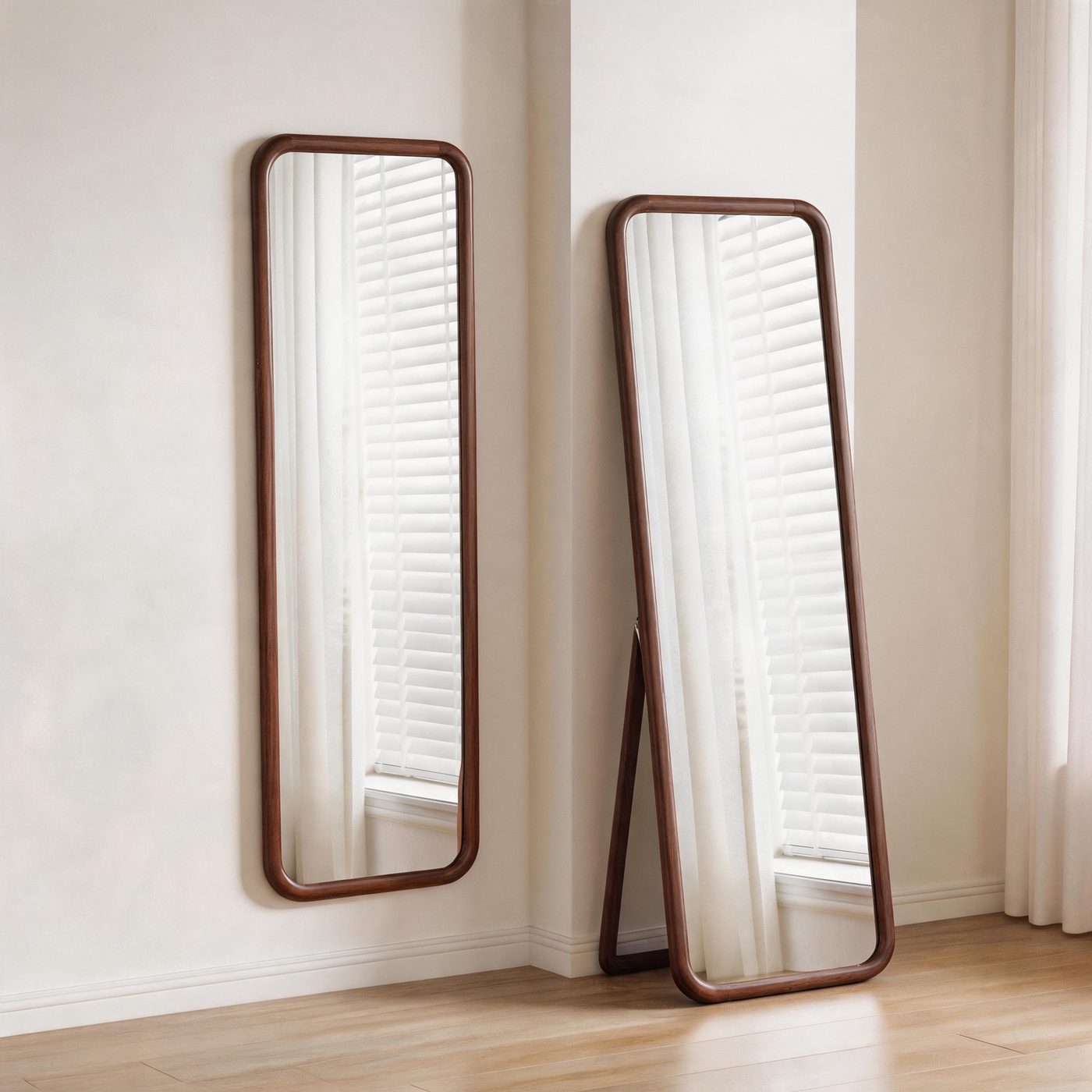
Two numbers decide whether the federal tip-over standard applies to a piece of furniture: 27 inches of height and 30 pounds of mass. Our tallest mirror is 68.9 inches and 49.9 pounds. It clears both, and the standard still does not apply to it.
Not a loophole — the numbers sit inside a definition, not a general rule.
What 16 CFR 1261 actually covers
16 CFR 1261.1(b) defines a clothing storage unit as “any free-standing furniture item … intended for the storage of clothing, typical of bedroom furniture,” and applies it to every unit manufactured after September 1, 2023. Section 1261.2 then makes a voluntary standard, ASTM F2057-23, mandatory.
The two numbers come from that standard’s scope. In CPSC’s direct final rule adopting it, a covered product is a free-standing clothing storage unit 27 inches or taller, 30 pounds or heavier, holding 3.2 cubic feet or more of enclosed storage — chests, drawer chests, armoires, dressers, door chests. The tests simulate a child up to 60 pounds, and the rule protects children up to 72 months.
The same standard lists what it excludes: “shelving units, such as bookcases or entertainment furniture, office furniture, dining room furniture, jewelry armoires, underbed drawer storage units, occasional/accent furniture not intended for bedroom use.”
Hold our own catalog against that: the tallest piece with drawers is a 23.4-inch nightstand, and the tallest piece overall is a 66.5-inch mirror with open shelves and no enclosed volume. No page here describes a covered unit — which isn’t the same as safe unanchored.
The injury data doesn’t follow the definition
CPSC’s 2023 Tip-Over Annual Report puts the annual average at 17,800 emergency-department-treated tip-over injuries for 2020–2022, plus 217 reported deaths between January 2013 and July 2023. Children under 18 took 7,800 of the injuries — 44% of them, at 22% of the population — and 155 of the deaths.
Break it down by product and the shape changes. 14,500 of the 17,800 involved furniture. Among children, furniture injuries averaged 6,400 a year: 2,400 a table, 1,800 a chest, bureau or dresser, 1,000 shelving or a bookcase, 1,200 everything else.
Tables are the largest category for children, and a dining table is not a clothing storage unit under any reading. Bookcases injure 1,000 children a year and the standard excludes them by name. The 27-inch line sorts factory output. It was never a line between furniture that can fall on a child and furniture that cannot.
A 63-inch mirror on a 20.7-inch base
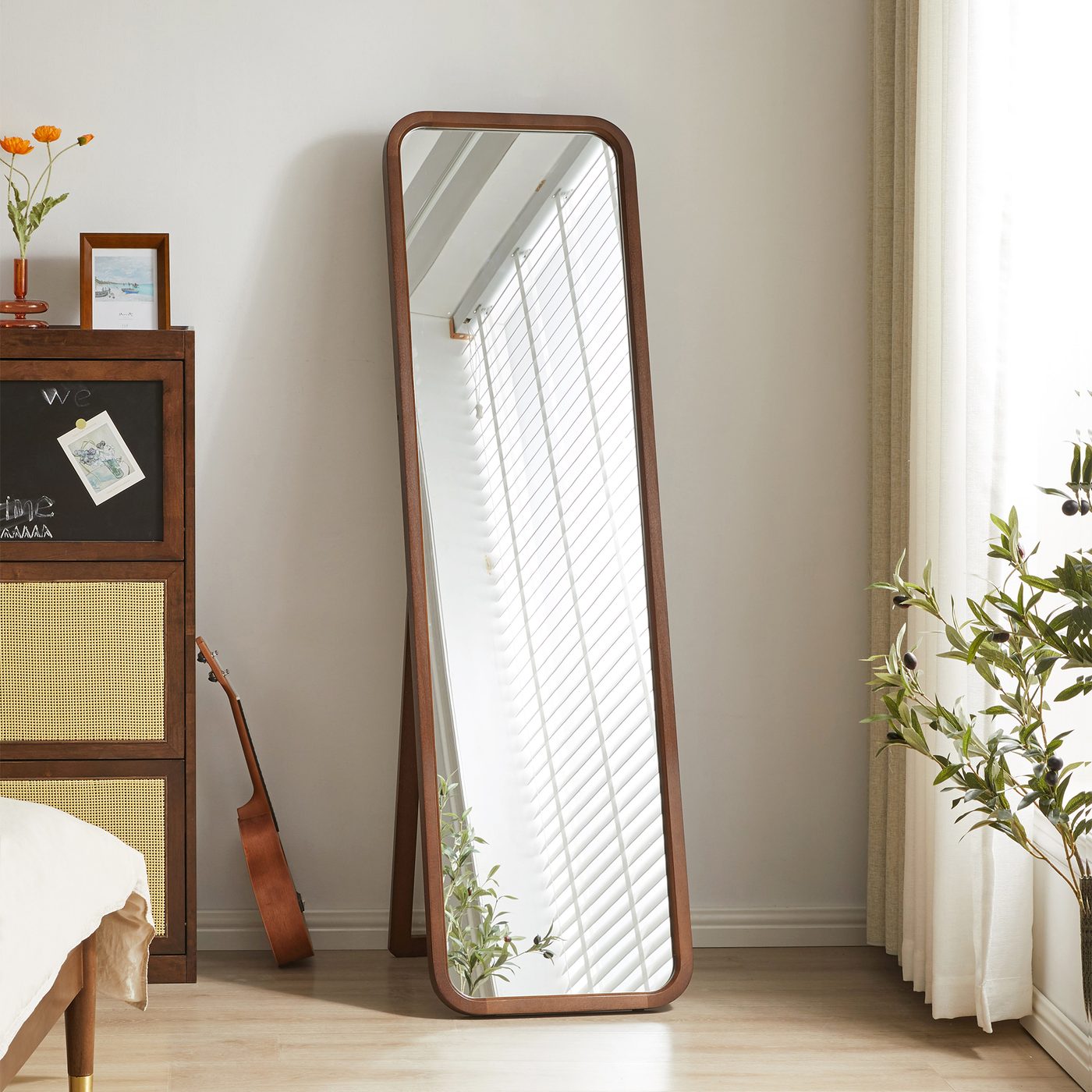
Take the piece it matters most for. Our beech floor mirror is 63.0 inches tall, stands on an 18.1 × 20.7 inch footprint, and weighs 28 pounds.
Assume the mass sits in the middle of the frame — honest without a scale and a tape. The center of gravity is then 31.5 inches up and 10.35 inches behind the front edge, so the frame rotates about 18 degrees before that point passes the edge and its own weight finishes the job. Same arithmetic, 68.9-inch mirrors on 18.9-inch bases: 15.3 degrees. The 67.7-inch cabinet: 15.6.
Fifteen to eighteen degrees is not a shove. It is a door swinging back, a dog turning around, a toddler pulling up on the frame, a vacuum cord catching the bottom rail. Leaning the frame back on its A-frame moves the mass backward and buys a few degrees. That is real, and it is all you get.
Five of the six mirrors carry the same sentence: “freestanding, so it stands against the wall without a bracket or a drill.” The rotating one adds “no bracket, no wall anchor,” and says a double-layer base and a braced back are what let it stand — plus “On deep carpet, rock it before you load the shelves.” CPSC names carpet as a stability factor for the same reason.
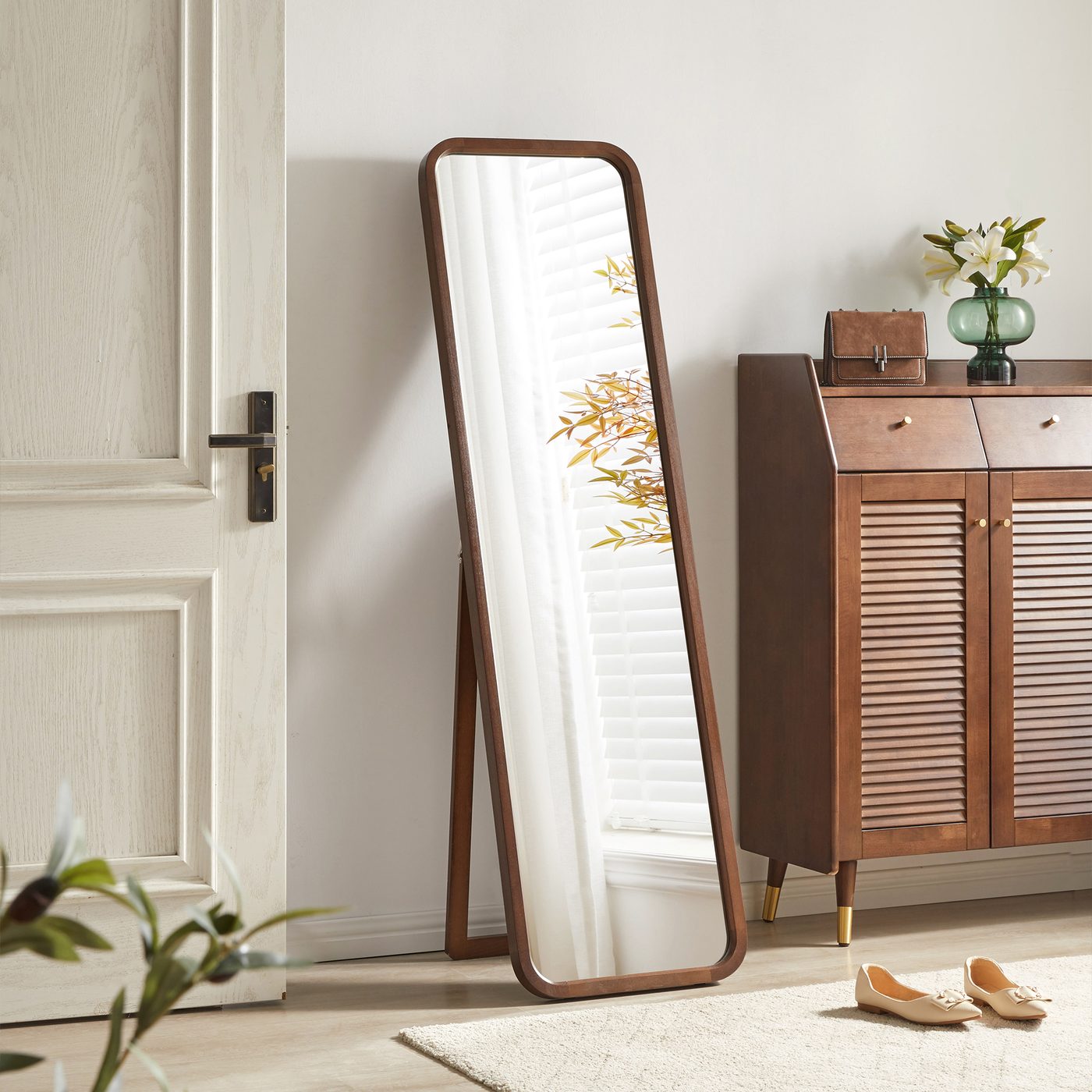
Only one page names the hardware. The beech mirror in walnut says: “Leave it leaning on its A-frame at an adjustable angle, or mount it on the wall with the hooks supplied with it.” If there is a climbing toddler in the house, that is the one to buy, and the hooks are in the box.
What CPSC says about the anchor itself
Here is the part that surprises people. In its 2022 rulemaking CPSC wrote that “tip restraints are not effective as the primary method of preventing CSU tip overs,” citing restraints that detached or broke, and called them useful as “a secondary safety system” (87 FR 72598). That rule was later superseded, but the reasoning is CPSC’s own.
The restraint standard behind it, ASTM F3096-14, tests a 50-pound static load with the device attached to a fixed structure. It does not evaluate the connection to the wall, or to the furniture. And the F2057 stability tests run with no restraint installed: the unit has to stand up on an open drawer by itself.
Read those together and the anchor stops being the plan. It is the backup for the day someone bounces on the open drawer. The footprint is the plan.
If you can’t drill
Renters get told an adhesive kit solves this. It partly does. The honest version, from an industry write-up on no-drill furniture anchors: “These kits can work, but only for lighter pieces, on the right wall surface, with careful prep. They are not a like-for-like substitute for a strap screwed into a stud.”
So the decision moves back to what you buy. A 28-pound mirror on a 20.7-inch base has more margin than a 49.9-pound mirror on an 18.9-inch base — and if the lease forbids holes, that difference is the whole plan. Corner it, keep bags off the frame, keep it out of a door’s swing.
What to check before you order
Four things, and three of them are printed on the page you are already reading:
- Height and base depth, in inches, from one source. A tall piece on a narrow base is the shape that tips.
- What is in the box. Wall hardware, or nothing. If a page doesn’t say, ask before you order.
- Whether the piece must touch a wall. A leaning mirror needs a wall behind it; a hung mirror needs one you can drill.
- Weight is not the safety number. Our 16.5-pound nightstand still changes shape the moment a child stands on an open drawer: the weight that was over the base is suddenly out in front of it. CPSC exempted units under 30 pounds only because its incident data showed no known deaths reported for them.
The nightstands we sell sit at 16.5 to 33 pounds and 19.7 to 23.4 inches, which puts all of them under the standard’s floor. Anchoring one is still a ten-minute job with a strap and a stud, and the strap costs less than the piece.
Sources
- 16 CFR Part 1261, Safety Standard for Clothing Storage Units — https://www.ecfr.gov/current/title-16/chapter-II/subchapter-B/part-1261 (accessed 2026-11-16)
- CPSC, Safety Standard for Clothing Storage Units, direct final rule, 88 FR 28403, effective September 1, 2023 — https://www.federalregister.gov/documents/2023/05/04/2023-08997/safety-standard-for-clothing-storage-units (accessed 2026-11-16)
- CPSC, Safety Standard for Clothing Storage Units, final rule, 87 FR 72598 (superseded) — https://www.federalregister.gov/documents/2022/11/25/2022-24587/safety-standard-for-clothing-storage-units (accessed 2026-11-16)
- CPSC, Product Instability or Tip-Over Injuries and Fatalities Associated with Televisions, Furniture, and Appliances: 2023 Report, February 2024 — https://www.cpsc.gov/s3fs-public/2023_Annual_Tip_Over_Report_Posted_2024Feb_FINAL.pdf (accessed 2026-11-16)
- dgfloors, No Drill Furniture Anchors: Do Adhesive Anti-Tip Kits Work? (industry blog, not a testing body) — https://dgfloors.com/no-drill-furniture-anchor/ (accessed 2026-11-16)