

Fifteen of the 36 pieces on this site say something specific about how they go together. Six desks say the hardware is “numbered per leg” and that one person needs “about half an hour.” Six side tables and the oak chairs say the hardware arrives “bagged and numbered.” The rolling coat rack cuts the job down to “the casters and two cross bars — about ten minutes.” The tallest mirror is the most specific of the lot: “four steps, 11 bolts, and the 4 mm Allen key comes in the box.”
Worth reading before you order, and not because assembly is hard. On a flat-packed piece those sentences are usually the only place a listing says anything about how the thing is fastened — and the fasteners, not the wood, are what decide whether it survives its first move.
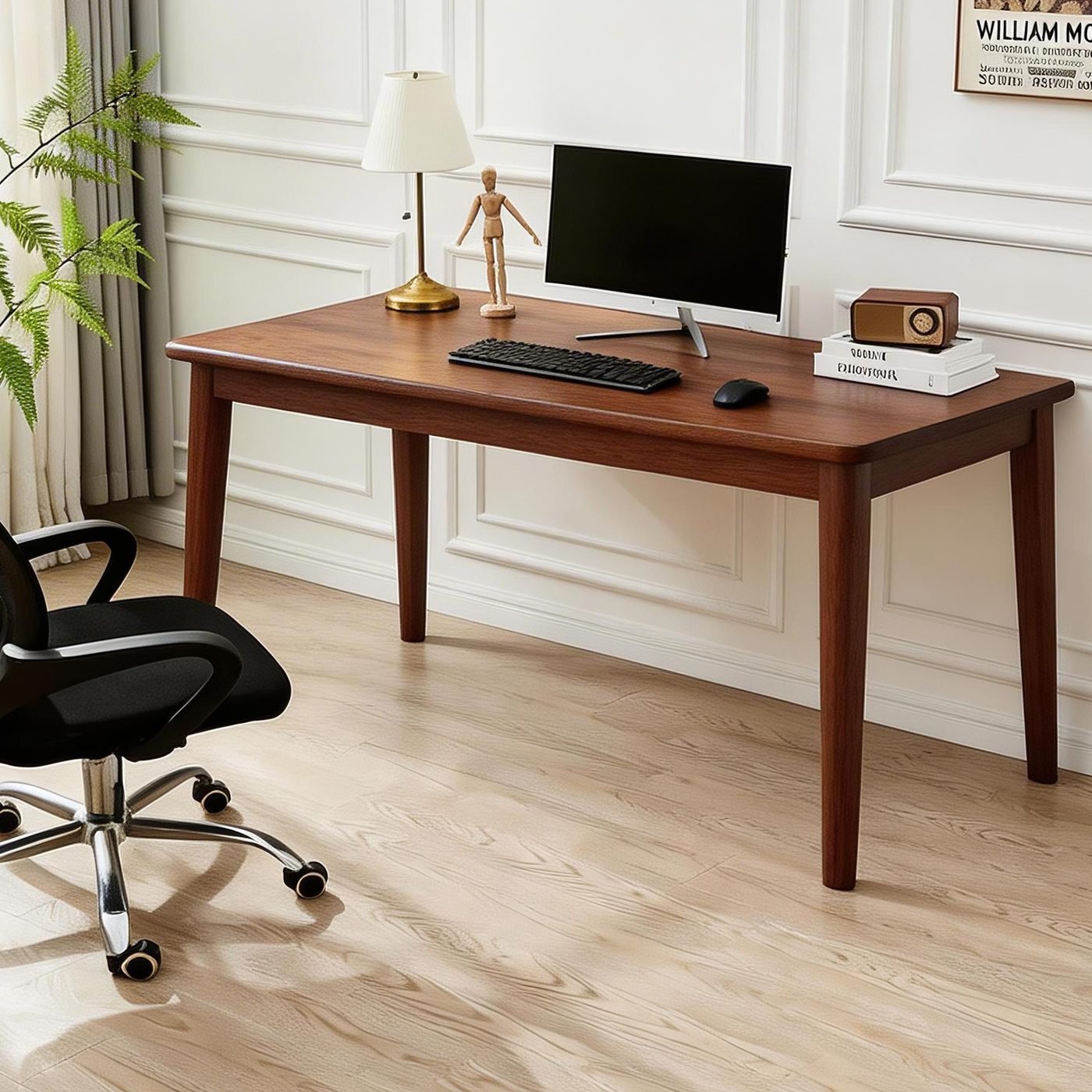
What each sentence commits to
| What the page says | What it actually fixes | What it leaves open |
|---|---|---|
| “Hardware numbered per leg” — six desks | which bag goes with which leg, and that one person can do it | the fastener type, and whether a tool is in the box |
| “Hardware bagged and numbered” — six side tables, oak chairs | the parts are sorted, so you are not guessing by shape | how many steps, how long |
| “Four steps, 11 bolts, 4 mm Allen key in the box” — mirror | the tool, the count, and that it takes two people to carry | nothing much |
| “The casters and two cross bars — about ten minutes” — coat rack | the whole scope of the job | whether the casters need adjusting on carpet |
Three of those four are sorting promises, which matters most the second time the piece comes apart.
Flat-pack is a carton, not a material
Search the question and you get a category error stated confidently. A UK removals company puts it flatly: “Unlike traditional solid wood furniture, flat pack furniture is manufactured using engineered boards such as MDF or particleboard.” A furniture retailer in Singapore is a little softer — “most flat-pack pieces” — and then names the fasteners: cam locks, dowels, self-tapping screws driven into particleboard or MDF.
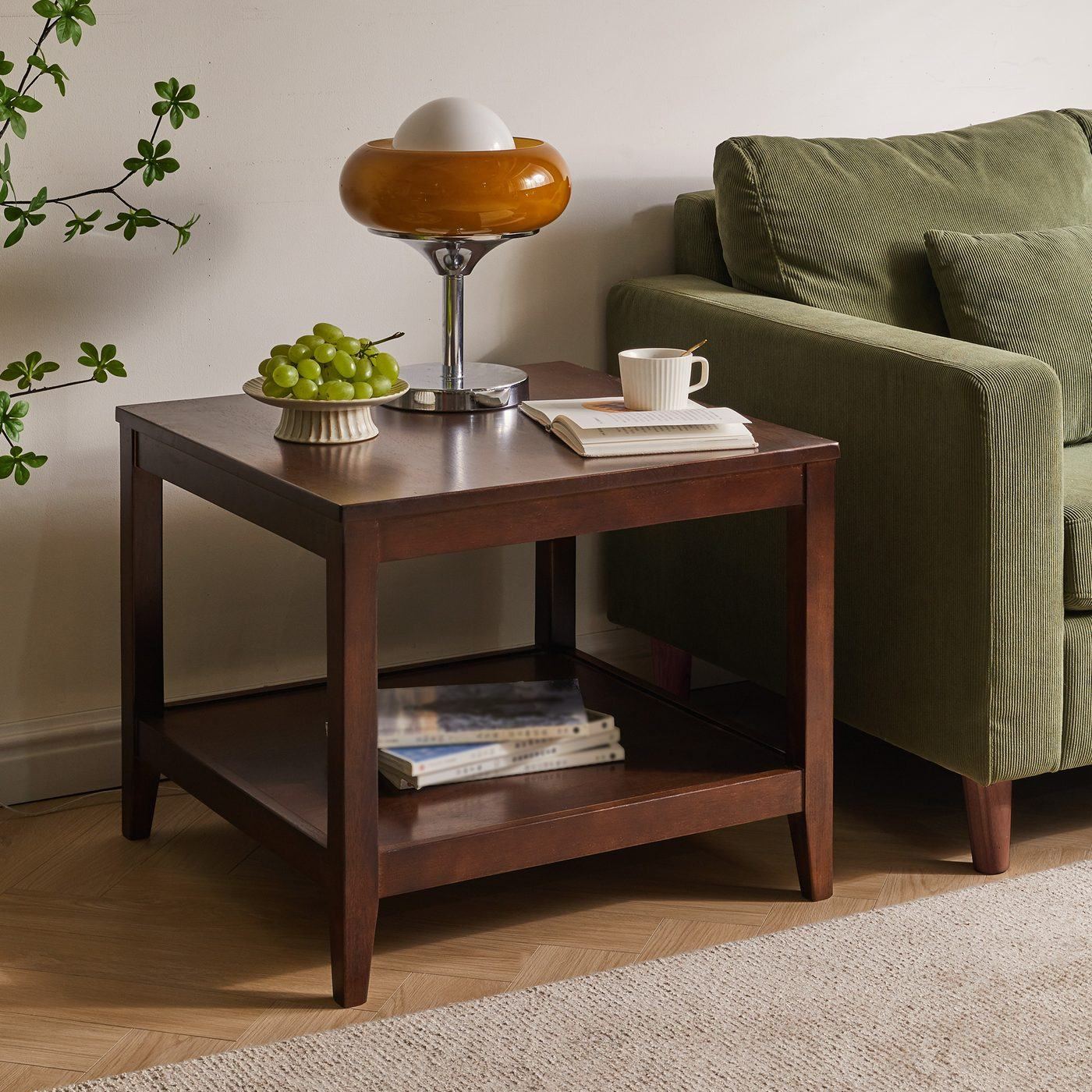
Both sentences are true of a great deal of furniture and false as a rule. The 63-inch desk here ships flat in a carton and its top is solid rubberwood; the page’s own words are “solid rubberwood top in a walnut finish.” Flat is how it travels. Solid or not is what it is made of. Reading one as the other is how people overpay for a panel, or skip a solid piece because the box was flat.
The material sentence has a subject
Look at what the sentence is about: that is the part the page stands behind.
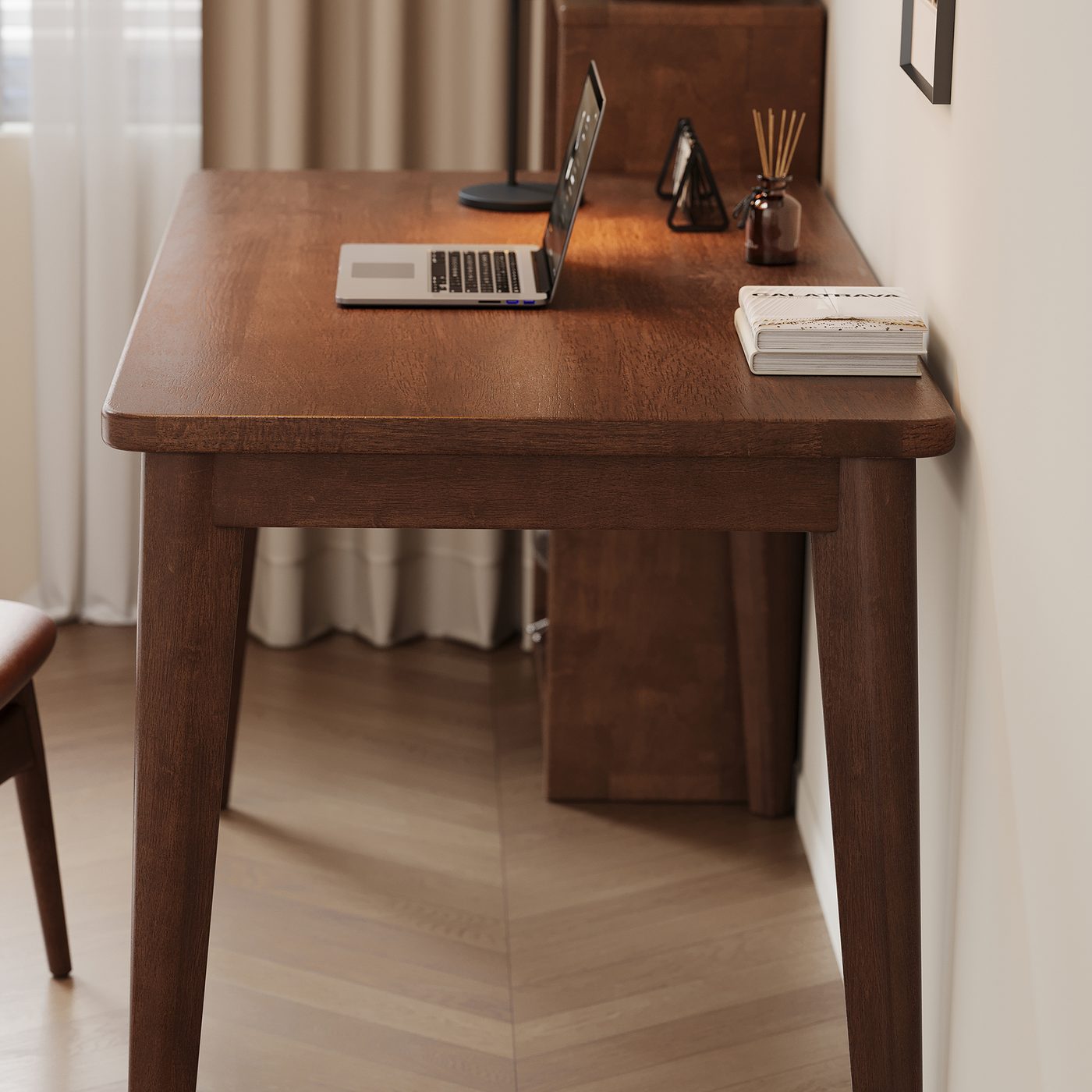
On the 63-inch desk and the 39.4-inch writing desk, the subject is the top: “solid rubberwood top.” The leg frame is described by position instead — it “sits back from the edges, so a chair slides under it” — and no species is named for it. On the 19.7-inch square end table the subject is the whole piece: “Solid rubberwood, 19.7 × 19.7 × 23.6 in,” with a water-based finish and an open front.
That difference is not hidden: across the sixteen pieces in the tables category, the desks name the top, the side and dining tables name the piece, and the charging side tables name the body as MDF. Naming the material and the dimensions talks about the piece; “top” tells you where the good board went. Neither tells you the species of the legs.
What fails first when a piece is taken apart
The moving trade agrees on the diagnosis, and it is not the wood. “Screw holes gradually enlarge. Cam lock fixings wear. Wooden dowels loosen. MDF begins to crumble around fixings. Hidden stress cracks can appear,” the same removals company writes — after saying no reputable mover should promise the furniture is as strong afterwards.
The retailer’s version: “By the second or third assembly, that same hole no longer grips properly, and there is no easy fix once the fibres in particleboard have stripped out.” A UK bed maker describes the mechanism: in stripped particle board, extra torque does not pull the faces closer together, it “simply strips out the remaining compressed dust.”
All three are describing a fastener biting into a panel that has no long grain to bite. They disagree on emphasis — joinery, hardware, material — and none gives a number. No source I found says how many assemblies a given fastener survives, and no page here does either. Treat “assembled once” as a warning about the joint, not a spec.
The 30 minutes and the ten
The time figures are allowances, and they differ in scope. A desk gets “about half an hour” for one person. The coat rack gets “about ten minutes” for casters and two cross bars. The mirror gets “20 to 30 minutes,” plus “two people to carry it, one to put it together” — a different job, because the panel is glass.
What the figures do not cover: unpacking, and getting the carton to the room it belongs in. The mirror’s page is blunt about it — the carton is 68.31 inches long, “so it arrives at the door rather than in the room.”
And bring your own screwdriver. Only one of the fifteen pages promises a tool in the box (the mirror’s 4 mm Allen key). The rest promise sorted hardware, which is not the same thing.
What no page answers
Three things are missing from every listing here.
The desks say the hardware is numbered per leg. They do not say whether that hardware is a bolt into a threaded insert, a cam lock, or a wood screw. That matters if you plan to take the piece apart: the first two are made to be undone, the third is not.
No page says how many times a piece can be disassembled and rebuilt. I looked; it is not published, here or on the pages above.
And no page rates the legs. Where a page names the material for the whole piece, it is the whole piece; where it names the top, the legs are unstated. If leg species matters to you, ask before the order, not after.
Keep the bag
If a move is on the horizon, the numbered bag is the most valuable thing in the carton — more than the receipt. Tape it to the underside of the top, write the leg numbers on a strip of masking tape, and photograph the hardware laid out before you start. The mover’s advice on reassembly is the one line worth memorising: “If a fixing feels loose, don’t simply tighten harder.” Tightening harder is how a stripped hole becomes a permanent one.
None of this makes a flat-packed solid wood desk a lifetime piece. It makes the second assembly possible, and it means the thing you are buying is wood in a box rather than a box that happens to be made of board.
Sources
- VCB Removals, “Flat Pack Furniture and Moving House: Everything You Need to Know Before Moving,” 2 August 2026 — vcbremovals.co.uk
- Nova Furnishing, “The Hidden Cost of Flat-Pack Furniture: Why ‘Easy Assembly’ Often Backfires,” 8 April 2026 — novafurnishing.com
- The Honest Plank, “Why Flat-Pack Beds Break in House Moves,” 20 October 2026 — thehonestplank.co.uk
- Product pages quoted (assembly wording, material lines, dimensions): the 63-inch Mid-Century Rubberwood Desk, the 39.4-inch Small Writing Desk, the 19.7-inch Square Two-Tier End Table, the Rotating Full-Length Mirror, the Rolling Coat Rack. All accessed 16 November 2026.