

Two boots on the mat, one still dripping, and the hallway gets walked through again in twenty minutes. At that moment the bench’s width is not the question. The question is whether there is a lid, because a lid is the only thing in an entryway that can hold damp air against a pair of shoes.
Three designs on this site sit in that decision: a two-tier bench with no lid at all, and a lift-top bench in two widths, 31.5 and 39.4 inches, each in two colours. All three are solid rubberwood, all three are within 0.4 inch of each other in depth, and they treat a wet pair completely differently.
The three of them, by the numbers
| Two-Tier Entryway Shoe Bench | Lift-Top, 31.5 in | Lift-Top, 39.4 in | |
|---|---|---|---|
| Width | 31.5 in | 31.5 in | 39.4 in |
| Depth | 11.4 in | 11.8 in | 11.8 in |
| Height | 16.5 in | 16.9 in | 16.9 in |
| Weight | 22.8 lb | 17.6 lb | 19.8 lb |
| Lid | none | lift-top, storage under the seat | lift-top, storage under the seat |
| Seat | flat wood top | padded, with a cover | padded, with a cover |
All six numbers are from the product pages. The 0.4 inch between 11.4 and 11.8 of depth will not decide your purchase. The lid will, and so will the two pounds that separate the plain bench from the 31.5-inch lift-top.
A word on the weight, because it surprises people: the bench with no lid is the heavier one, 22.8 lb against 17.6 lb. More shelves, no seat box.
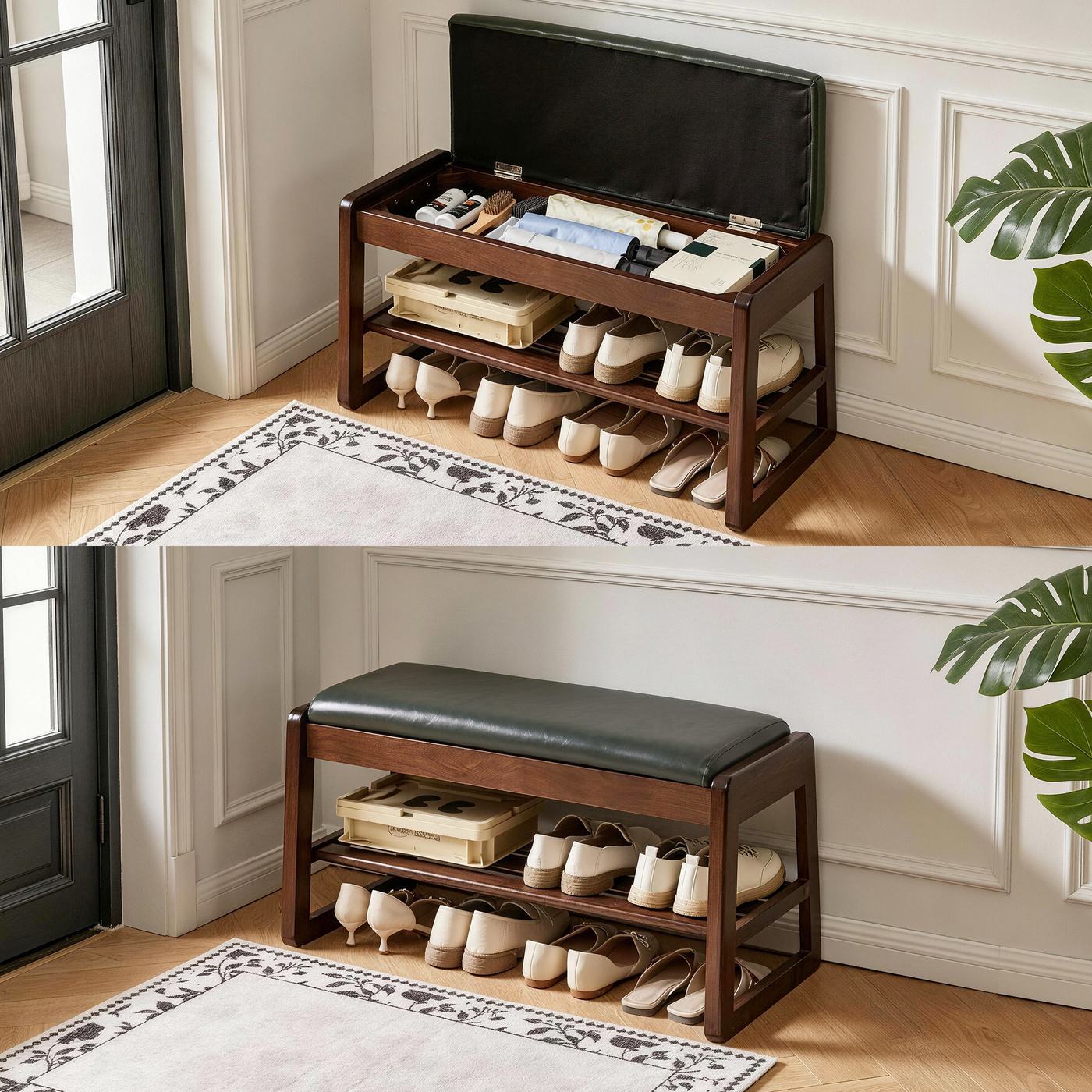
The lid is the only closed volume in the room
The lift-top pages say this and nothing more: “Lift the seat and there is storage underneath — room for a few pairs, depending on size.” That is the whole mechanism, stated plainly. The seat is the lid.
A lid that is also the seat gets closed by default. Nobody leaves a bench seat propped open in a hallway, so whatever goes into that compartment sits in a closed box under a padded cover until someone lifts it again. A furniture retailer’s shoe storage guide describes precisely this: “When worn shoes are stored in a closed cabinet, damp materials and limited ventilation can allow unpleasant odors to linger,” and, in the same piece, “Keep wet umbrellas, soaked boots, and damp accessories away from your enclosed shoe cabinet until they dry.”
Put that together with the page copy and one rule falls out: the compartment is for dry things. Gloves, a shoe brush, an umbrella that has already dried off. Not the pair you walked in wearing.
What the lift-top is besides a lid
Here the description is thinner than the product. The 31.5-inch lift-top in green runs three lines of description and never mentions shelves — but its photos show two open racks below the seat, and the supplier’s spec sheet calls the design “lift-top hidden storage compartment and open layered shoe racks.”
Two storage types in one footprint, which changes the advice rather than killing it. Wet boots go on the open racks, exactly as they would on a plain bench, because those racks are the drying surface. The compartment takes the small things that otherwise end up on the floor by the door.
That distinction does not survive on the page, and it is the sort of thing you only learn by counting shelves in a photo. If you are comparing the wider lift-top against a plain bench, check the gallery before you assume the seat compartment is the only storage.
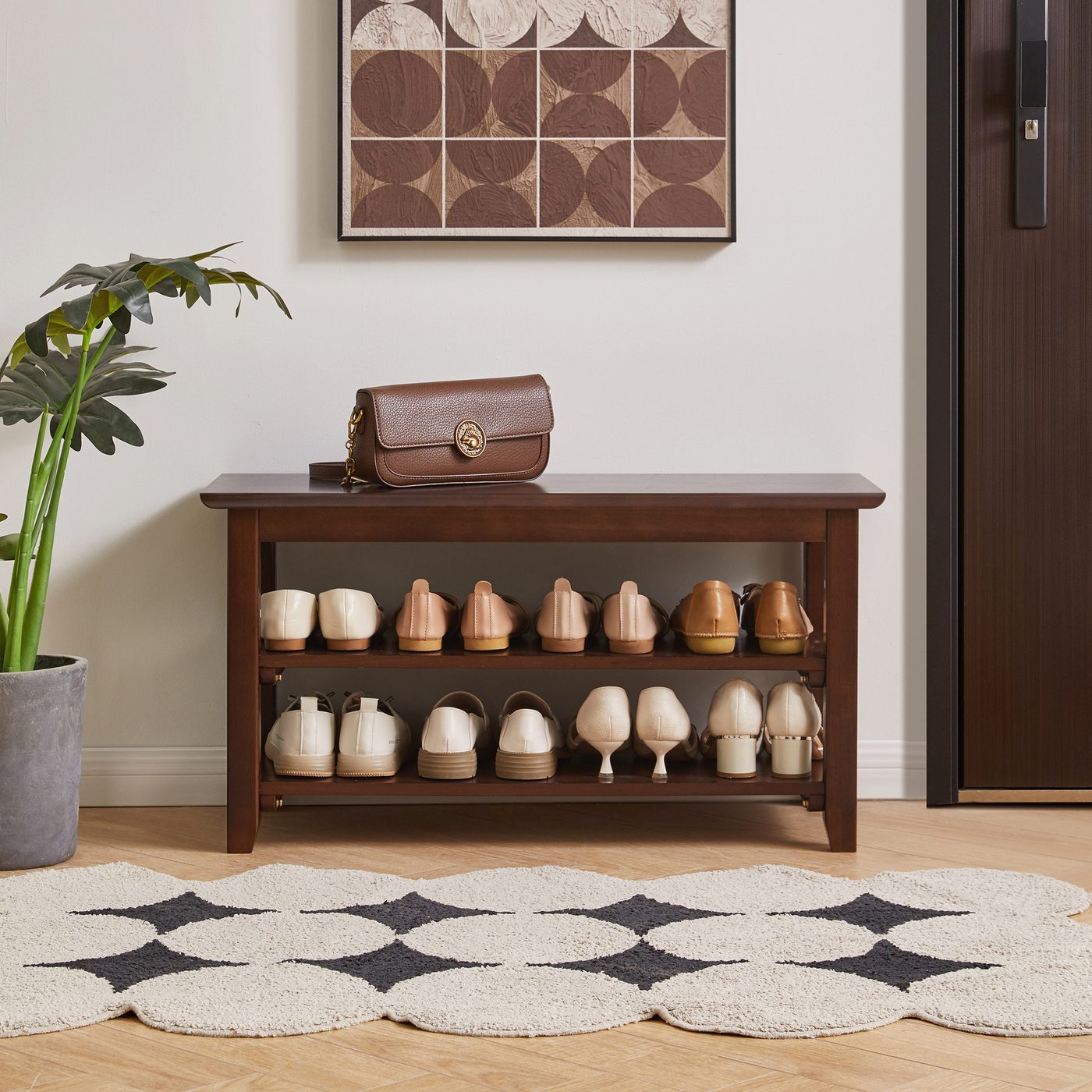
What the open bench costs you
The two-tier bench with no lid has two open shelves and a flat wood top, and the page is unusually direct about what it is not: “nothing hinges, there is no padded seat and no fabric cover.”
Two things matter before a soaked pair goes on it.
The frame is 11.4 inches deep and the shelf is shallower than that. The page says so itself: “11.4 in is the overall depth of the frame — the shelves sit inside it, so plan on slightly less usable depth than 11.4 and check your longest shoe.” Take your longest boot and put a tape against it before you order. That shelf is the shortest measurement in this whole comparison, and it is the one your boots have to fit.
Two tiers means the top tier drips onto the bottom one. Water off the upper pair lands on whatever is below. In practice the wet pair goes on the lower shelf and everything dry stays above it, which is the reverse of what most people do the first week.
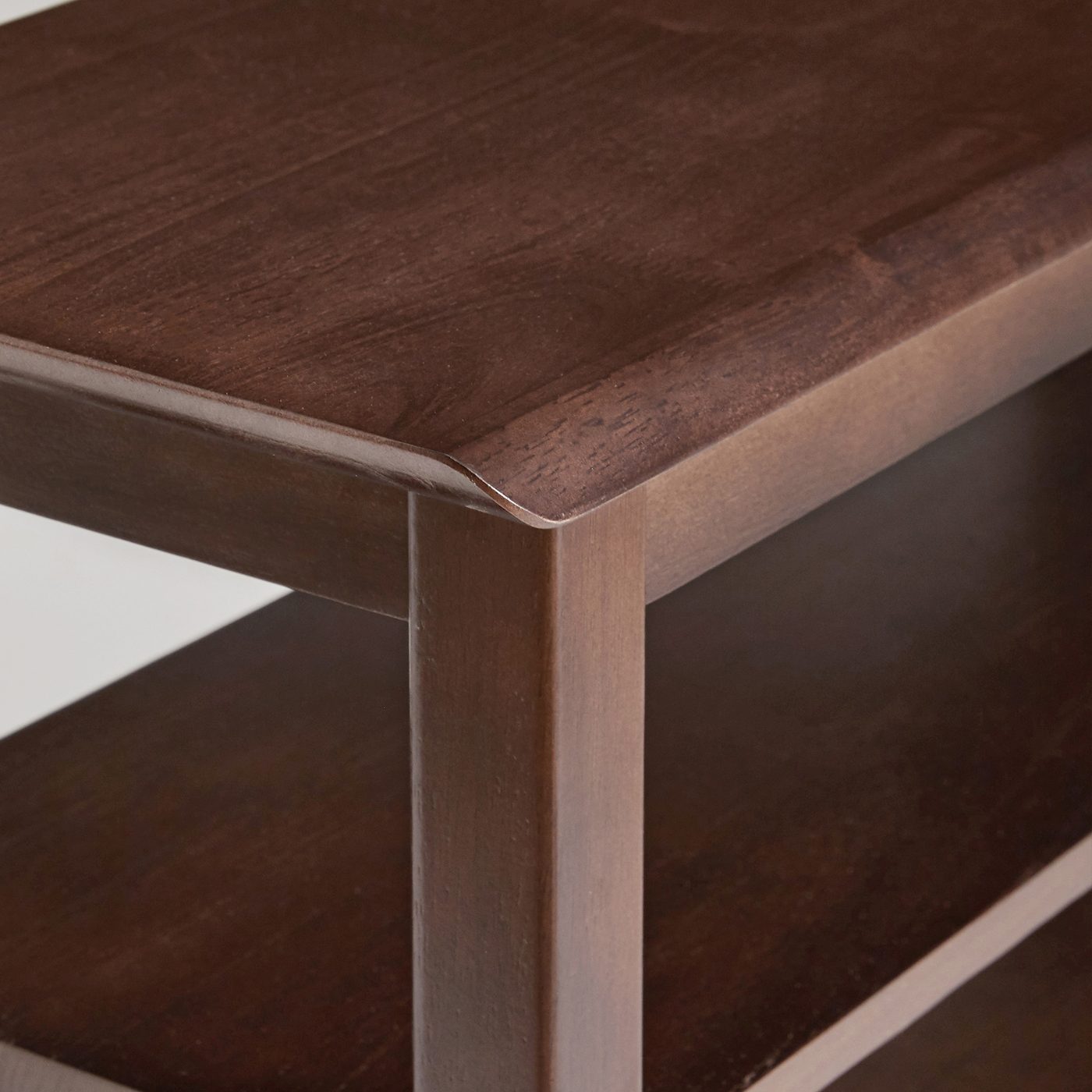
The material is the same on all three
Solid rubberwood on every one of them, and the care line is nearly identical: wipe the wood with a damp cloth, and on the lift-top, the seat cover too. There is no oiling step and no wax in the instructions, and none of the three pages names a finish.
For a wet winter that leaves one thing to manage: water left sitting overnight. A towel under boots you already know are soaked costs less than anything sold as protection, and it keeps the damp off the shelf that has the least clearance in the house.
Who should get which
- One or two people, boots come in wet, a mat at the door: the open two-tier bench. Nothing closes, so nothing holds the damp, and the wet pair goes on the lower shelf.
- You want a padded seat and somewhere for gloves and the shoe brush: the 31.5-inch lift-top, wet pair on the racks below, nothing wet inside the compartment.
- Four people’s shoes and a longer wall: the 39.4-inch lift-top. It is 7.9 inches wider than the 31.5 (39.4 against 31.5), which is roughly the point at which the open racks stop being the bottleneck.
- A doorway that is already tight: the 0.4-inch difference in depth is not your problem. Choose on the lid.
What none of them does
None of these three is a dryer. If boots come in soaked five days a week from November to March, the bench decides where they stand, not how fast they dry — moving air and something absorbent underneath do that part. Buy the bench for the storage pattern you actually have, then deal with the water separately.
The one thing worth checking before you order: how long your longest boot is against 11.4 or 11.8 inches of frame, and whether the wet pair has a shelf of its own. Colour, top, room: those you can settle from the photos, and all three benches sit in the same seating collection.
Sources
- Runva — Two-Tier Entryway Shoe Bench (31.5 W × 11.4 D × 16.5 H in, 22.8 lb; the page states that the shelves sit inside the 11.4 in frame depth) — product page — accessed 2026-11-25
- Runva — Lift-Top Shoe Bench, 31.5 in, Green (31.5 × 11.8 × 16.9 in, 17.6 lb) and Lift-Top Shoe Bench, 39 in, Green (39.4 × 11.8 × 16.9 in, 19.8 lb) — 31.5 in, 39.4 in — accessed 2026-11-25
- Tribesigns — How to Keep Shoes from Smelling in a Shoe Cabinet: 7 Simple Ways (a furniture retailer’s guide, not an industry standard) — tribesigns.com — accessed 2026-11-25