

Charging Side Table: Where the Outlet Sits and Where the Cord Goes
A 23.6-inch bedside table with two outlets and two USB ports does not make the charger disappear. It moves the charger into the furniture — and the furniture now needs a wall socket of its own, on the same wall, behind the same bed. Whether that works comes down to three numbers and one detail about where the power actually sits.
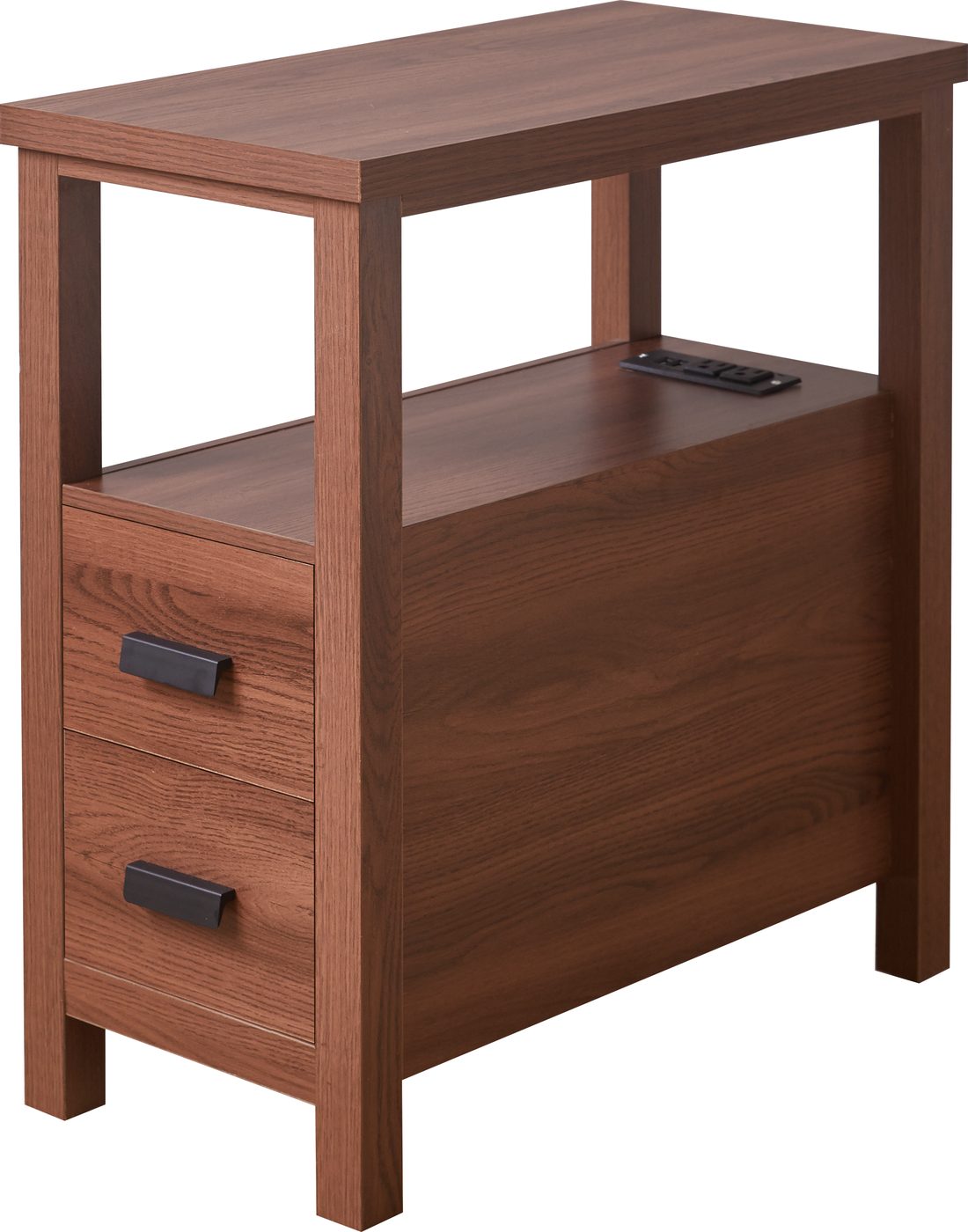
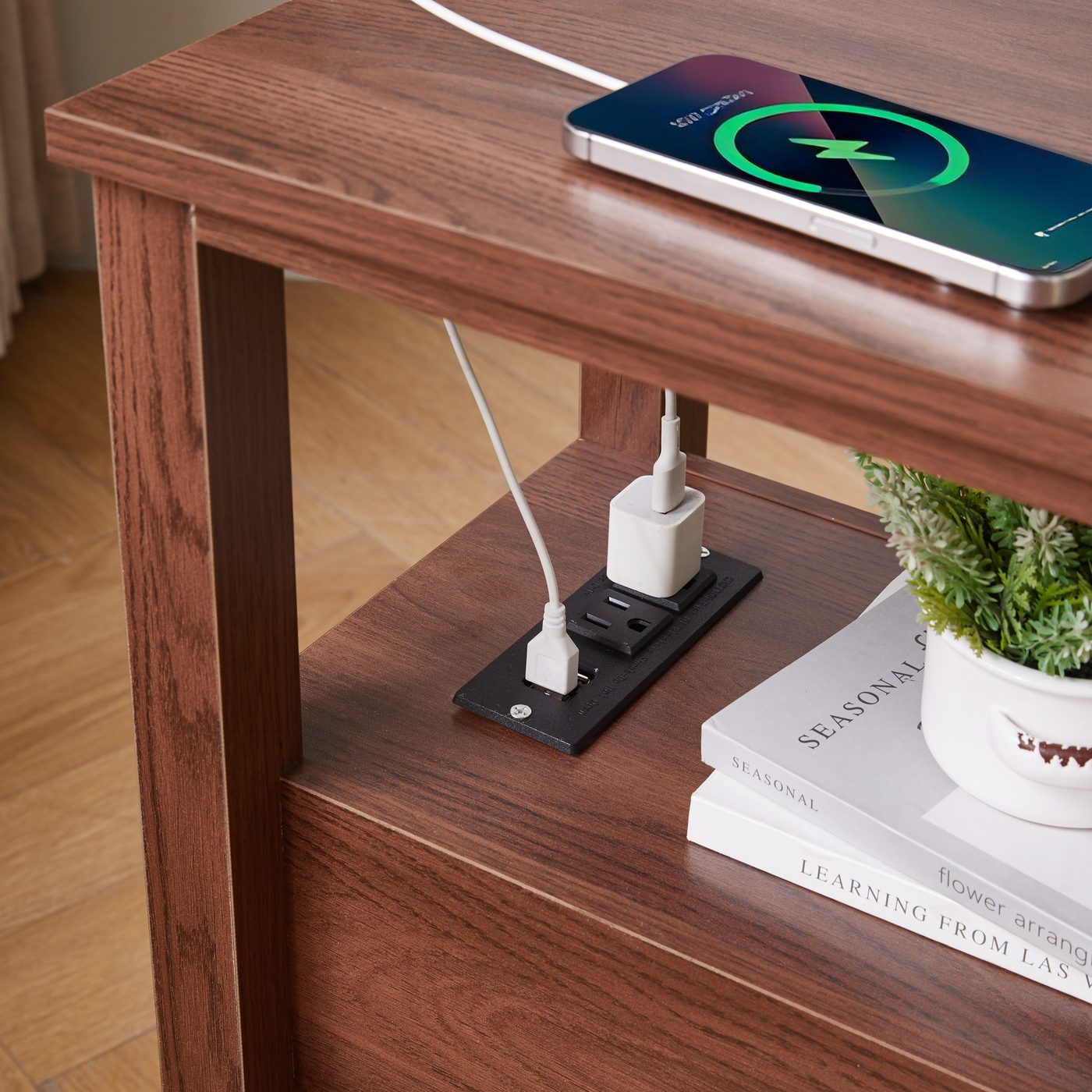
The numbers: 23.6 in long, 11.8 in deep, 24.4 in high, 27 lbs. The detail: the outlets are not in the tabletop. They are on a strip fixed inside the open shelf below the top, with the sockets facing up, and the cord leaves through the back panel.
That detail decides how you use the piece. The back panel decides where it can stand.
What is actually inside the table
The charging table in walnut describes the strip where the manual shows it: two outlets and two USB ports on a separate bar sitting on the open shelf, sockets facing up, with nothing cut into the tabletop. What the page does not spell out is how the strip is held down and where the cord goes, and those two things decide how you plug in.
In the manual, the power strip is a separate part — item U, one per table — fixed inside the open compartment with two screws. A small bracket (item S) sits at the corner where the cord turns, and the cord leaves through the back. In the studio photos the strip lies flat on the shelf inside the open compartment, its sockets pointing at the ceiling, not set flush into the wood above it.
| What it is | Where you can check it |
|---|---|
| Two outlets and two USB ports on a separate strip, sockets facing up | Listing, manual and photos agree |
| Strip held down with two screws, with a bracket at the corner where the cord turns | Manual, items U and S |
| Cord runs out the back, behind the drawers | Listing and photos |
| 23.6 × 11.8 × 24.4 in | Manual cover prints “W 11.8 x H 24 x D 23.5 in”, the same piece rounded off |
What that changes: you plug in from the shelf opening, not from above. A lamp goes in at arm’s height while you are sitting on the bed, and the sockets stay hidden from the door. It also means the top is not a dock: nothing stands on it, and a phone there charges through a cable that drops into the shelf below.
It needs a wall socket, and that socket is probably already behind the bed
The strip is powered by the table’s own cord. So a charging table is not a source of power, it is another thing plugged into your room — and it takes the receptacle nearest the bed, which is usually the only one on that wall.
One table, one outlet, no problem. Two tables and one duplex is where the plan collapses: the second table has nowhere to plug in unless a cord crosses the floor, and that is when people start chaining power strips.
Don’t. The US Consumer Product Safety Commission counts about 2,000 residential fires a year tied to electric cords or plugs, killing 60 people, and says those fires usually start with short circuits, too many products plugged into one cord, and damaged cords. A strip feeding a strip feeding a nightstand is that last scenario with furniture around it.
Two workable answers if the wall has one duplex:
- One charging table, one plain one. Put the powered table on the outlet side and a plain table on the other. A matched pair of 19.7-inch round side tables does the job on the far side — no cord, nothing to unplug when you vacuum. If you need a different width, the rest of the side tables are listed with their dimensions.
- One charging table, and you plug the lamp into it. That is what the two outlets are for: a lamp plus a phone, a watch, earbuds — bedside scale, nothing to extend.
How much room the back needs
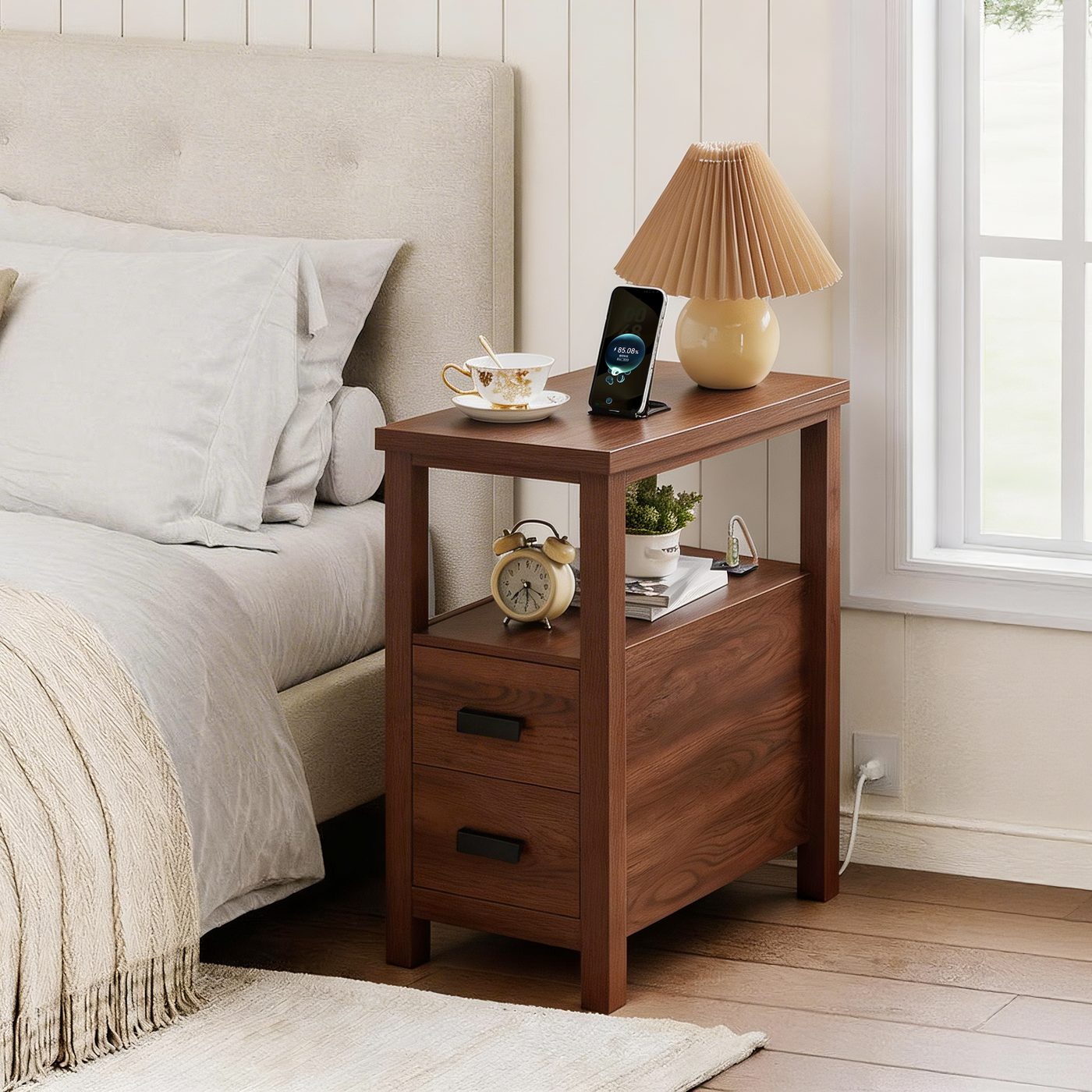
The cord leaves through the back panel, so the wall is part of the installation. Two things eat the gap between the back of the table and the wall: the baseboard, which stands proud of the plaster, and the plug body sticking out of the receptacle.
The listing gives no cord length, and no single gap figure fits every room, so measure. Run a tape from the wall to the spot where the back panel will land. If the receptacle falls inside that footprint, check that a plug can sit in it without the table pressing the plug sideways — the failure people find months later, with a plug half out of the wall and nothing charged overnight.
If the gap is tight, fix it with layout rather than force: slide the table forward of the receptacle so the cord turns beside it, or hand the receptacle’s job to the other side of the bed. What you should not do is shove the piece back until it touches, because the cord leaves low on the back panel and bends exactly where the plug meets the wall.
Where the cable you are charging with ends up
Because the sockets face up inside the shelf, the cable you charge with is a vertical run: from the device on the tabletop, over the front edge of the shelf opening, down into the strip. A 3-foot cable has slack for that run, and the strip sits far enough back that you do not see it from the door.
The top has a raised edge, so a glass set down in a hurry does not slide off while you are reaching under it. The two drawers underneath are where the spare cables go — the difference between one cable on the shelf and a tangle at the back panel.
The MDF part, said plainly
The carcass is MDF with a walnut finish, not solid wood. The page says so in its FAQ: a panel holding a power strip and two drawer fronts stays flatter than solid boards, which move with humidity, so the plate and drawer gaps keep their alignment. A handful of the pieces on the site are built this way; most of the rest are solid wood.
Walnut here is a finish, not a species. Care is a damp cloth and then dry — the one thing to avoid is a drink standing beside the strip on the shelf.
When this is the wrong table
- The only free receptacle is across the room. A charging table does not fix that, and a cord across a bedroom floor is a trip hazard.
- You want fast charging. The page lists two USB ports and stops there — no USB-A or USB-C, no wattage. If you need a laptop charged overnight, check the port type before you buy rather than after.
- You want the sockets for a space heater or a hair dryer. Nothing in the listing publishes the strip’s rating. Bedside electronics, not appliances.
Check the cord and the plug the day the carton arrives. The 14-day window covers damage or a wrong item, and a pinched cord is obvious on day one and expensive later.
Sources
- U.S. Consumer Product Safety Commission — Power Up With Safety: Extension Cords & Power Strips (NSN-09-2) — https://www.cpsc.gov/s3fs-public/ExtensionCordsPowerStrips.pdf — accessed 2026-11-26
- Runva — Side Table with Charging Station, Walnut — https://runvaus.com/product/side-table-with-charging-station-walnut/ — accessed 2026-11-26