
Take a hardback off the shelf and measure the front cover: 6 inches across, 9 inches tall. That is a standard US trade hardcover, and standing upright it uses 6 inches of shelf depth and 9 inches of the air above it. Now look at a bookcase listed as 11.8 inches deep: depth will not be the number that disappoints you. The opening will.
A book has three dimensions. The shelf only argues with two.
Standing upright, a book spends its thickness along the shelf’s width, its cover width going back into the depth, and its height against the shelf above. Publishers work from a short list of trim sizes, and Reedsy’s rundown covers most of what sits on a home shelf: fiction from 4.25 × 6.87 up to 6 × 9 inches, non-fiction 5.5 × 8.5, 6 × 9 and 7 × 10, textbooks 8.5 × 11. The first number is the cover width — the depth a standing book eats. The second is the height — the clearance it needs.
| Book | Trim (in) | Depth it takes | Clearance it needs |
|---|---|---|---|
| Trade paperback | 5.5 × 8.5 | 5.5 | 8.5 |
| US trade hardcover | 6 × 9 | 6 | 9 |
| Non-fiction | 7 × 10 | 7 | 10 |
| Textbook, workbook, binder | 8.5 × 11 | 8.5 | 11 |
| Oversize art book | 11 × 17 | 11 | 17 |
Read the third column against 11.8 inches: nothing standard comes close to filling that depth. Which is why depth is the easy number on a bookcase listing, and the opening is what sends people back to the photos.
Where the 11- and 12-inch standard comes from
It comes from lumber, not from books. In the boarded bookshelf chapter Popular Woodworking publishes as a PDF, the builder wants 13 inches of shelf: “A standard 1×12 is 11-1/4″ wide, which is too narrow to hold the biggest books.” Every case built from that stock lands between 11 and 12 inches deep, and that range became the retail standard.
Retailer guides then work backwards from it. DecorGuider, a furniture blog, publishes a ladder of 8 inches for paperbacks, 10 for all-purpose, 12 for hardcovers and 14-plus for art books — size the shelf for the biggest thing you own and let the paperbacks live with extra room.
Our six-cube, measured from the inside
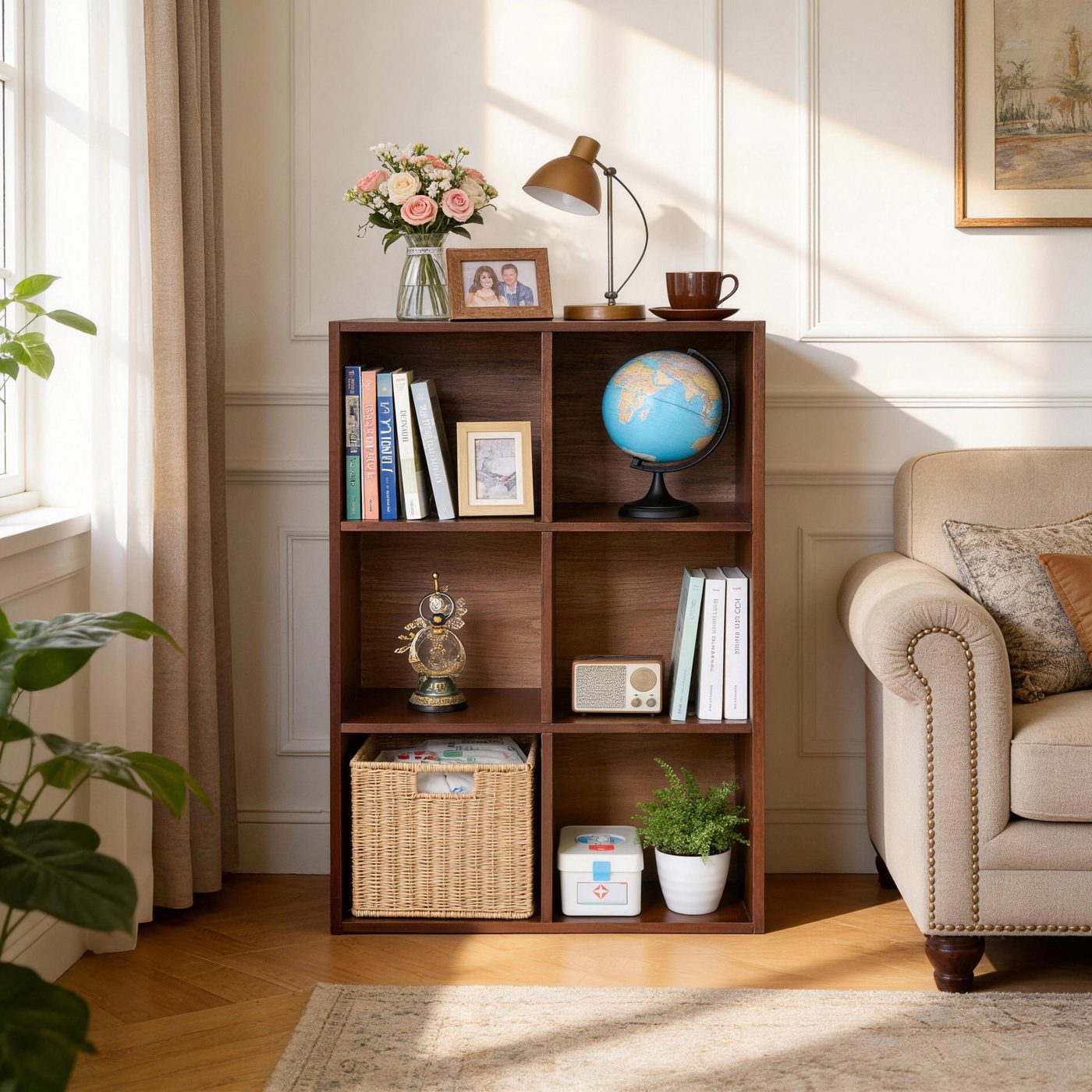
The listing gives the outside: 35.4 × 11.8 × 23.6 in, six open cubes, 17.5 lb in the supplier spec. The second image in the gallery is a dimension drawing and it is more useful than the listing text. Lying on its long side — 35.4 in across, 23.6 in tall — each opening is 11.02 in wide, the top row 10.55 in tall and the bottom row 11.81 in tall.
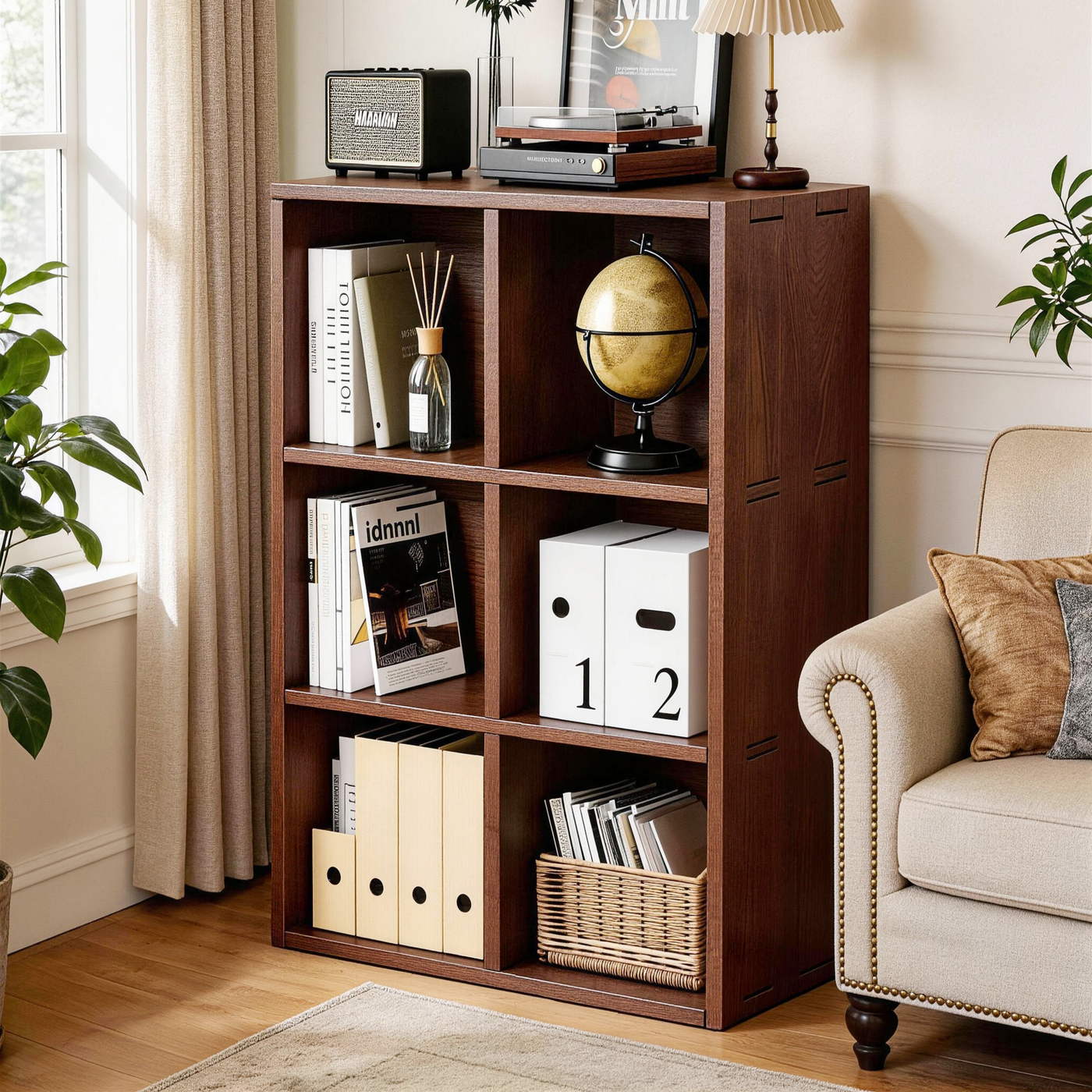
The same drawing shows the unit standing the other way, two cubes wide and three tall, and the gallery photos confirm both layouts. Stand it up and the 11.02-in dimension turns vertical, the columns stop being equal, and an 11-inch book clears every opening instead of only the bottom row. That is arithmetic from a drawing, not a published spec.
The drawing and the spec sheet disagree slightly on the outside numbers: the drawing says 24 in high and 11.5 in deep, the listing text and supplier spec say 23.6 and 11.8. Normal drift between supplier artwork and a spec sheet, and it changes nothing below, because the inside numbers are what your books meet.
| What goes in a cube | Height | Wide, top row | Wide, bottom row | Tall, any cube |
|---|---|---|---|---|
| Trade paperback | 8.5 in | fits | fits | fits |
| 6 × 9 hardcover | 9 in | fits, 1.55 in spare | fits | fits |
| 7 × 10 non-fiction | 10 in | fits, 0.55 in spare | fits | fits |
| 8.5 × 11 textbook | 11 in | no | fits, 0.81 in spare | no margin |
| 11 × 17 art book | 17 in | no | no | no |
The books this bookcase turns away
If most of your library is 8.5 × 11 — textbooks, workbooks, binders — plan on standing the unit 3 cubes tall. Wide, those books go only in the lower row, and set flat they need 11 inches of an 11.02-inch opening: straight in only, no angling around the shelf above. Standing it up gets 11.02 in of clearance, two hundredths over an 11-inch book — a drawing, not a guarantee. If the shelf is mostly textbooks, buy a unit that publishes its clear opening in words.
Art books at 11 × 17 fit no opening, standing or flat. They go on top of the unit, where a 17-inch book overhangs an 11.8-inch-deep top by more than 5 inches — less like display, more like a book waiting to be knocked off. The depth is generous; the openings are the filter, and they are sized for reading copies, not atlases.
5.8 inches of air behind a novel
A 6-inch-wide hardcover leaves 5.8 inches of empty depth behind it, and books drift back until the spines sit in shadow. Push everything flush with the front edge when you shelve, and run a bookend behind the last book so the row can’t slide.
Or use the depth: two rows of 5.5 × 8.5 paperbacks, front to back, come to 11 inches, inside 11.8. Rarely-opened ones behind, what you actually read in front. Crowded from the side, fine from the room.
What 11.8 inches takes out of the room
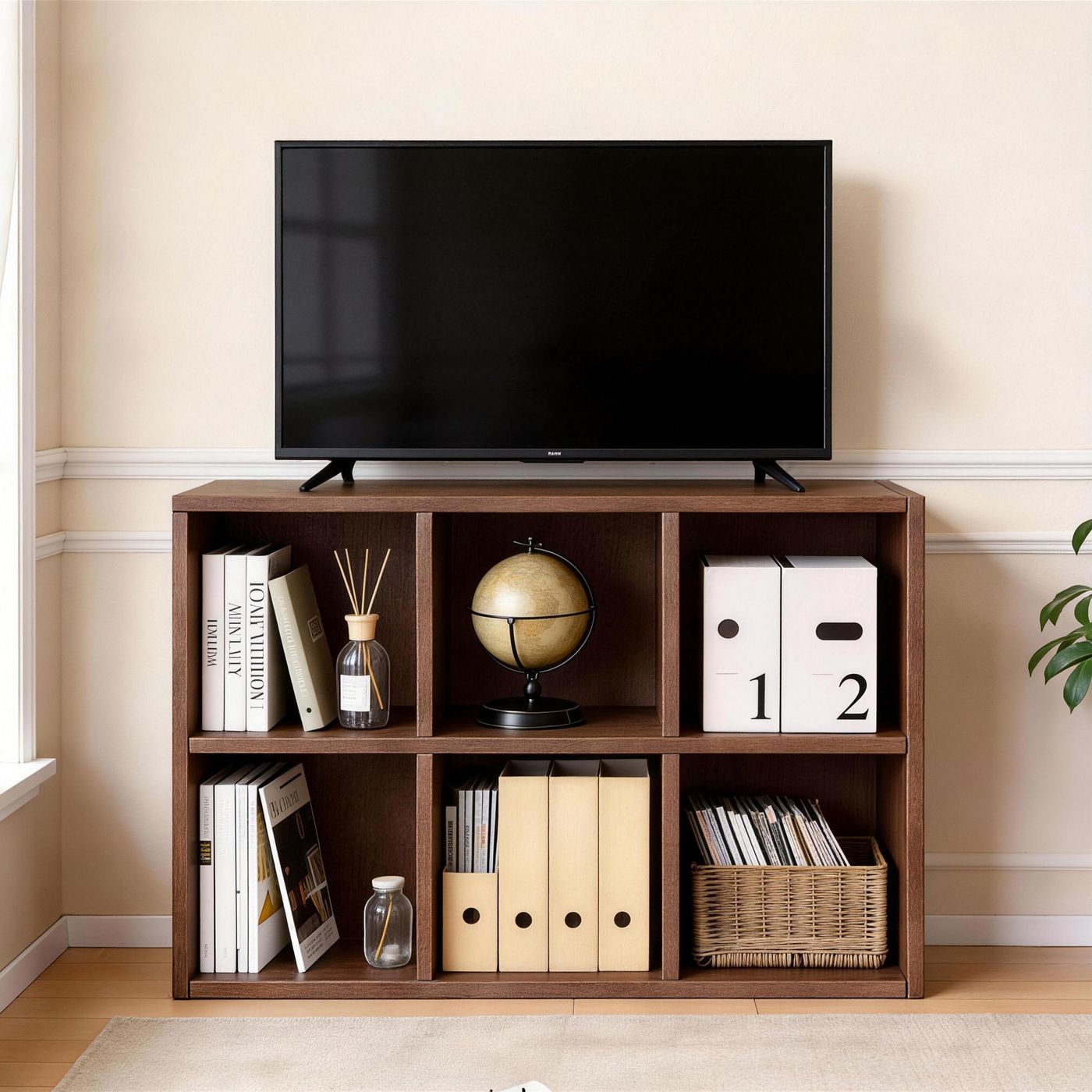
It claims a foot of floor along whatever wall it stands against. Wide, it is 35.4 in across and 23.6 in tall; stood up, 23.6 in across and 35.4 in tall. Next to an armchair that is nothing; in a hallway it is the difference between walking past and turning sideways, which is what the listing’s own copy means by shallow enough not to swallow a hallway. If the entry needs hanging more than shelving, the rolling coat rack with storage basket does the same job in a 17.7 × 15.8 in footprint and 68.1 in of height.
If your books are oversize
Cube shelving is the wrong tool for 11 × 17, and deeper cubes don’t fix it: a 17-inch book needs 17 inches of a dimension no bookcase has. A flat surface is the answer. The mid-century coffee table with storage gives 47.2 × 23.6 in of top at 17.7 in high, enough for an art book lying open. Lower than a shelf is the trade-off: you look at coffee-table books sitting down.
Measure your own library in two minutes
- Stack the ten biggest books and the binders, if you own them, and measure the tallest standing upright. Add 1 inch for getting a finger over the spine: your minimum opening height.
- Measure the widest front cover and add 1 inch. That is your minimum depth, and it will be smaller than you expect.
- Compare both to the opening, not the outside. If a listing publishes only outside dimensions, ask for the clear opening; if nobody can tell you, treat the outside as an upper limit.
- Check whether shelves adjust or the unit turns. On the six-cube solid wood bookcase the two layouts are not equal — 10.55 in in the short row of the wide lay-out, 11.02 in everywhere when it stands tall — and that is a decision you make at assembly.
If step one comes back above 11 inches for most of your books, skip cube units. At 9 or 10, an 11.8-inch cube is more depth than your books need and exactly the height they do.
Sources
- Reedsy — What Are the Standard Book Sizes in Publishing? — https://reedsy.com/studio/resources/standard-book-sizes/ — accessed 2026-11-10
- Popular Woodworking — Boarded Bookshelf (chapter PDF) — https://media.popularwoodworking.com/app/uploads/2022/10/boarded_bookshelf.pdf — accessed 2026-11-10
- DecorGuider (furniture blog) — Bookshelf Depth: 8 to 14 Inches by Book Type — https://decorguider.com/how-deep-should-a-bookshelf-be-expert-sizing-guide/ — accessed 2026-11-10