

Put a tape measure across your entry hallway at the narrowest point, usually between the door casing and the opposite wall. Say it reads 36 inches. Now put a 15.8-inch-deep coat rack against the wall and you have 20.2 inches left to walk through — narrower than a standard door, narrower than the federal minimum for a walking surface, and about the width of a full laundry basket carried sideways.
That is entryway storage in one subtraction. A coat rack is sold on height — 68.1 inches, tall enough for long coats — and on footprint, 17.7 × 15.8 inches, about two square feet. Neither number tells you whether you can still get past it.
The footprint is the small number
Our rolling coat rack with storage basket is 17.7 wide, 15.8 deep and 68.1 tall, 38.1 lb, solid rubberwood, four locking casters, a basket at the base. Set it against a wall and it covers 17.7 × 15.8 = 279.7 square inches, or 1.94 square feet of floor. Compare that with the other entryway pieces on the same shelf:
| Piece | W × D (in) | Floor it covers | Height (in) |
|---|---|---|---|
| Rolling coat rack, basket base | 17.7 × 15.8 | 1.94 sq ft | 68.1 |
| Floor mirror with coat rack, 70 in | 18.9 × 18.9 | 2.48 sq ft | 68.9 |
| Rotating mirror with clothes rack | 19.69 × 18.89 | 2.58 sq ft | 66.5 |
| Two-tier entryway shoe bench | 31.5 × 11.4 | 2.49 sq ft | 16.5 |
Floor area is width times depth divided by 144; the other columns are the listings’ own numbers. The rack wins on floor covered and loses on the number a hallway actually measures. A 31.5-inch bench hugging the wall at 11.4 inches deep steals less walkway than a 17.7-inch rack pushing out 15.8, though they cover nearly the same floor.
Two faces, one box
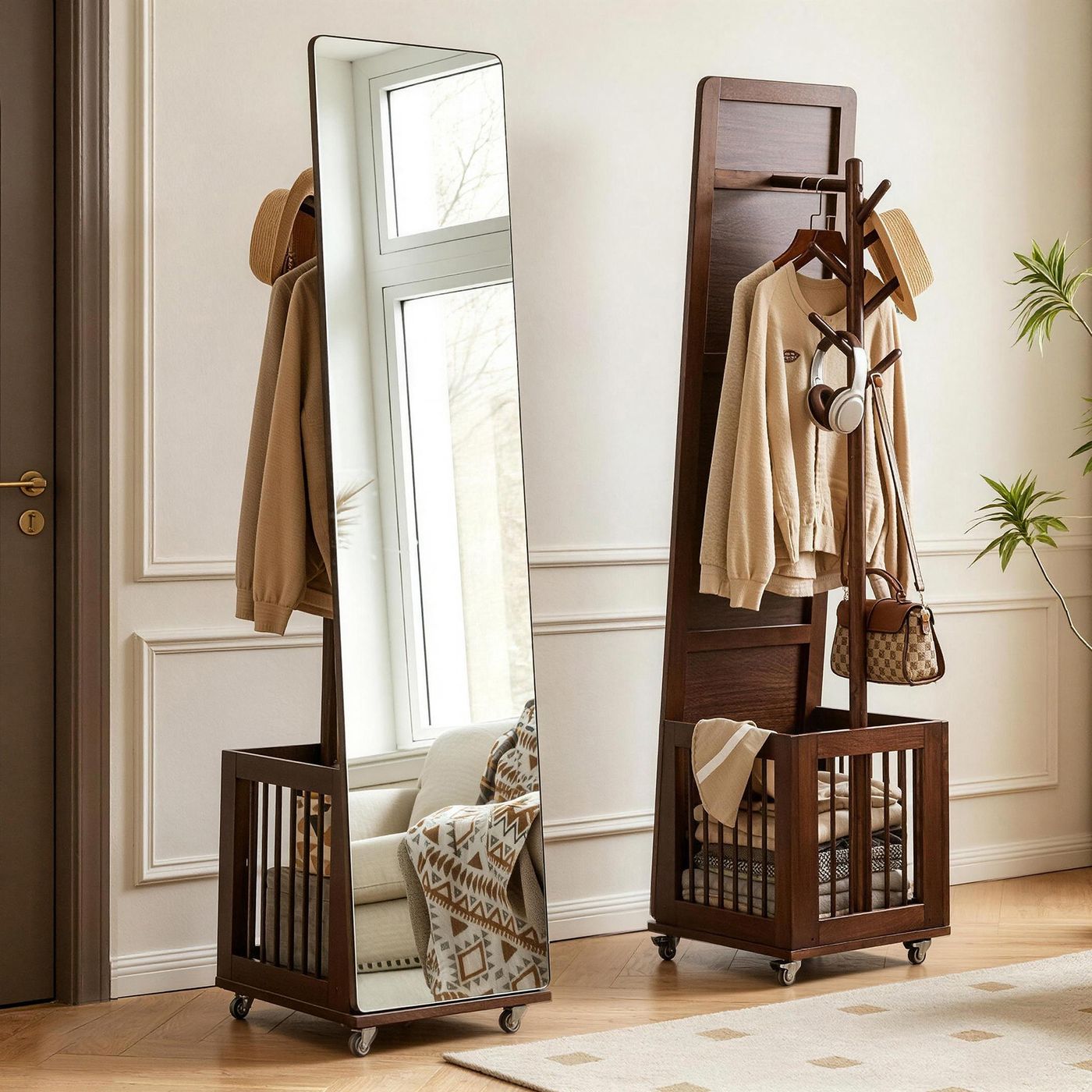
The listing photos show the piece doing two jobs. One face is a full-length mirror, 15.75 inches wide by 68.11 inches tall in the supplier drawing, sitting on the castered base. Turn it around and the other face carries the hooks, with the slatted basket at the bottom for shoes, a folded throw, whatever lands at the door. The description text only mentions the rack side; the photos are the part to study.
That matters for floor space, because a mirror is the piece people buy second. If you already own a floor mirror with a coat rack, it is 18.9 inches square at the base and stacking two tall things in a hallway is how hallways stop working. If you don’t own one, one footprint covers both jobs.

Standing room in front was never on the spec sheet
Every guide publishes how tall a rack should be and how far apart the hooks go. Almost none publishes how much clear floor you need in front of it, and the ones that do don’t agree — which tells you something: the number depends on whether you are reaching or walking.
The only hard number for walking comes from outside residential furniture. The 2010 ADA Standards for Accessible Design, §403.5.1, put the clear width of a walking surface at 36 inches minimum, with a limited exception down to 32 inches for at most 24 inches of length. That is a federal accessibility standard for public buildings, not a rule for your apartment, but it is what a stroller and a delivered mattress need.
Reaching is cheaper: you stand in the doorway, lean in, hang the coat, feet never leaving the threshold. What the depth costs you is the second person, the suitcase, the grocery run.
It turns on its casters, and a turn needs a circle
The casters are why this piece works in a bad hallway: it rolls out for vacuuming and rolls back. Turning it — mirror side out, then hooks side out — sweeps a circle the width of its diagonal, not its width. 17.7² + 15.8² = 562.93, and the square root is 23.73, so it wants roughly a 24-inch clear circle. A 17.7-inch slot between a wall and a radiator will hold it and never let you turn it. That is geometry, not a published spec: tape a 24-inch square on the floor first.
Measure the door swing before the wall
Standard US door widths run 28 to 36 inches for interior doors, 32 inches being the common modern size, and 36 inches for exterior doors, per Angi’s door-size guide. A door swinging into the entry sweeps an arc about as wide as the door, and a 68.1-inch rack standing in it gets hit on the first windy Tuesday.
Measure from the hinge side, not the middle of the opening. If the swing lands where you wanted the rack, the workable spot is usually the wall behind the open door, or the short wall at the end of the hall.
68.1 inches is the right height. The hook height is not published.
Standing coat racks run 60 to 75 inches tall, with 66 to 72 inches as the working range for adults, per a sizing guide from ashdeco, a furniture retailer. Below roughly 55 to 60 inches adult coats drag; above 75 you are buying drama unless the hooks are still in the normal zone. At 68.1 inches this one sits inside the range.
The catch is the one that guide raises itself: “If the post is 72 inches but the highest branch is at 58 inches, the ’72-inch’ label is marketing.” What decides whether a wool overcoat clears the floor is the height of the hanging point — 60 to 65 inches for adults. Our page publishes overall height, not hook height, and the supplier sheet doesn’t label it either. Ask before you buy, or measure the coat you wear most from shoulder seam to hem.
Depth advice for standing racks is usually 18 to 24 inches of base, because a post-and-feet tree with coats on one side wants a wide footing. This piece is 15.8 inches deep and doesn’t work that way: a rectangular frame with the basket at the base, 38.1 lb empty, mass sitting low. It is still freestanding on casters with nothing bolted to a stud, and we don’t publish a tip-over rating — treat one heavy bag on one hook as the limit of good sense.
If you have 40 inches or less
Do the subtraction first, with the real depth of the piece you are considering:
| Hall width | Minus 15.8 in of rack | Left to walk through |
|---|---|---|
| 36 in | 20.2 in | tight for one person with bags |
| 40 in | 24.2 in | one person, no bags |
| 42 in | 26.2 in | workable |
| 48 in | 32.2 in | comfortable |
| 60 in | 44.2 in | a proper foyer |
Under 42 inches, this rack belongs on a dead-end wall — the one you walk toward and turn at, not the one you walk past. If your entry is a corridor with no dead end, a 15.8-inch-deep anything is the wrong shape: the fix is a shallower bench along the wall, or hooks at 60 to 65 inches and no furniture at all, which costs zero floor.
Sources
- U.S. Access Board — 2010 ADA Standards for Accessible Design, §403.5.1 Clear Width — https://www.access-board.gov/ada/ — accessed 2026-11-11
- Angi — What Are Standard Door Sizes? — https://www.angi.com/articles/standard-door-sizes.htm — accessed 2026-11-11
- ashdeco (furniture retailer) — Coat Rack Dimensions: Standing Height, Base Size & Wall Length — https://ashdeco.com/blogs/buying-guides/coat-rack-dimensions — accessed 2026-11-11