

31.1 inches is the length of our dining bench. Put two adults on it and each gets 15.6 inches of seat. The bench charts ask for 22 to 24 inches per adult.
That gap, not the finish, is the whole decision. A bench is a length of seat divided between the people on it, and the division either works or it doesn’t.
The published numbers, and where they disagree
No standard covers dining benches the way one covers tables. Two recently updated guides give ranges that overlap but don’t match:
| What you’re measuring | Bench guide | Chair guide |
|---|---|---|
| Seat height | 17–19 in | 17–19 in, or 18–23 in (two sources, one article) |
| Seat depth | 14–18 in | not given |
| Seat to tabletop | 10–12 in | 10–12 in, or at least 12 in |
| Length per adult | 22–24 in | — |
| Smallest two-seater | 42–48 in | — |
The heights agree, which is the useful part: a bench at 17 to 19 inches puts your thighs at the same distance under the table as a chair does. The disagreement is on clearance (10 to 12 inches, or a flat minimum of 12) and on how much length one adult needs.
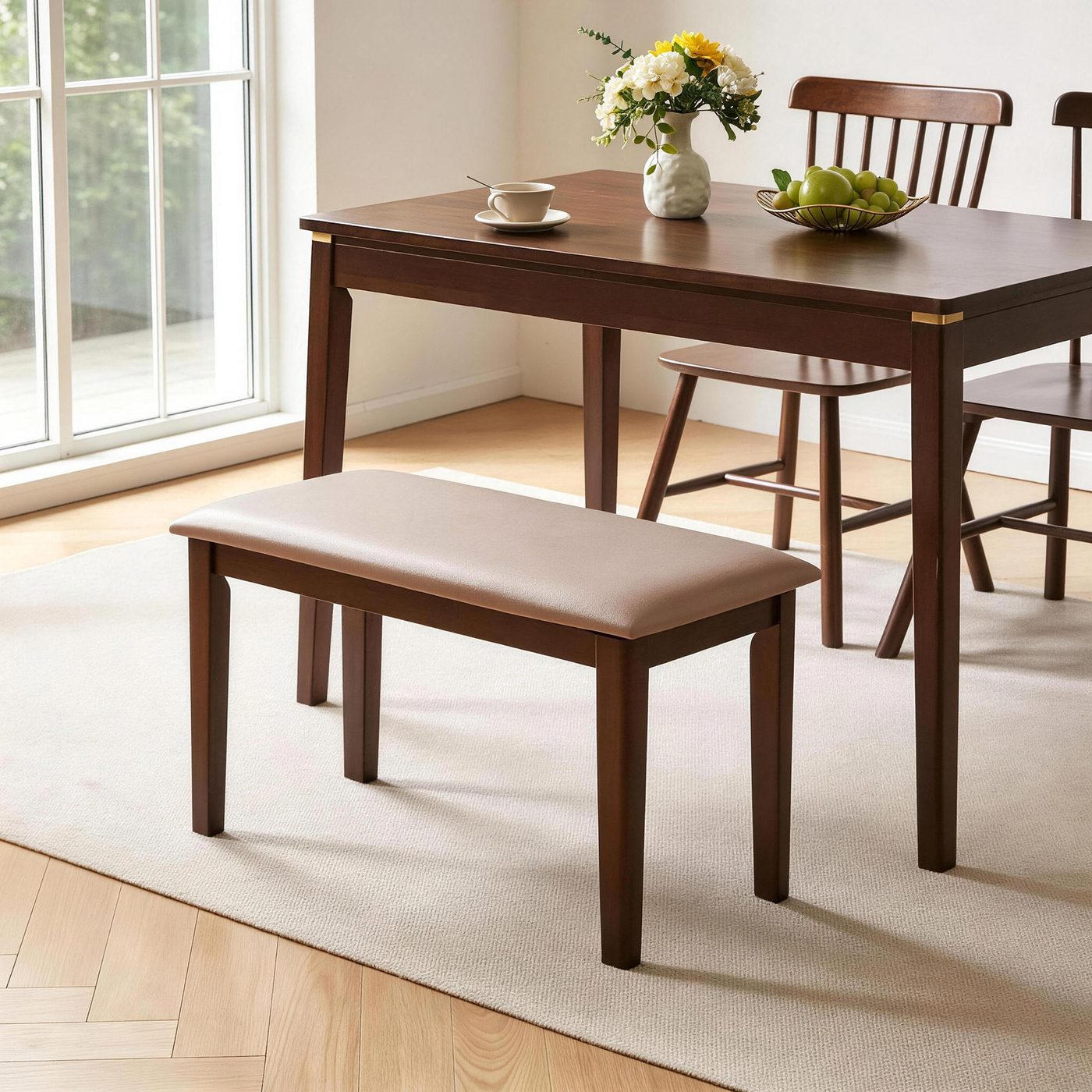
What 31.1 inches actually seats
At 22 inches per adult, 31.1 inches holds 1.4 people. At 24 inches, 1.3. A two-seat bench, by every chart I found, starts at 42 inches.
So the honest reading of our own bench — the page calls it “two adults, three if they’re friendly” — is two people who don’t mind touching elbows, or an adult and a child, since children need roughly 16 to 18 inches each. Three adults would get 10.4 inches apiece. That isn’t sitting, it’s stacking.
None of that makes the bench bad — just 31.1 inches long, with specific uses.
17.7 inches against a 29.5-inch table
The bench is 31.1 × 15.0 × 17.7 inches; our 71-inch dining table is 29.5 inches tall. Subtract: 11.8 inches from seat to tabletop, inside the 10-to-12 window both guides describe.
Two details move that number once someone sits down.
The cushion is one. A guide that pairs real chairs with real tables notes that “an upholstered seat sits lower once you are on it, while a wood or woven seat stays close to its listed number.” The 17.7 inches is measured with nobody on the bench, so the seat you actually sit on is a little lower, and your knees drop slightly further from the apron.
The apron is the other. The rule is at least 7 inches between seat and the underside of the apron, and the table’s rail is set back far enough that knees clear it. A backless bench at 15 inches deep is why that works: you can pull it in until your thighs are under the top, because no backrest stops it.
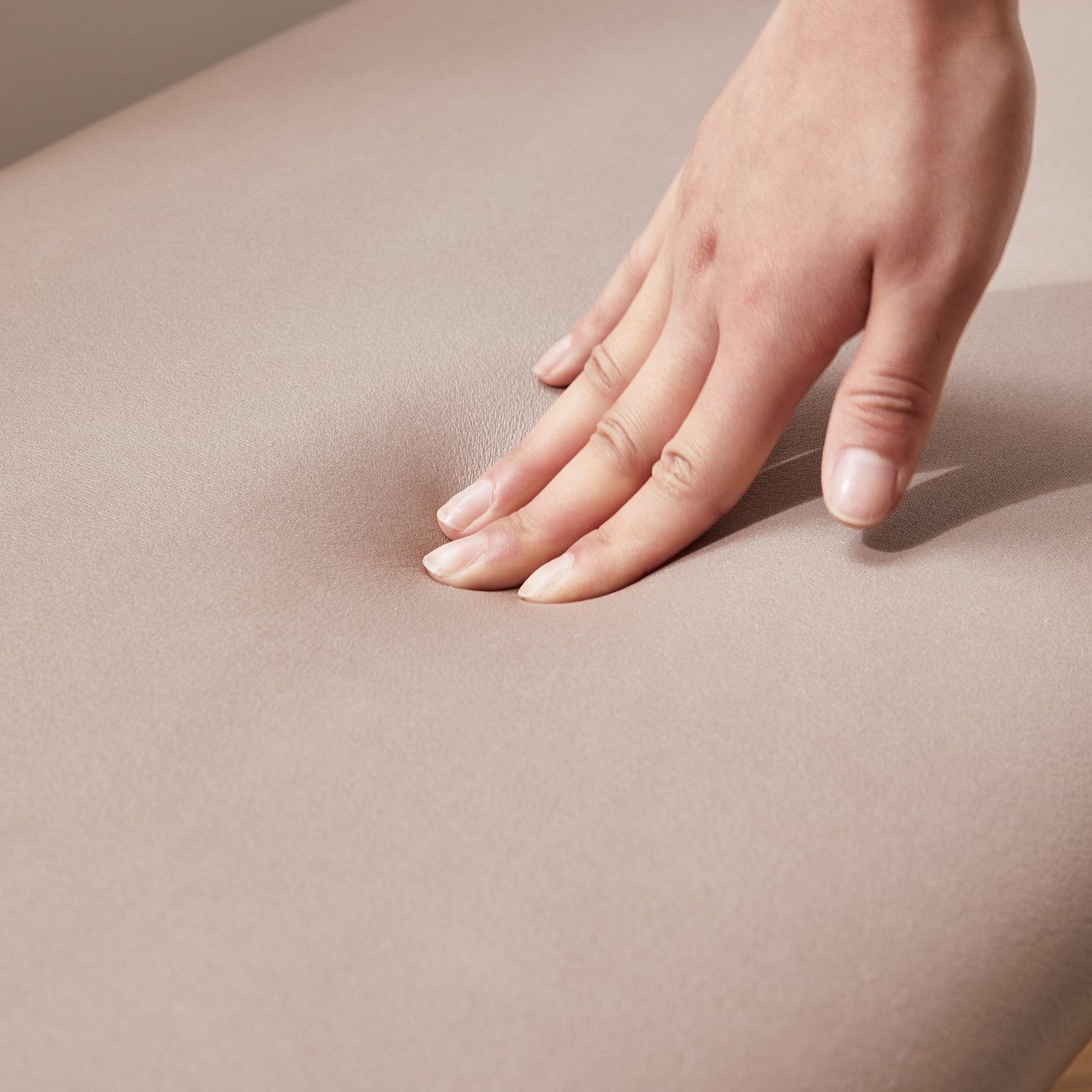
The cushion is the part that gets dirty
Both of our dining seats are solid wood; they wear differently at the top surface, and that difference decides which one survives a house with children.
The bench has a cushion that lifts off the frame, and the cover spot-cleans. The chairs have bare red oak seats, and the listing’s care instruction is a damp cloth plus keeping them out of direct sun.
Gravy, butter, a dropped meatball, a glass of red wine: at a dining table this lands on the seat, not the legs. On oak, a damp cloth ends it. On fabric, it’s a spot-clean and the mark may stay faint. The lift-off cushion helps — you can work on it off the frame, and get at the wood underneath — but no fabric at a table stays new. With small children, the oak chairs are the lower-effort seat.
Rubberwood against red oak, in numbers
The bench frame is solid rubberwood. The chairs are solid red oak.
| Rubberwood | Red oak | |
|---|---|---|
| Janka hardness | 960 lbf (4,280 N) | 1,220 lbf (5,430 N) |
| Average dried weight | 37 lb/ft³ (595 kg/m³) | 43.8 lb/ft³ (700 kg/m³) |
Janka measures the force needed to push a 0.444-inch steel ball halfway into the wood — resistance to indentation, the thing that happens when a leg gets kicked or something is dragged across a seat edge. Red oak’s figure is 27 percent higher, and it is 18 percent denser.
Both are hardwoods; rubberwood is plantation wood, not a softwood, and not the “cheap substitute” the phrase usually implies. But it is the softer of the two, so the bench frame takes a dent the oak chair would shrug off — and a bench frame gets dragged more than a chair frame.
What a chair gives you that a backless bench can’t
A back. Ours is a curved red oak back that meets your shoulders instead of pushing them forward, and it’s the reason a chair is still the right seat for a two-hour Thanksgiving dinner.
Chairs also divide space by person instead of by bench. From our listings: the bench is $76.68 for 31.1 inches of seat, the chairs are $148.51 for the pair — $38.34 a seat against $74.26. The bench wins on price right up until the third person arrives, and it tucks fully under the table, where a chair back leaves 8 to 10 inches of itself in the walkway.
Pairing a 31-inch bench with a 71-inch table
The rule for bench length is roughly the tabletop minus 12 inches, so the bench clears the legs and slides under. For our 70.9-inch table that’s 58.9 inches — a bench 27.8 inches longer than this one.
On the long side, two chairs at 24 inches apart take 48 inches and leave room at the ends; three need 66 to 72, which is why the table page says it “seats four with room to spare, six if you pull it out from the wall.” The 31.1-inch bench is not the side seating for a 71-inch table. It’s the extra seat — the end, the corner where a chair back would block the walkway, the place a child sits sideways.
If you want the bench look and four seats, the honest combination is chairs on the long sides and the bench as the third surface, or a shorter table.
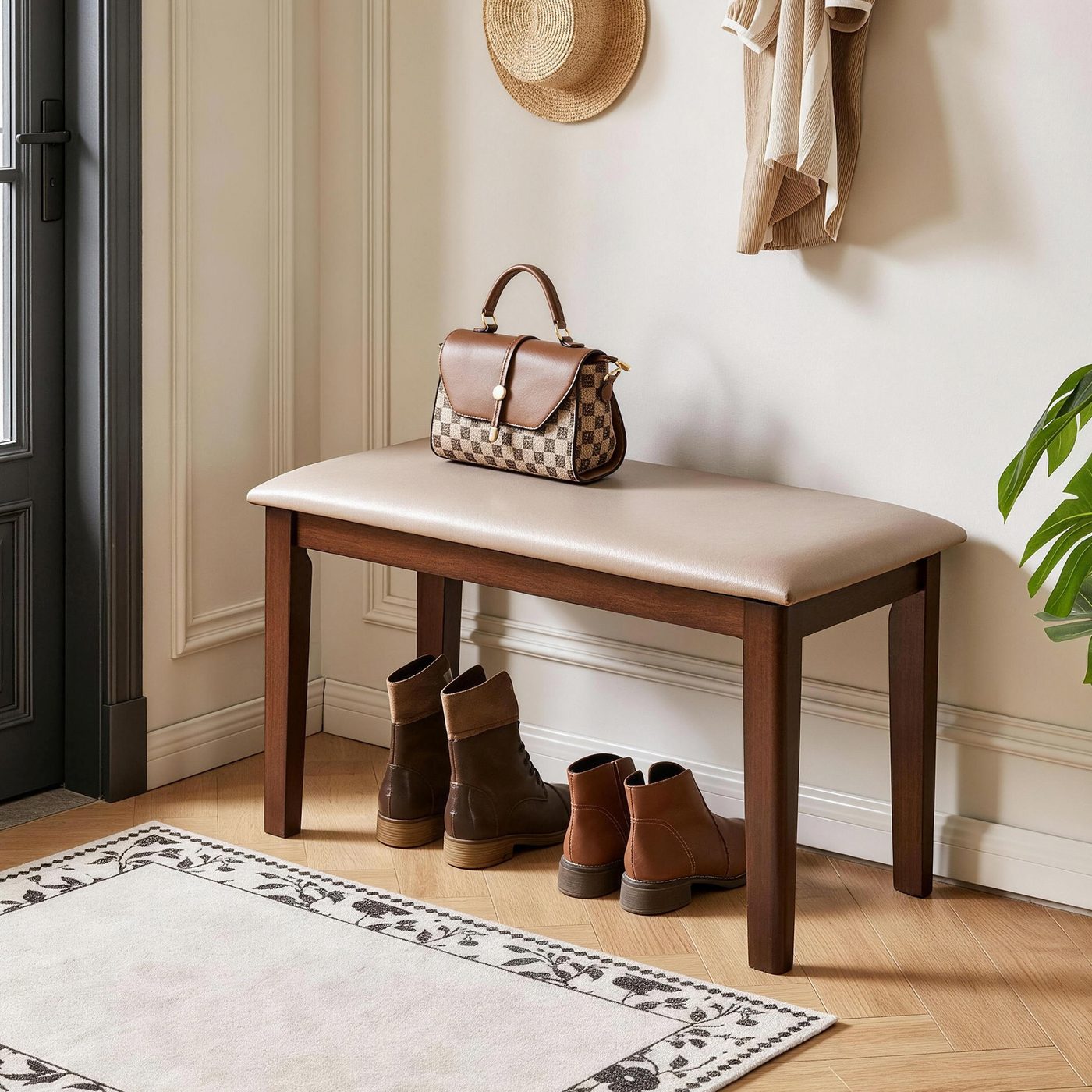
Where 31 inches is the right size
Properly sized for the places a dining table doesn’t reach:
- The end of a bed — 15 inches of depth between footboard and wall, if you measure first.
- An entry beside the door — same 15 inches, and the cushion is kinder than a hard seat when you’re pulling boots on.
- A living room, pulled up as extra seating — tucked against a wall until there are more people than sofa.
- One side of a table for two — proportionate at 30 to 36 inches of table; it’s the 71-inch table that makes it look lonely.
The seating collection shows the proportions next to the 31.5-inch and 39.4-inch shoe benches — same length, built as storage.
How to decide in four questions
- Two or more adults, every day, on the same side? Chairs.
- Is there a wall or a walkway behind the seat? A backless bench tucks in where a chair back would block the path.
- Anyone over 65 or with back trouble sitting for an hour? Chairs, with backs.
- Will food land on it weekly? Bare oak is a damp cloth; fabric is a spot-clean, every time.
If the first answer is “one, plus a kid,” 31.1 inches is fine, and the bench is $76.68 with free shipping from our US warehouse. If it’s “four at Thanksgiving,” start with the chairs and add the bench as the overflow seat.
Sources
- DG Floors — Dining Bench Dimensions: Length, Height and Table Fit — https://dgfloors.com/dining-bench-dimensions/ — accessed 2026-11-09
- The Everything Depot — Dining Chair Height Guide: Seat to Table Clearance — https://theeverythingdepot.com/dining-chair-height-guide/ — accessed 2026-11-09
- The Wood Database — Rubberwood and Red Oak — https://www.wood-database.com/rubberwood/ and https://www.wood-database.com/red-oak/ — accessed 2026-11-09