

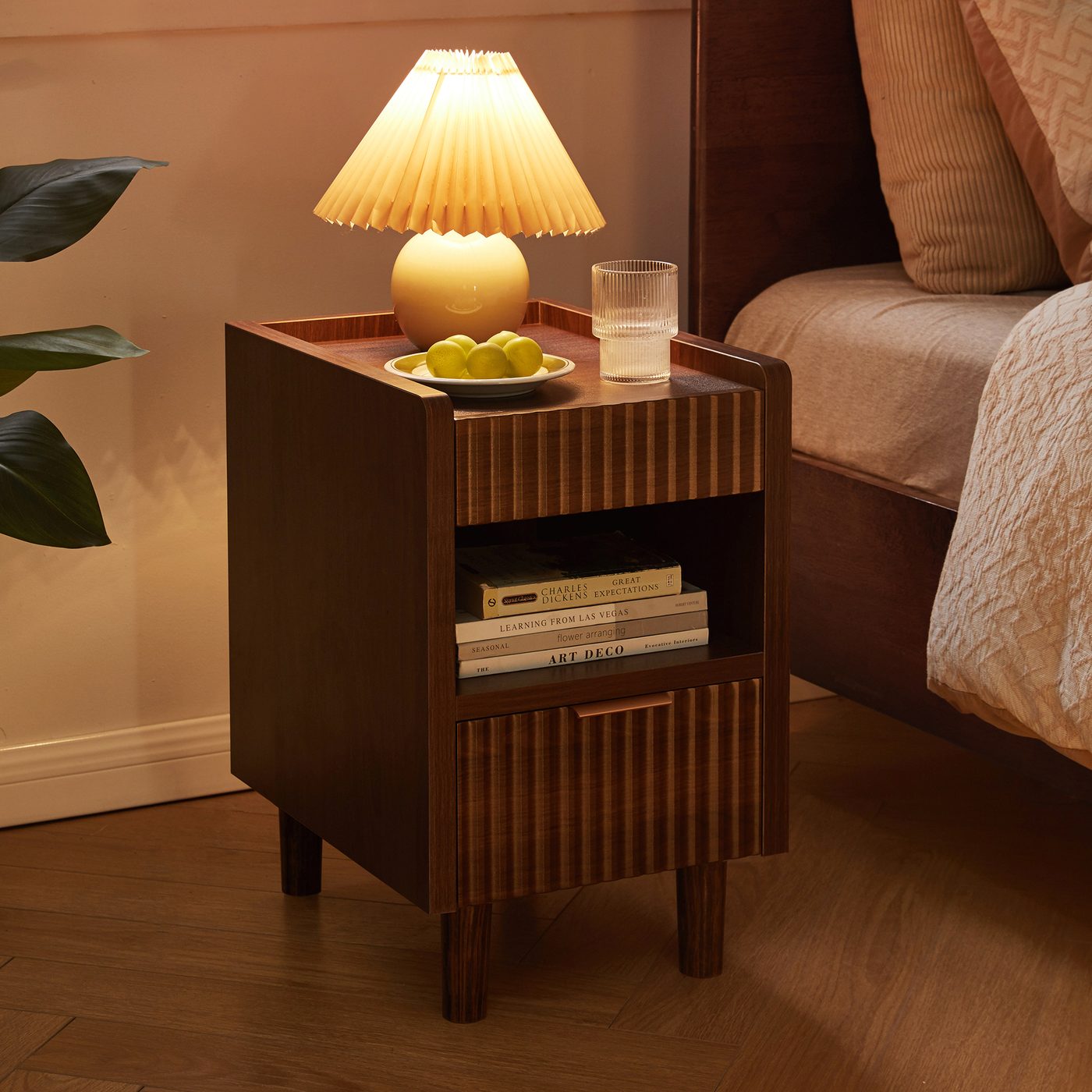
A glass of water goes over at 11:40 pm, on the open shelf of a nightstand, inches from a paperback. You grab a towel. What the next ten minutes decide depends on three letters the listing already gave you.
The walnut fluted pair on this site says it this way: “MDF with a walnut finish. The open shelf takes a book and a glass of water; the drawers take everything else.” That is the page putting the glass of water on the shelf itself. The charging side table says something similar in a different sentence: “The body is MDF; the top has a raised edge so things do not slide off.”
Both are MDF. Both are bedroom and living-room pieces, not bathroom vanities. Whether a spill is a five-minute wipe or the end of the piece comes down to two numbers that look contradictory until you see what each one measures.
Two numbers, ten times apart
Gene Wengert, in the Wood Dr. column for Woodworking Network, answered the stability question with both halves at once: “If an MDF panel is wetted with liquid water, extreme swelling in thickness can be encountered – up to 25 percent increase in thickness. Certainly, with MDF, it is prudent to avoid liquid water wetting. Solid wood might swell as much as 8 percent when exposed to liquid water.”
Then the same answer gives the humidity figure: across a relative humidity swing from 35 to 85 percent, MDF changes about 1/2 percent in width and length, where solid wood changes 1 to 3 percent.
So “MDF is stable” and “MDF is wrecked by water” are not in conflict. They describe different conditions: humid air barely moves the panel, which is why MDF makes a flat, quiet box; liquid water standing on it is a separate event, and 25 percent is the top of the range Wengert reports, not what a wiped spill does.
A manufacturer’s spec sheet sits between those two numbers. Roseburg’s technical data for Medite, its standard industrial-grade MDF, lists thickness swell at ≤11 percent (≤0.065 in). Eleven percent of a 3/4-inch panel is about 0.08 in — a hair over 1/16 in, in the one place water reached the fiber.
And it stays there. The Composite Panel Association’s technical bulletin on dimensional stability is blunt about it: when particleboard or MDF swells past its original dimensions, “it is not reversible (i.e. not fully recovered upon re-drying to the initial equilibrium moisture content).” Drying stops the damage. It does not undo it.
| What is being measured | Number | Source |
|---|---|---|
| Thickness swell, standard MDF (Medite) | ≤11% (≤0.065 in) | Roseburg technical data |
| Thickness swell, moisture-resistant MDF (Medex MR50) | 3% | Roseburg technical data |
| Solid wood / MDF swell in liquid water | up to 8% / up to 25% | Woodworking Network, Wood Dr. |
The page says "MDF", not "moisture-resistant"
The 3 percent panel in that table is a different product from the one in a standard nightstand. Roseburg sells Medex for “applications with potential water exposure like countertops and signs”; its thickness swell spec is 3 percent against 11 for the standard board.
Our [storage pieces built in MDF](https://runvaus.com/product-category/storage/) say “MDF” and stop. So does the [charging side table](https://runvaus.com/product-category/tables/). That is the correct thing to plan around: a standard panel in a dry room, with a finish on it, not a wet-area material.
Where the water actually goes
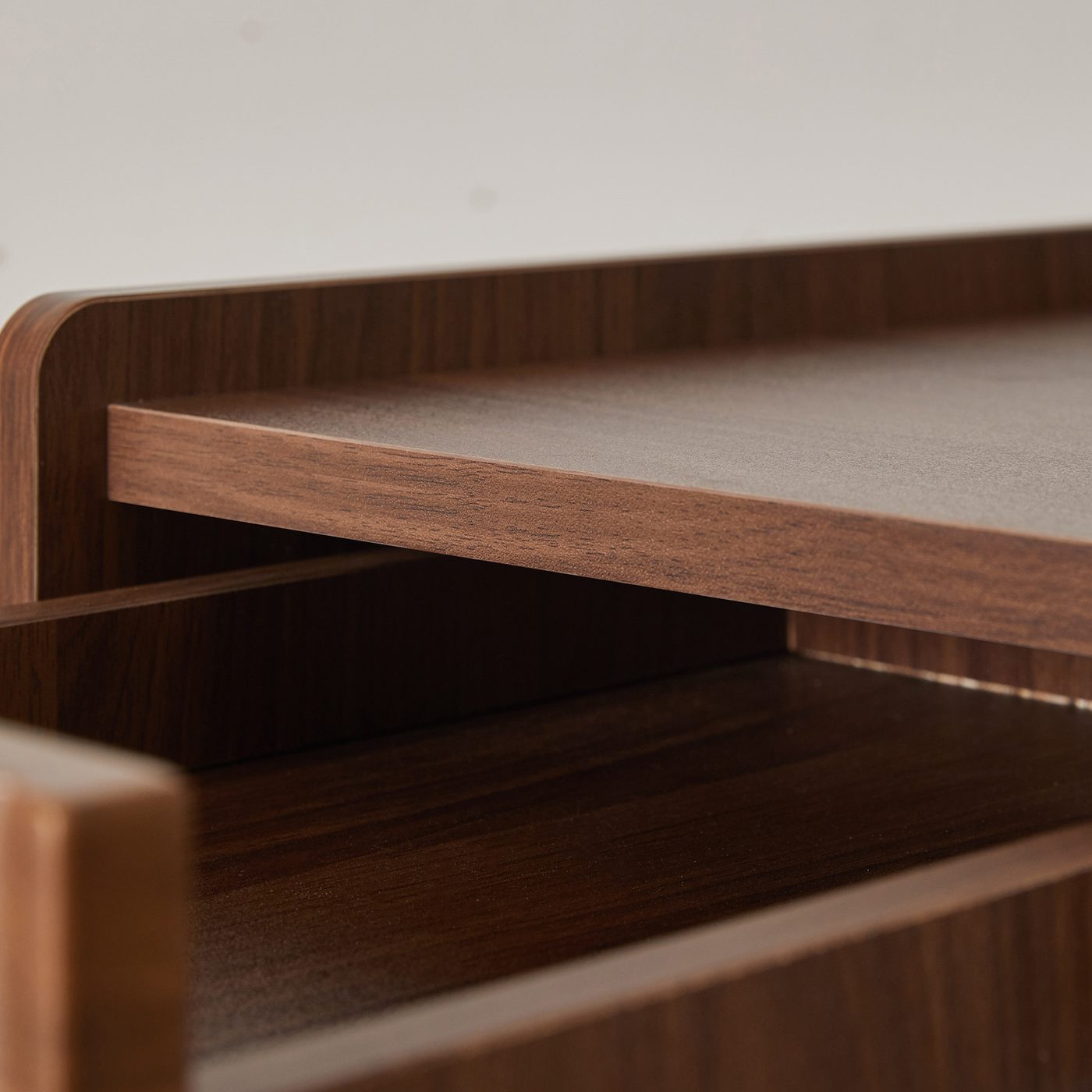
The fluted pair prints 11.8 × 15.8 × 19.7 in with no labels. The supplier’s dimension drawing puts 15.75 in across the front, 11.81 in front to back, 19.69 in high — so the listing’s first figure is depth. That matters here: an 11.8-inch deep shelf is shallow enough that a knocked glass lands within an inch or two of the side panel, which is a joint, not a flat field.
Three places take water differently:
- The face. Finished, and the care line covers it: “Wipe with a damp cloth.” A spill that is blotted off the top is a finish question, not a panel question.
- The edge. Where the top meets a side, where the back panel sits in its groove, where the drawer box is assembled. The cut edge is fiber, and fiber is what swells.
- The cutouts. The charging table puts “two USB ports and two outlets … in the top”, and every one of those openings is a cut edge in the same panel. The raised lip that stops things sliding off has a second effect: a tipped drink stays on the top instead of running off it, pooling against the lip and around those openings.
Nobody designs a table to trap water. But the feature that solves “my phone slides off” also holds a spill where the panel has the most openings.
The ten minutes that matter
Blot, don’t wipe. A cloth pushed across a puddle drives water into the seam you are trying to protect. Then get air moving and leave it — the swelling is in the fiber, not a dent in the surface, so heat and pressing buy nothing.
What not to do: sand it wet, and expect an iron or an oil rub to lift a bump along a seam the way it lifts a white ring on a finished top. Those household tricks work on moisture trapped in a film finish. Once the fiber has swelled, there is nothing on the surface to dry out.
If the edge has risen and a drawer now drags, the piece has told you which problem you have. A swollen box binds in its opening; that is past cosmetic.
A ring and a swollen edge are different problems
A pale ring under a cold glass on a film finish is moisture in the coating, and it usually lifts. A line of raised material along a seam, a soft spot, a drawer that no longer runs clean — that is the panel, and it does not come back.
Solid wood behaves differently, which is why the [listing wording matters more than the photo](https://runvaus.com/solid-wood-or-mdf-read-the-listing/): it swells in liquid water too, up to 8 percent by Wengert’s figure, but returns toward its size as it dries. The 31 solid pieces on this site are not immune to a spill. They are just forgiving of one.
Where an MDF piece is the right call
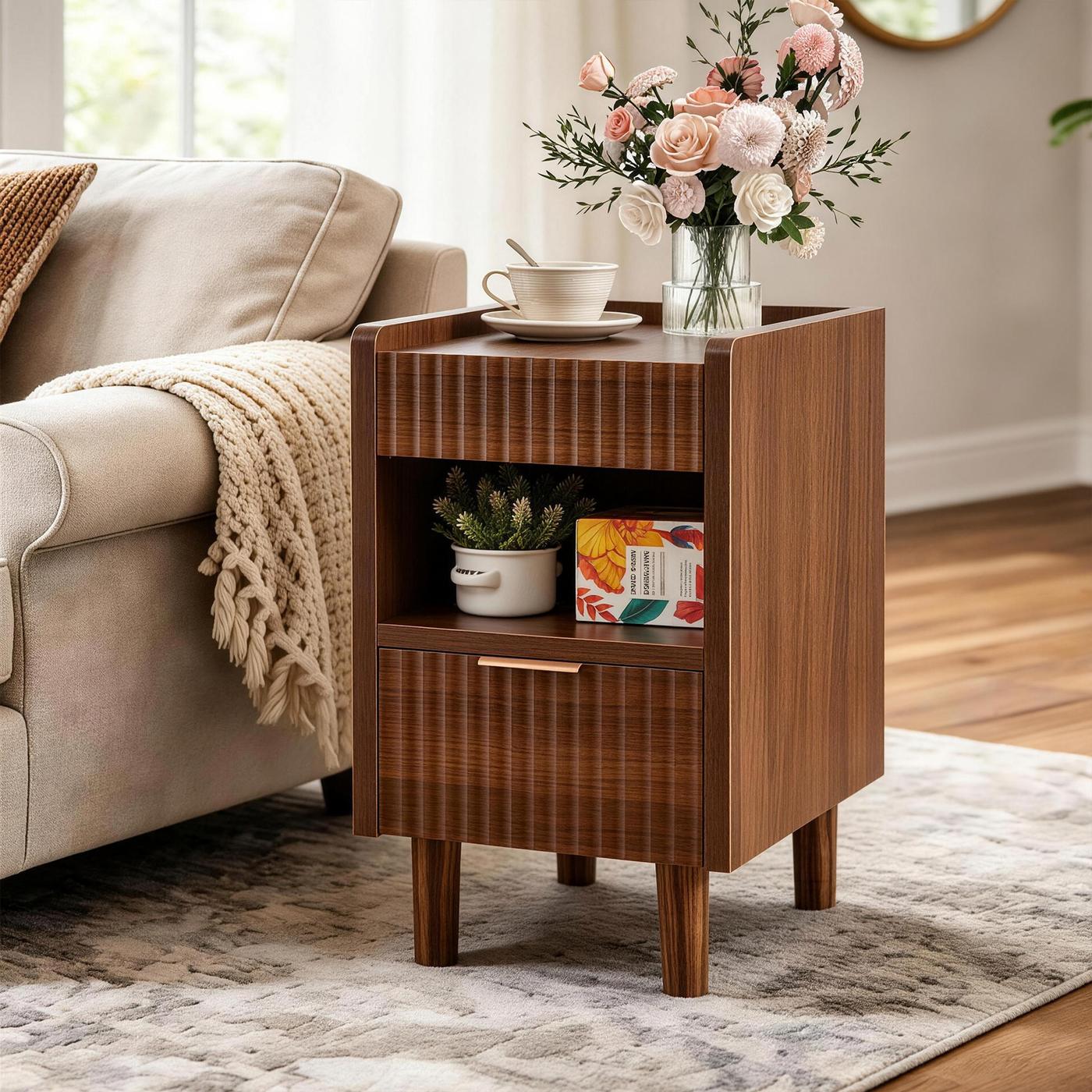
A bedroom is a dry room, and so is a living room — unless the humidifier points at the furniture or a single-pane window runs with condensation all winter above the piece.
The rules are short: coasters under glasses, a tray under any plant, no standing water on the top, and a couple of inches between the cabinet and a sweating window in January. For everything else, the [care routine for the finish](https://runvaus.com/clean-water-based-furniture-finish/) is all the piece asks for.
The shelf holds the glass fine. It is the ten minutes after it tips that decides whether the nightstand keeps its shape.
Sources
- Woodworking Network — Gene Wengert, MDF stability (Wood Dr. column, 3 November 2013; 25% and 8% liquid-water figures, 0.5% and 1–3% humidity figures) — https://www.woodworkingnetwork.com/knowledge-center/wood-dr/mdf-stability — accessed 2026-11-18
- Composite Panel Association — Technical Bulletin #2: Dimensional Stability (swelling not reversible; thickness swell and linear expansion greater than solid wood) — http://www.compositepanel.org/wp-content/uploads/23-CPA-0043_Print_Technical-Bulletin_2_DimensionalStability_F.pdf — accessed 2026-11-18
- Roseburg — Medite MDF technical data sheet (thickness swell ≤11%, ≤0.065 in; linear expansion ≤0.33%) — https://www.roseburg.com/resources/medite-technical-data-sheet-el-dorado/ — accessed 2026-11-18
- Roseburg — Medex MR50 MDF product data (thickness swell 3%; linear expansion 0.25%; “applications with potential water exposure like countertops and signs”) — https://www.buildsite.com/pdf/roseburg/Medex-MDF-Product-Data-2079593.pdf — accessed 2026-11-18