

Four product pages I opened on a Sunday in mid-November all carried the same line: “Order today, estimated arrival Nov 20–26.” The shipping policy page, opened at the same moment, said orders ship within 3–5 business days of cleared payment, and that most orders arrive 2–6 days after they ship.
The line and the policy turn out to be the same story: five to eleven days from cleared payment to a doorstep, written once as a schedule and once as two dates. What the line still does not give you is a single day, and that gap — a week of possible afternoons — is where deliveries turn into a bad afternoon.

Two clocks, and only the second one is a delivery date
The policy page keeps the two numbers separate:
- “Orders ship within 3–5 business days of cleared payment.”
- “Most orders arrive within 2–6 days after they ship, depending on how far you are from our warehouse.”
The first is handling: someone pulls the piece, checks it, boxes it, hands it to a carrier. The second is transit. They add up, and neither is a promise of a date.
| What the page says | What it covers | Monday order (Nov 16) |
|---|---|---|
| Ships within 3–5 business days of cleared payment | Warehouse handling, until the carrier has it | Wed Nov 18 – Fri Nov 20 |
| Arrives 2–6 days after it ships | Time on the road | Fri Nov 20 – Thu Nov 26 |
That is a five-to-eleven-day spread from click to doorstep, out of two sentences that both sound precise. “Cleared payment” matters too: a card that clears Tuesday starts the clock Tuesday, not the day you filled the cart.
Whether a range on a listing includes transit
Some listings count both clocks and some stop at the warehouse door, and at a glance the two look alike. The test takes fifteen seconds: measure how wide the range is, not how far away it is.
Shipping contributes three to five business days, which is a spread of two days between the first and the last ship date. Transit contributes two to six, a spread of four. So a range two or three days wide is handling only, and every mile is still ahead of it; a range close to a week wide has already added the road.
On Nov 15 the retro writing desk and the rest of the furniture listings here showed Nov 20–26 — six days wide, which is the policy’s five-to-eleven-day spread written as two dates. Nothing there promises Nov 20: that is the earliest afternoon the desk can reach a door, and Nov 26 is the latest.
What “free” is required to mean
“Free shipping” is one of the few marketing phrases with a federal rule behind it. Under the FTC’s guide (16 CFR 251.1), a shopper has “a right to believe that the merchant will not directly and immediately recover, in whole or in part, the cost of the free merchandise or service by marking up the price of the article which must be purchased.” The same section requires the conditions to be set out “clearly and conspicuously at the outset,” and says a footnote marked with an asterisk does not count.
Three checks follow: are the conditions on the same page as the claim, is the item priced higher than where shipping is billed separately, and are the exclusions named?
Ours are: the 48 contiguous states, no Alaska, Hawaii, territories, military mail or PO boxes, and an order that arrives with one of those addresses is cancelled and refunded in full before it ships. That sits on the shipping and returns page, not in a footnote.
Where other furniture stores draw the line
In furniture, “free shipping” usually names a service level, and the levels differ sharply. A freight retailer’s policy states it plainly: “Free shipping promotions cover free curbside delivery. Free shipping and curbside service do not include any inside placement, unpacking, assembly, or any special customer requests.” The same policy quotes 2–3 business days to process an order and 3–10 business days in transit, with a call to book a date but no time window. A mattress retailer’s help page explains the reason heavy pieces change carrier: over 150 lbs cannot go by standard parcel service, so it moves with partners who provide “doorstep/curbside” (also called threshold) delivery.
| Service | Usually includes | Leaves to you |
|---|---|---|
| Curbside | Box at the curb or driveway | Carrying it in, unpacking, assembly |
| Threshold | Box just inside the first door or lobby | Stairs, tight turns, unpacking, assembly |
| Room of choice / white glove | Placement in a room, often unpacking and debris removal | Little, but usually a paid upgrade |
The runvaus shipping page uses none of those three terms. It says free shipping to the 48 states, 3–5 business days to ship, and 10–30 minutes of assembly with hardware in the box. Whether the driver brings the carton inside is not stated anywhere, so ask before you order: does the carrier bring it in and up a flight of stairs, will anyone call to schedule a day or give a window, and does the box come off the truck at ground level or on a liftgate? Email answers arrive within one business day — useful before checkout, useless once the truck is loaded.

The carton is bigger than the piece
Everything arrives flat-packed, and the carton is not the size of the furniture. From the suppliers’ packing sheets (the product pages print assembled size and weight, not the box):
| Piece | Assembled | Carton | Carton weight |
|---|---|---|---|
| Retro writing desk, 47.2 in | 47.2 × 21.6 × 30.1 in, 45.3 lbs | 50.59 × 24.21 × 7.28 in | 46.7 lbs |
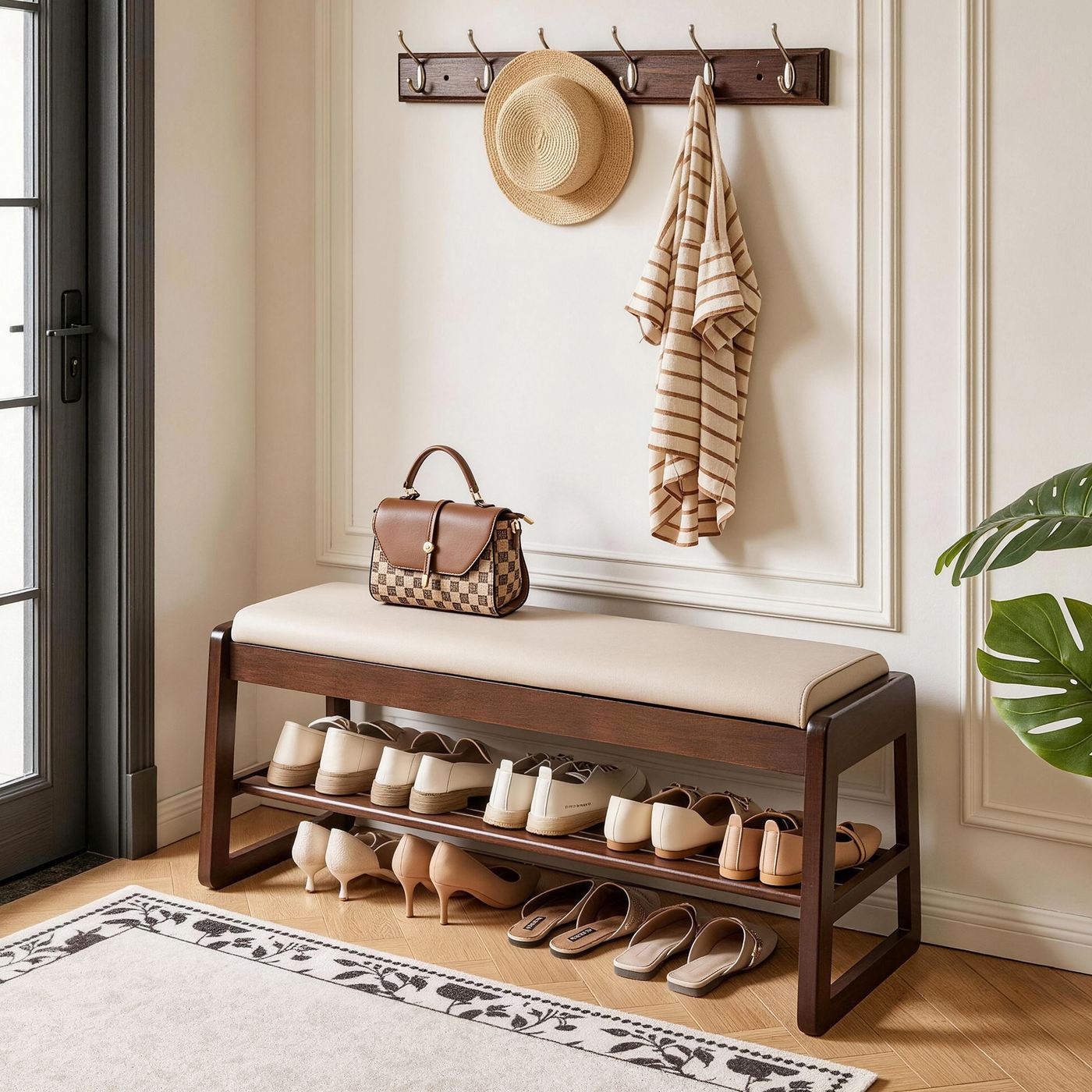
| 39 in lift-top shoe bench | 39.4 × 11.8 × 16.9 in, 19.8 lbs | 40.16 × 16.54 × 7.87 in | 22.5 lbs |
| Rustic side table, small | 19.7 × 19.7 × 19.7 in, 10.5 lbs | 22.6 × 21.7 × 4.5 in | 12.7 lbs |
The desk’s carton is 3.4 in longer and 2.6 in deeper than the desk it becomes — a flat box, not a boxy one. If the stair landing turns at a wall, measure the turn, not the desk: a five-foot carton does not bend and cannot be assembled in the hallway.
The weights decide who carries it. 12.7 lbs is a one-hand trip; 46.7 lbs in a flat box with no handles is a two-person lift upstairs, or a slow slide along the floor. The side table ships with hardware bagged and numbered, the desk page says to allow one person about half an hour — budget an hour, and open the carton in the room the piece will live in.
Cancelling is free until a label exists
The window is tied to the tracking number, not the truck:
- “You can change or cancel an order any time before it ships, at no cost.”
- “You get a tracking number as soon as the label is created, not when the truck leaves.”
Together, those mean the free-cancellation window can close a day before anything moves. If a size is in doubt, decide before the label.
After delivery the terms are narrow on purpose: damaged or wrong items within 14 days, with a photo and the shipping label to hello@runvaus.com, return shipping covered when the problem is on the seller’s side. Change of mind or “bigger than expected” is not covered, so measure before checkout — and keep the boxes until the piece is assembled and checked.
Sources
- Runva, Shipping & Returns Policy, accessed Nov 15, 2026 — shipping window, transit estimate, delivery exclusions, cancellation, returns, assembly time.
- Runva product pages, accessed Nov 15, 2026: retro writing desk, 39 in lift-top shoe bench, rustic side table, small, fluted nightstands, set of 2, solid rubberwood dining table — assembled dimensions, weights, and the date range shown on each listing.
- Supplier packing sheets for the same three pieces (carton size and carton weight); the product pages do not print box specs.
- FTC, 16 CFR § 251.1, Guide Concerning Use of the Word “Free”, accessed Nov 15, 2026.
- Restaurant Furniture Express / Baxton Studio, Freight Shipping Policy, accessed Nov 15, 2026 — curbside scope, processing and transit times, appointment scheduling.
- Avocado Green Mattress help center, Regular shipping vs. in-home delivery, accessed Nov 15, 2026 — the 150 lb parcel limit and doorstep/curbside (threshold) delivery.