

A 63-inch mirror standing on the floor reaches about 61 inches of glass. Stand two feet from it with your eyes at 64 inches — a 5-foot-8 frame — and the highest part of yourself you can see is 58 inches. That is your chest.
Nothing is wrong with the mirror. What is wrong is the number nearly everyone uses to pick the height, which is half your height, and which was never written for a mirror that stands on the floor.
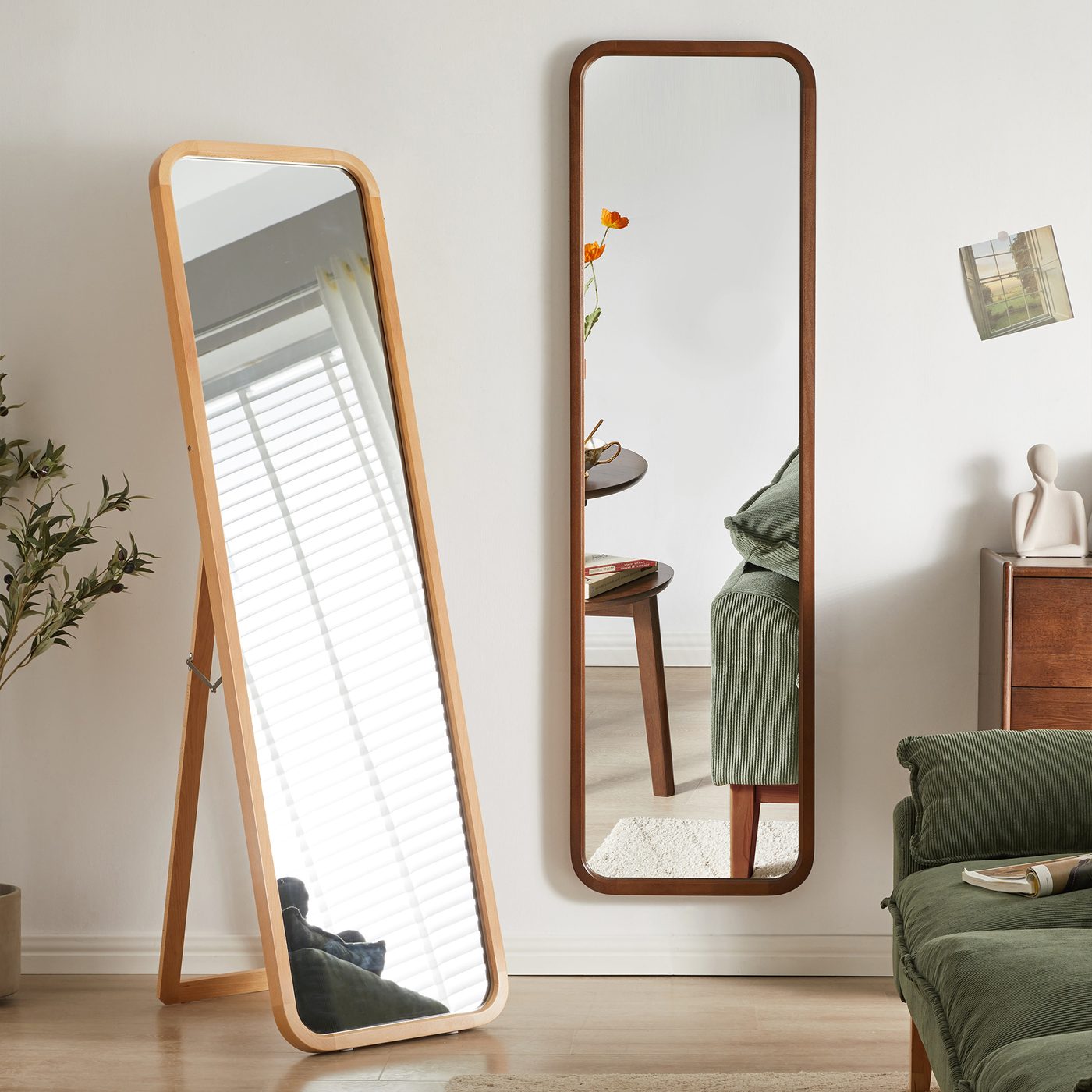
Half your height is correct — for a mirror on a wall
The rule is sound: a plane mirror only needs to be half your height to show you head to toe, and that holds at any distance you stand. Calibrate Physics works through the geometry in its ray optics notes — minimum mirror length equals half the person’s height, independent of distance — and then adds the part that gets skipped.
The glass cannot float. It has to run from the midpoint between your eyes and your feet up to the midpoint between your eyes and the top of your head, and the notes are blunt about the lower edge: it sits at half your eye height above the floor, “not at the floor.”
That describes a mirror bolted to a wall, with air underneath. A floor mirror has a base, and the glass starts in a slot just above the floor. On a 5’6″ buyer, half the height is 33 inches of glass — and the piece cannot put that glass where the rule needs it, because the bottom 32 inches of that wall are behind a wooden base.
Where the buying guides go wrong
Most guides compress the placement into one sentence and lose the geometry on the way. A typical line, from Lily’s Furniture’s full-length mirror guide: half your height — “33 inches of glass for someone 5’6″” — “positioned with the top edge at eye level or just above.”
A 5’6″ buyer has eyes around 62 inches, so that glass would run from 29 to 62: feet below it, head above it. The two halves of the sentence cancel each other out.
The mirror brands reach the right number from the other end. A buyer who is 6 ft with an eye level of 68 in needs a reflective surface reaching at least 70 inches above the floor, per Hasipu’s sizing page. Sixty-six inches is half his height, and leaves him looking at his own chin.
The two measurements that settle it
Take a tape measure to a door frame. Stand against it in socks and mark your eye height and the top of your head, then add the two numbers and divide by two. That is the height the glass has to reach, measured from the floor, on a mirror that stands on the floor.
For a 5’8″ buyer with eyes at 64: (64 + 68) ÷ 2 = 66 inches. For 6 ft with eyes at 68: (68 + 72) ÷ 2 = 70 inches, the number Hasipu publishes.
Since the crown sits about four inches above the eyes, the rule folds down to something you can hold in your head in a showroom: the glass needs to reach two inches above your eye level. Hasipu’s table uses the same four-inch difference — 5’8″ with eyes at 64, 6’0″ with eyes at 68.
Stepping back does not rescue a short mirror. Distance changes how large your reflection looks, not which part of you the glass can return.
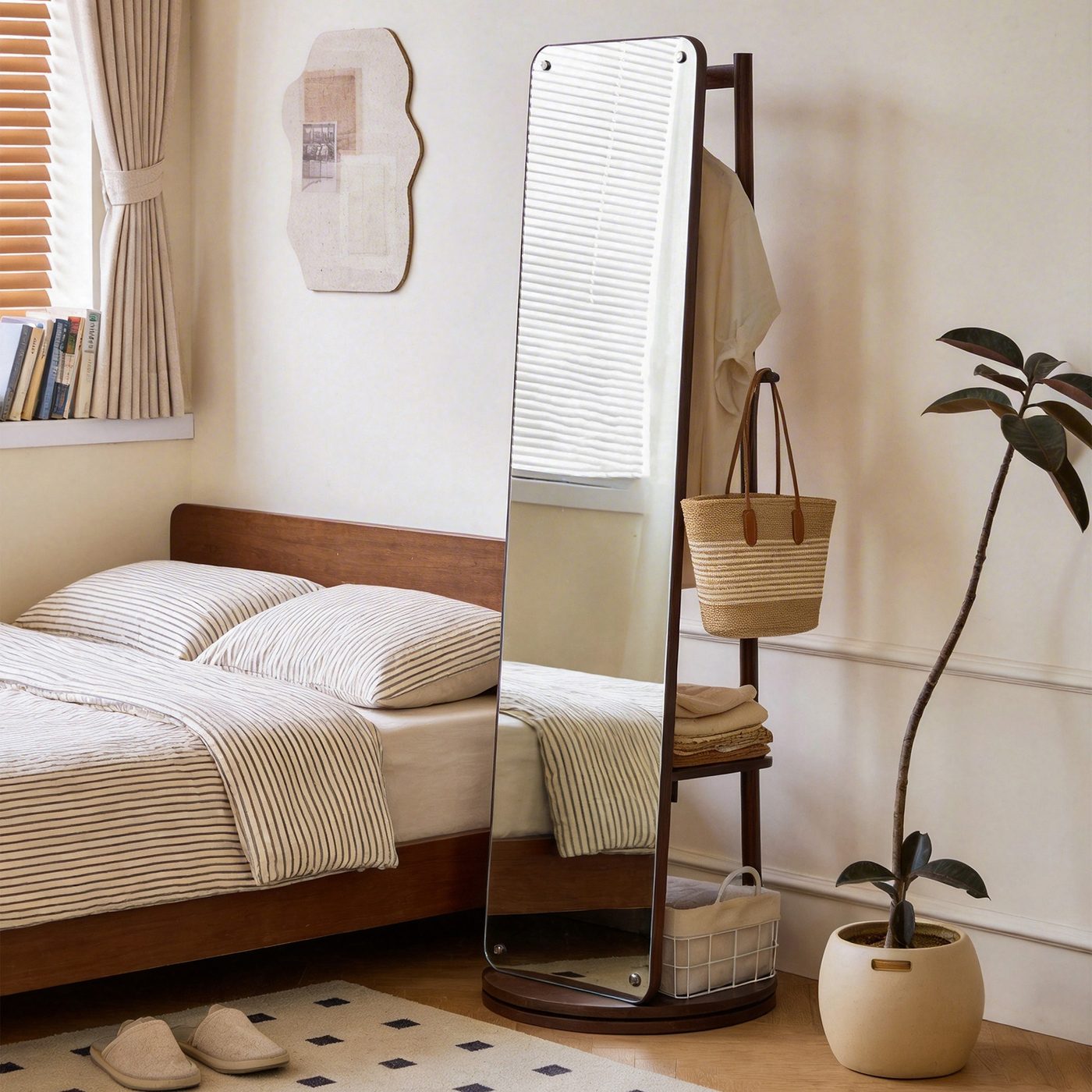
What 63, 66.5, 67.7 and 68.9 inches actually reach
All six of our mirrors are freestanding, so the glass begins near the floor and stops at the frame. On the one model where both numbers are published, the rotating mirror with clothes rack, the frame tops out at 66.53 in and the glass at 64.76 — the frame alone costs 1.77 in before your crown takes anything. The estimates below apply that allowance to the models that publish overall height only, then the two-inch rule.
| Mirror | Height | Glass reaches | Your eye level, at or below | Roughly, if you’re |
|---|---|---|---|---|
| Beech floor mirror | 63.0 in | about 61 in | 59 in | 5’3″ |
| Rotating mirror with clothes rack | 66.53 in | 64.76 in (published) | 63 in | 5’7″ |
| Rotating mirror cabinet | 67.7 in | about 66 in | 64 in | 5’8″ |
| 360° rotating floor mirror | 68.9 in | about 67 in | 65 in | 5’9″ |
| Floor mirror with coat rack, “70 in” | 68.9 in | about 67 in | 65 in | 5’9″ |
Two caveats. The beech pair lean — both stand on A-frame supports that tilt the glass back a few degrees, visible in the product photos — and a leaning mirror does better than an upright one, by inches rather than feet. The other four stand vertical. And the last column assumes four inches between eyes and crown, an average rather than a fact about you.
So the 63-inch beech mirror is a chest-up mirror for a 5’8″ buyer and a full-length one for someone 5’3″ or shorter; for hems, shoes and waist-level fit it works from any distance. The 68.9-inch models carry a 5’9″ buyer head to toe. Above that the arithmetic turns steep: a 6-foot buyer needs 70 inches of glass, and nothing freestanding in the mirrors category reaches it. Most of the market doesn’t either — this is the height where floor mirrors stop and wall-mounted ones start.
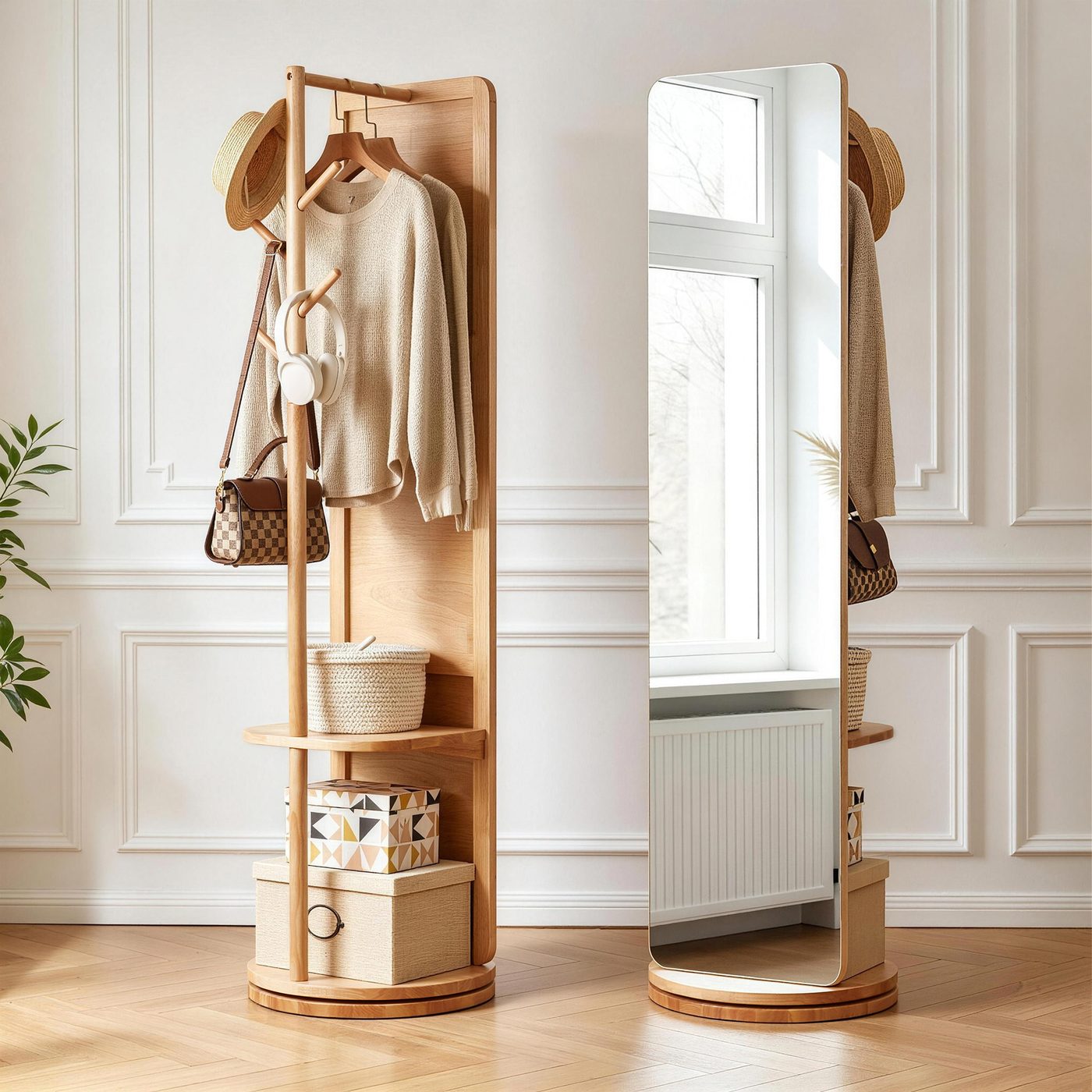
Raising the mirror buys two inches for one
If you already own a 63-inch mirror, or you want the 68.9-inch piece without buying a taller one, the lever is a riser: a shallow plinth under the base, set against a wall. Lift the glass one inch and the highest point of your body you can see rises two, because that point is always twice the glass height minus your eye height. Three inches of riser under the 68.9-inch mirror takes a 6-foot buyer from chin-up to head-to-toe.
What it costs: a 49.9 lb mirror on an 18.9-inch base now stands on something, and we do not publish a tip-over rating for these, so a raised one belongs against a wall and nowhere else. You lose nothing at the bottom until the glass’s lower edge climbs past about half your eye height — around 32 inches for most adults — which is where your shoes drop out.
Width is a separate subtraction
Height decides whether your head is in the frame; width decides how much of you fits across. A flat mirror shows twice its own width at your own body, at any distance, so the clothes-rack mirror’s 15.75 in of glass covers 31.5 in of you — shoulders with an inch or two either side, no arms-out poses. The others publish overall width (18.1 in beech, 18.9 in rotating), and their frames take some of it.
Measure the room after you measure yourself
The beech mirrors are 18.1 × 20.7 in at the base; the rotating ones are 18.9 × 18.9. Leave a swivel model about 20 in of clear floor plus the same again of swing to turn it freely, which is what the clothes-rack model’s page asks for. Its carton is 68.31 in long, so it arrives at your door rather than in the bedroom, and the assembled piece is 50.22 lb: two people, one at each end.
Sources
- Calibrate Physics — Field of View & Characteristics of Images by Plane Mirrors — https://calibratephysics.com/calibrate-hub/revise/ray-optics/field-of-view-characteristics-of-images-by-plane-mir — accessed 2026-11-11
- Hasipu Mirrors (mirror retailer) — Full-Length Mirror Size by Height — https://hasipuhome.com/blogs/news/full-length-mirror-size-by-height — accessed 2026-11-11
- Lily’s Furniture and Mattress (furniture retailer) — Full-Length Mirrors: Cheval, Leaning or Wall-Mounted — https://lilysfurnitureandmattress.com/full-length-mirror-guide/ — accessed 2026-11-11