

A coffee table photographed in front of a window carries one bright rectangle on its top: the window itself, reflected. In the photo it reads almost like a mirror. Under a lamp, away from the glass, the same table may read as a flat brown plane. Neither photo is wrong — they are two readings of one surface at two angles, and the thing between them has a number.
Furniture listings almost never print that number. They print a word.
Satin means two different things depending on who printed the label
Two real finish documents, both current, both American:
| Sheen name | Miller Paint, Evolution Interior (2024 product guide) | General Finishes, High Performance water-based topcoat |
|---|---|---|
| Matte / Flat | Matte 0–5 @ 60° | 0–10 @ 85° | Dead Flat (under 5), Flat (10 or less) |
| In between | Soft Sheen 0–10 @ 60° | 10–20 @ 85° | — |
| Satin | 10–20 @ 60° | 30–40 @ 85° | 25–35 |
| Semi-gloss | 35–55 @ 60° | 60–70 @ 85° | 50–60 |
| Gloss | — | 80+ |
Read the satin row twice. Same word, and the two sheets are 15 gloss units apart: Miller’s satin cabinet finish sits where General Finishes’ flat-to-satin gap begins.
Neither sheet is wrong. The word is a marketing band, not a measurement. If you are matching a new piece to a table you already own, “satin” is not a match — it is a direction.
Why the reading is taken at 60 degrees
Gloss is a reflection measurement, and reflections change with where you stand. ASTM D523, the test method both sheets quote, states its scope this way: it “covers the measurement of the specular gloss of nonmetallic specimens for glossmeter geometries of 60, 20, and 85°.”
The 60° reading is the general-purpose one and the number most sheets print. The 20° geometry is used for high gloss. The 85° geometry is the one used for low and matte surfaces, because at a shallow angle even a flat film has something to say: the Miller satin row reads 10–20 at 60° and 30–40 at 85°.
Two lines from the standard matter more than they look:
- The rating comes from comparing light off the sample with light off a black glass standard, and it changes with the surface’s refractive index. A dark walnut-stained film and a white painted film can share a number and still not look alike.
- “Little information about the relation of numerical-to-perceptual intervals of specular gloss has been published.”
The numbers are a ruler, not a promise about what your eye will do in your room.

What our own listings give you instead
We sell 36 pieces. Today, 23 of those product pages use the word “finish”: 13 say “walnut finish,” one “white finish,” one “natural finish,” one “natural wood wash finish,” 11 “water-based finish.” Searching all 36 pages for gloss, satin, matte or sheen returns nothing. No page prints a reading.
“Walnut finish” is a colour over whatever the piece is made of — a beech frame with a walnut finish is beech, not walnut. “Water-based” is a different kind of statement: it describes what carries the resin, not how shiny the dried film is.
The General Finishes line makes that point by itself. It is a water-based topcoat, and the same product runs from Dead Flat under 5 to Gloss at 80+. Water-based tells you about the solvent and the smell in the workshop, nothing about the surface you will be wiping.
So the honest answer to “is it matte or satin?” on our pieces is: the page does not say. Ask before you order rather than guess from a photograph. That is a gap we would rather name than paper over.
What sheen actually changes on a surface you use
The most useful thing either manufacturer says about sheen is not in the numbers table.
General Finishes, comparing its matte topcoat with its urethane one, says the matte product “dries softer to the touch” and “will show more marring and fingerprints,” then recommends the urethane for “high use areas such as table tops and kitchen cabinets.”
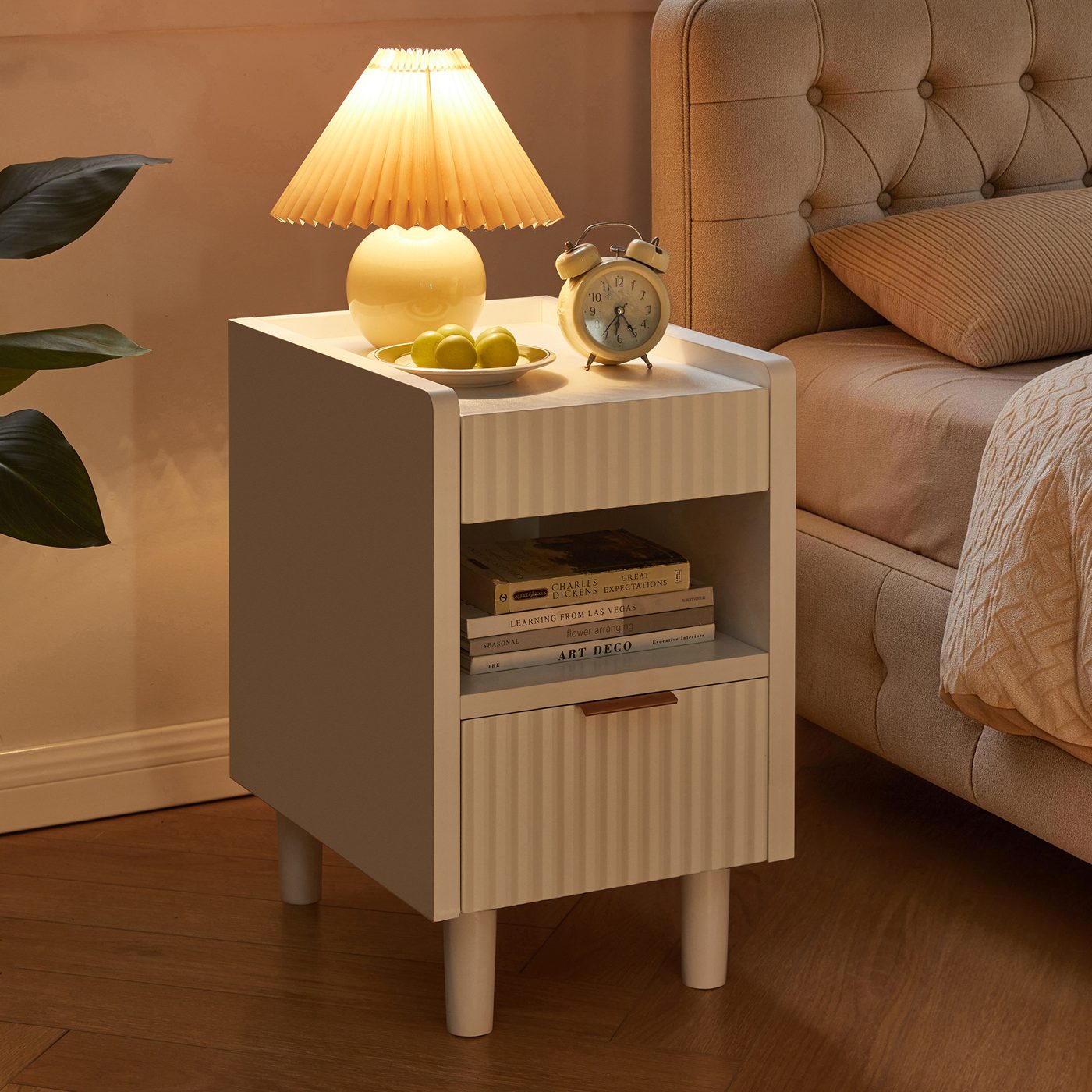
That is the trade in one sentence: a flatter film hides reflections and records handling instead. A coffee table or dining top — the surfaces in our tables that take keys, plates and coasters — is where a matte finish is least forgiving. On a side table holding a lamp it has far less to survive. On a painted piece there is no grain to share the load: a white top is the sheen and nothing else, which makes the painted nightstands and storage pieces the hardest place to live with a finish you do not like.
There is an escape hatch, with a catch. General Finishes’ answer to “the sheen is too shiny” is that a second coat in another sheen “will replace the appearance of the first.” True, and also a spray job, not a brush in a living room. Wiping a water-based film without adding to the marks is its own set of rules.

How to read sheen from a photograph
Since the number is missing, the photo is the evidence. It can be read.
- Find the brightest light in the frame. A hard-edged shape — the outline of a window or a lamp shade — means a higher sheen. A soft blur with no edge means a lower one.
- Compare two shots of the same piece. Direct light shows sheen; bounced light hides it. One photo only tells you what that angle caught.
- Studio white-background shots are the worst evidence there is: the light is even, so matte and gloss photograph almost the same. Ask instead for a photo at eye level with a window behind the camera.
The question to ask before you order
Ask for the sheen by name and the reading behind it: “What sheen is it — and do you have the gloss number at 60 degrees?”
A seller who can answer has a finish spec sheet. A seller who cannot is guessing, and so are you. A range — 25 to 35, say — is still a hundred times more useful than the word alone.
For a piece that will sit under a lamp and hold a drink, satin is the safe middle in both sheets above. For a hall table you only look at, flat looks better and has less to lose. What you should not do is buy on the word, then find out in your own light.
Sources
- ASTM International — Standard Test Method for Specular Gloss, D523-14(2018), scope 1.1 and significance 5.1, 5.1.1, 5.3 — store.astm.org/d0523-14r18.html — accessed 2026-11-24
- General Finishes — High Performance Water-Based Topcoat, sheen range (Dead Flat under 5, Flat 10 or less, Satin 25–35, Semi-Gloss 50–60, Gloss 80+) — generalfinishes.com — accessed 2026-11-24
- General Finishes — What is the difference between Flat Out Flat and High Performance Topcoats? — generalfinishes.com/faq — accessed 2026-11-24
- General Finishes — Can I Change the Sheen of the Topcoat? — generalfinishes.com/faq — accessed 2026-11-24
- Miller Paint — Product Guide 2024, Evolution Interior sheen table (Matte 0–5 @ 60°, Soft Sheen 0–10 @ 60°, Satin 10–20 @ 60°, Semigloss 35–55 @ 60°) — millerpaint.com product guide (PDF) — accessed 2026-11-24
- runvaus.com product pages, finish wording counted across 36 published products — checked via REST API on 2026-11-24