

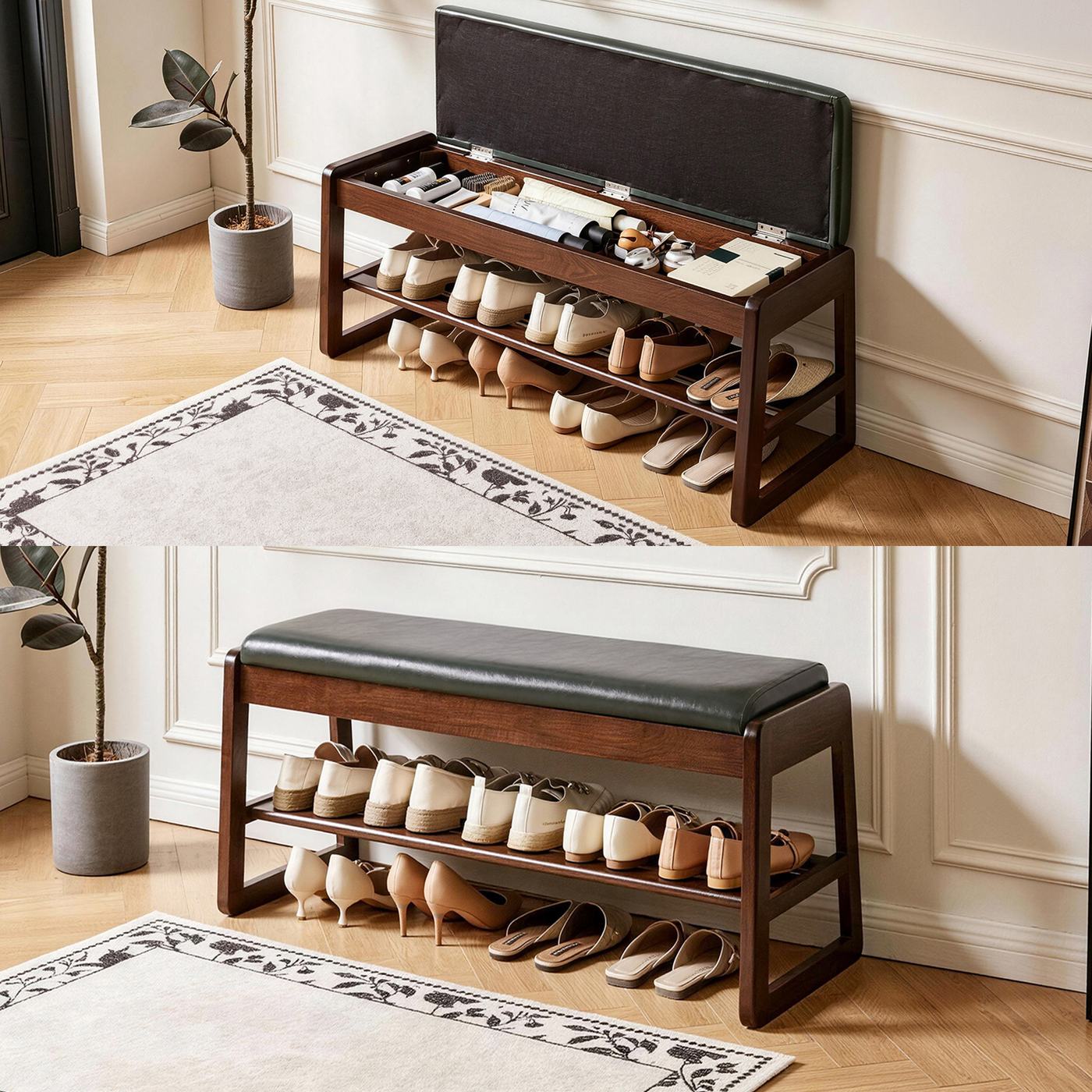
A 39.4-inch lift-top bench, 19.8 pounds, solid rubberwood frame, foam seat under a green cover. Move it two feet inside a front door and it becomes the only piece of wood furniture in the house that meets slush, rain and a wet boot every single day.
That’s the case rubberwood is rarely judged on. Most write-ups ask whether it’s good for a dining table. The answer changes a little when the furniture’s job is to sit next to the weather.
What “solid rubberwood” means on a listing
Rubberwood comes from Hevea brasiliensis, the tree that gives you latex. It’s felled when tapping stops paying — typically after about thirty years — and milled into furniture stock, which is why it’s cheap for a hardwood (Wood Database). Two numbers travel with it: Janka hardness 960 lbf and an average dried weight of 37 lb/ft³. Real wood, not a board product: it takes stain, holds screws, and dents before denser species do.
The naming is where listings get slippery. The same timber sells as parawood, hevea, and “Malaysian oak” — a marketing name for a wood that isn’t in the oak genus at all (Wood Database). If the grain you picture when you read “oak” is the open, porous figure of red oak, the Solid Oak Dining Chairs, Set of 2 are that species, and a fair reference for how far apart the two look.
Then read the material line word by word. “Solid rubberwood” means solid lumber, usually glued up from narrower strips — normal, and strong. “Rubberwood solids” is the weaker phrase: frame or legs solid, panels possibly veneer over MDF. Our listing says *solid rubberwood frame*, which covers the frame and doesn’t claim more than that.
The one thing rubberwood is genuinely bad at
Water. Not hallway humidity or a spill you blot up — standing moisture, repeatedly, in the same spot.
Wood Database is blunt about it: rubberwood “is perishable, and has very little natural resistance to decay,” and it’s susceptible to fungal staining. It also warps and twists while drying, though it’s “fairly stable in service once seasoned.” Together those describe a bench that sits straight for years in a dry house, and one that stains and swells at the joints if it’s asked to hold wet footwear.
That matters more than usual here, because this bench has a closed box under the seat. A soaked boot put in there at 7 a.m. sits in still, damp air all day; the moisture has nowhere to go, so it goes into the wood and back into the shoe.
The practical split, then:
- Open shelves — the pair you’re wearing today, the ones that came in wet. Air on several sides, dry by evening.
- Under the lid — dry things: laces, gloves, an umbrella, tomorrow’s shoes. Not today’s rain boots.
- The box itself — wipe it out now and then. It’s the one surface nobody ever looks at.
If your routine is wet boots four months a year, that’s not a reason to skip rubberwood. It’s a reason not to treat the storage compartment as a drying cabinet.
The 39-inch lid has three hinges, not two
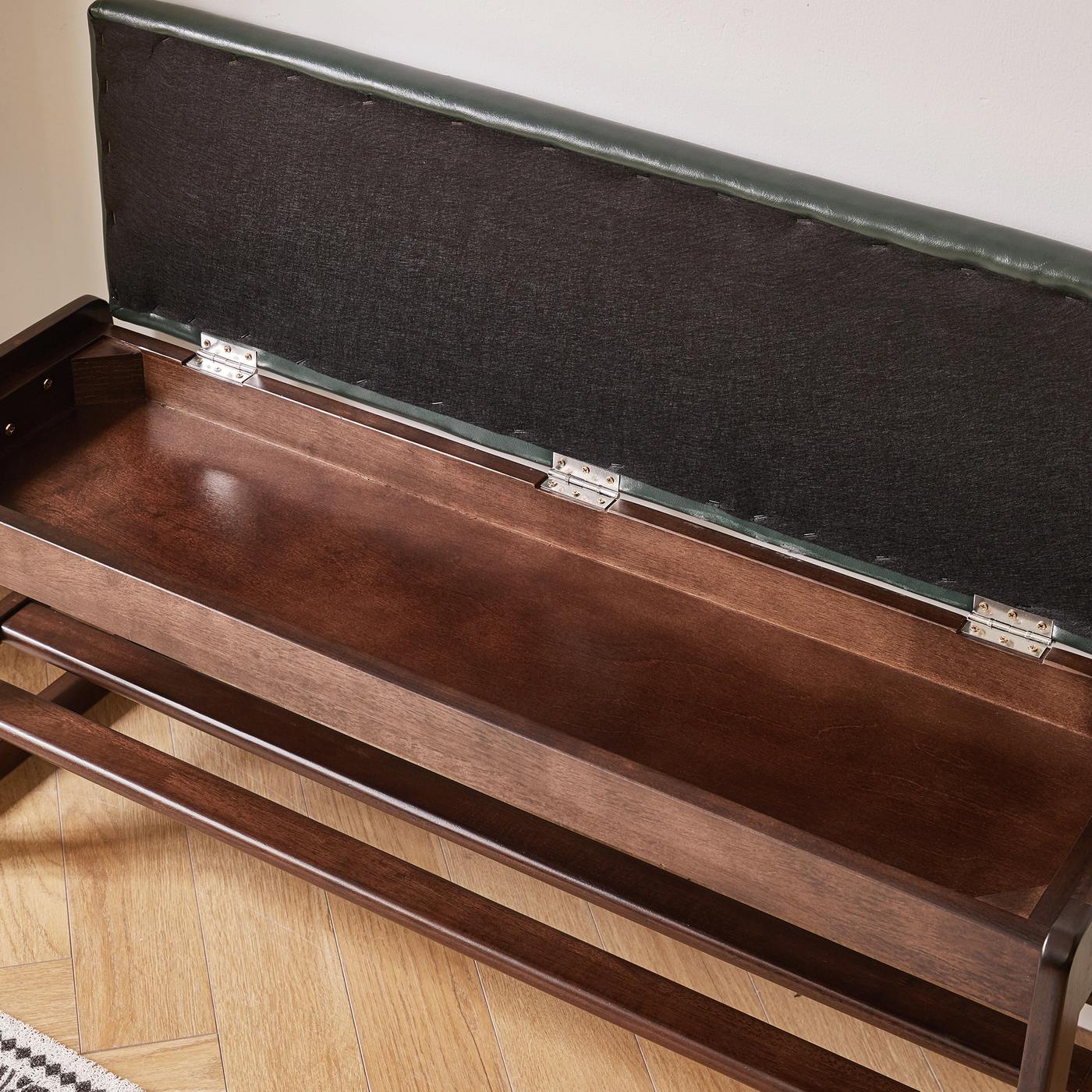
This is the detail that separates a long bench from a longer version of a short bench. The supplier’s assembly sheet gives the rule directly: at the 1.0 m length the lid gets three hinges; at 0.8 m or less, two. 39.4 inches is a metre, so this one is built with three. The 31.5-inch lift-top is the two-hinge build — same bench, shorter span.
The same parts list also answers a question buyers ask and listings usually skip: nothing in the hardware holds the lid open. No gas strut, no stay — hinges, bolts and washers. You hold the lid with one hand while you reach in with the other.
Assembly: tighten to 60%, then tighten everything
The sheet is unusually specific for flat-pack furniture, and the order is the point. Side panels bolt to the seat box first and are snugged to 60% — not fully. The lower shelf goes in afterwards, located by eight Ø8×30 mm dowels before four M7×48 screws pull it tight against the side rails. Only then does everything get its final tightening. That sequence is what keeps a bench square: the dowels set the shelf position, the bolts clamp, and nothing fights anything while the parts are still loose.
What’s in the box: a 4 mm hex key, six M6×30 bolts with washers, the dowels, the shelf screws, and four 30×15×2 mm pads. At 19.8 lb assembled, it’s a one-person job on a blanket on the floor.
Then do one thing most people skip: check the bolts after the first month, and again when the season changes. Furniture-care guidance puts it plainly — regularly tighten bolts to keep a piece stable — and a bench someone sits on while wrestling a boot off takes more sideways load than a side table ever will.
The wood and the seat need different cloths
Two materials, two routines, and using the wrong one is what usually leaves the mark.
*The frame.* Damp cloth, mild soap only if something is actually dirty, then blot dry. Care guidance for wood finishes is direct about the rest: “please no chemicals (i.e. Windex) or polish; for cleaning, simply use a damp cloth only followed by a dry soft cloth” (Oskar Huber). Blot spills rather than wiping them around — a wet ring in a topcoat is a permanent mark.
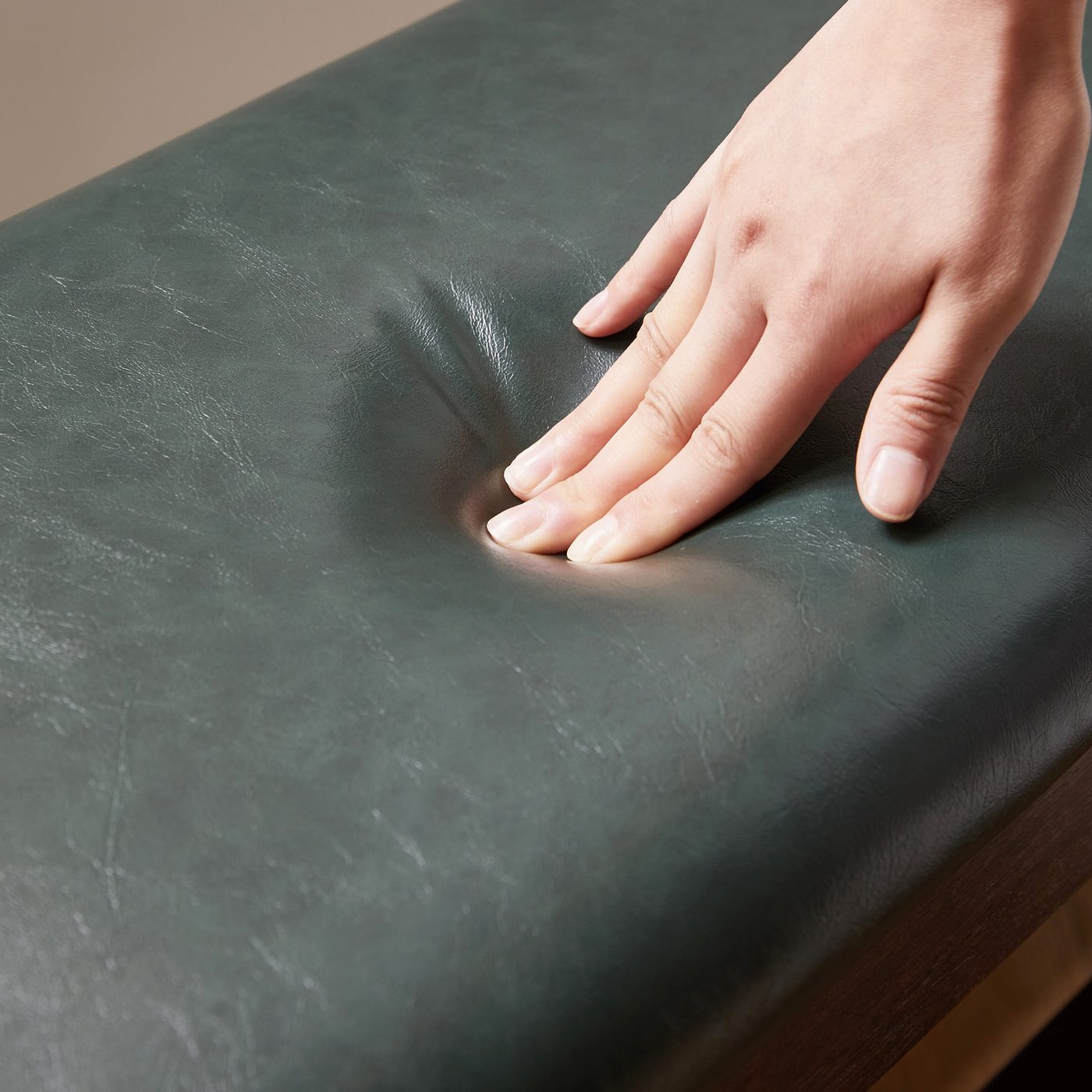
*The seat cover.* Foam under a wipe-clean cover — the supplier calls it vegan leather, the listing says seat cover. Note that on this bench the green is the cover, not the wood: the frame is stained brown, since rubberwood itself is pale. Water on a lint-free cloth takes off everyday dirt and body oils; a little non-alkaline, non-detergent soap for anything stubborn; no bleach and no general household spray cleaners, which can attack the surface (Furniture Choice).
The same guide names the real hazard for a bench by a door, and it isn’t cleaning at all: sharp objects. Buckles, heels, studs, keys in your hand as you sit down. That’s what scratches a seat cover.
So is rubberwood good for an entryway bench?
For this use, yes — with the moisture caveat, not in spite of it. At 39.4 × 11.8 × 16.9 in and 19.8 lb, it’s a bench you can sit on to take a shoe off in a footprint narrow enough for a hallway, and the wood is stable once it’s dry and indoors. What fails at a front door is rarely the species; it’s the water arriving with you.
The version of this bench that works is the one where the wet pair goes on the open shelves and the box stays for dry things. If your entryway is somewhere to sit for ten seconds and not where boots live, none of this is your problem.
Sources
- The Wood Database — Rubberwood — https://www.wood-database.com/rubberwood/ — accessed 2026-11-06
- Oskar Huber Furniture & Design — Wood Furniture Care — https://www.oskarhuber.com/img/Wood-Furniture-Care-1.pdf — accessed 2026-11-06
- Furniture Choice Help Centre — Faux leather — https://help.furniturechoice.co.uk/hc/en-gb/articles/5762566423313-Faux-leather — accessed 2026-11-06