
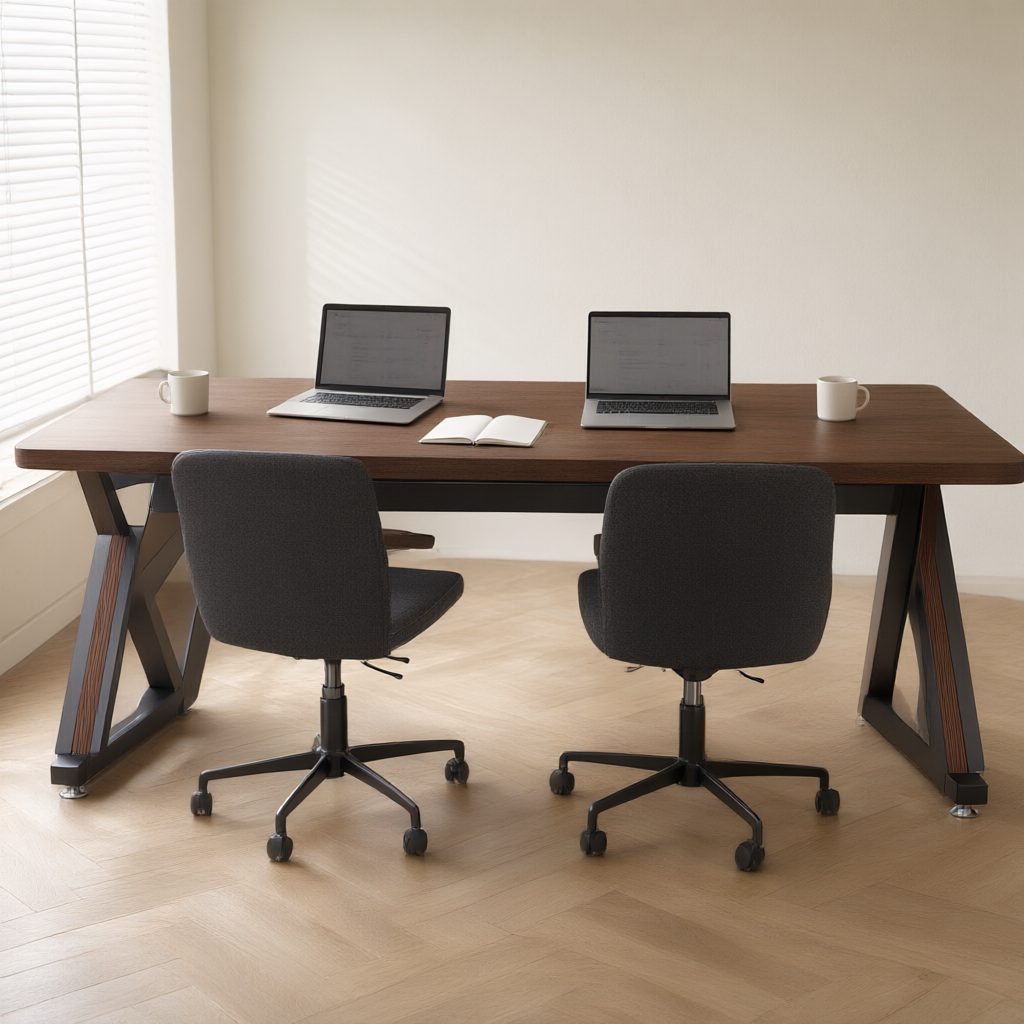
Two chairs under a 55.1-inch top leave 27.5 inches for each person. That is one laptop, one notebook, and a mouse you keep close to your own half. It is not two workstations, and no arrangement of the room changes the division.
The same desk comes in a 63-inch length, and both are 23.6 inches deep. The extra 7.9 inches is 3.95 inches per person. Whether that is worth giving up 7.9 inches of wall depends on one question: what does each of you actually put on the surface?
What the published numbers say each person needs
Three sources, three different floors, and they are not measuring the same thing.
| Source | Width per person | What the number assumes |
|---|---|---|
| UBC ergonomics guidelines (checklist table) | ≥36 in minimum, ≥60 in preferred | One full computer workstation |
| ergodeskspecs, two-person desk guide | about 35 in (90 cm) | A 27-inch monitor, full keyboard, mouse sweep, elbow room |
| Versa Desk, size guide | 30–36 in; “Below 30″ each, elbows start to touch” | Laptop to one small monitor per person |
Put the two desks against those lines:
| Desk | Total width | Per person | Against the floors above |
|---|---|---|---|
| Solid Wood Double Desk, 55 in | 55.1 in | 27.5 in | Under all three |
| Solid Wood Double Desk, 63 in | 63.0 in | 31.5 in | Clears Versa Desk’s 30-inch floor, not the other two |
They disagree because they are pricing different things. UBC’s 60 inches is a workstation with a screen, keyboard and papers laid out. Versa Desk’s 30 inches understands the same desk as a seat with a laptop. Neither is wrong, and that is why “is 55 enough for two” has no single answer.
What all three share is the 30-inch elbow line. A 55.1-inch top sits 2.5 inches under it, per person.
What 27.5 inches holds
Versa Desk’s own screen table gives the useful widths: a 24-inch monitor spans about 21–22 inches, a 27-inch about 24 inches.
- A 27-inch screen is 24 of your 27.5 inches. That leaves 3.5 inches for a mouse and nothing for a notebook, so one of you types with the mouse against the edge.
- A 24-inch screen leaves 5.5 to 6.5 inches. Enough for the mouse, not for paper beside the keyboard.
- Two screens each is out. Versa Desk puts two 27-inch screens at 48–49 inches per person. Neither desk on this page is in that conversation.
At 31.5 inches each, a 27-inch screen leaves 7.5 inches — a mouse and a notebook, the smallest setup that needs no negotiation. That is the whole practical difference between the two lengths.
The page claim worth testing
The 55-inch listing says two people “can sit at it without touching elbows, which is the whole point of this one.” That holds at rest. Two people seated square, arms down, have clearance on a 55.1-inch top. It stops holding the moment both of you are moving a mouse across the middle, because the middle is exactly where the two halves meet. Elbow clearance and working clearance are two different measurements, and only the first one is being promised.
Depth is the number buyers skip
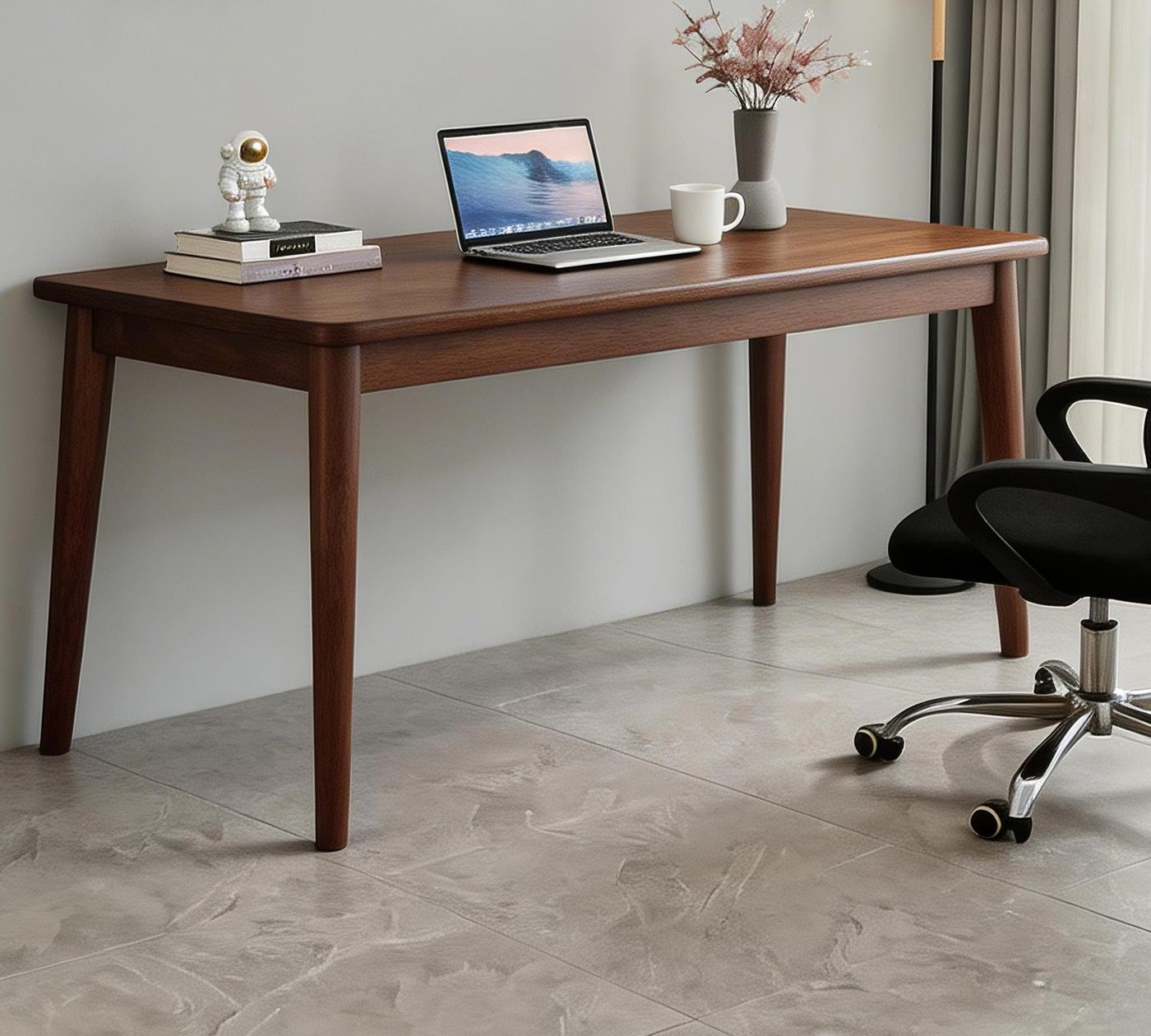
Both double desks are 23.6 inches deep. UBC’s checklist asks for at least 23.5 inches of depth under the desk for leg clearance — the double clears it by a tenth of an inch. That is not a coincidence; 23.6 inches is 60 centimeters, the depth most office furniture is built to.
The 55-inch mid-century desk is 19.7 inches deep. That is 3.8 inches short of the UBC line, and it matters more than it sounds once a screen is on the desk: a monitor on its stand takes 9–11 inches of depth before the keyboard arrives, per Versa Desk. On a 19.7-inch top the screen ends up near the front edge. On a 23.6-inch top it can sit back where it belongs.
For one person with a laptop, 19.7 inches is fine — that is what the mid-century desks were drawn for. For two people sharing a surface, take the extra depth.
Wall, floor, and the space behind the chairs
| Double 55 | Double 63 | One 55 + one 63 mid-century | |
|---|---|---|---|
| Wall length needed | 55.1 in | 63.0 in | 55.1 + 63.0 = 118.1 in |
| Depth into the room | 23.6 in | 23.6 in | 19.7 in |
| Clearance behind chairs | 36–48 in | 36–48 in | 36–48 in |
| Assembled weight | 66 lb | 70 lb | 30 lb + 33 lb |
Versa Desk asks for 36 inches behind a single chair and 36–48 for two, so both chairs pull out without one person trapped. Added to the 23.6-inch depth, that means roughly 60 to 72 inches from the wall to the back of the chairs.
The wall number gets misread the other way. A 63-inch desk needs 63 inches of wall, and the chairs sit along that 63-inch edge, not at the ends. If your wall gives you 60, the 55.1 fits and the 63 does not.
One top or two desks
Two 55-inch mid-century desks side by side give 110.2 inches of surface, 19.7 inches deep, for 60 pounds of furniture instead of 66 — more width, if the room can take 110 inches of wall. Most rooms cannot, which is why the double exists.
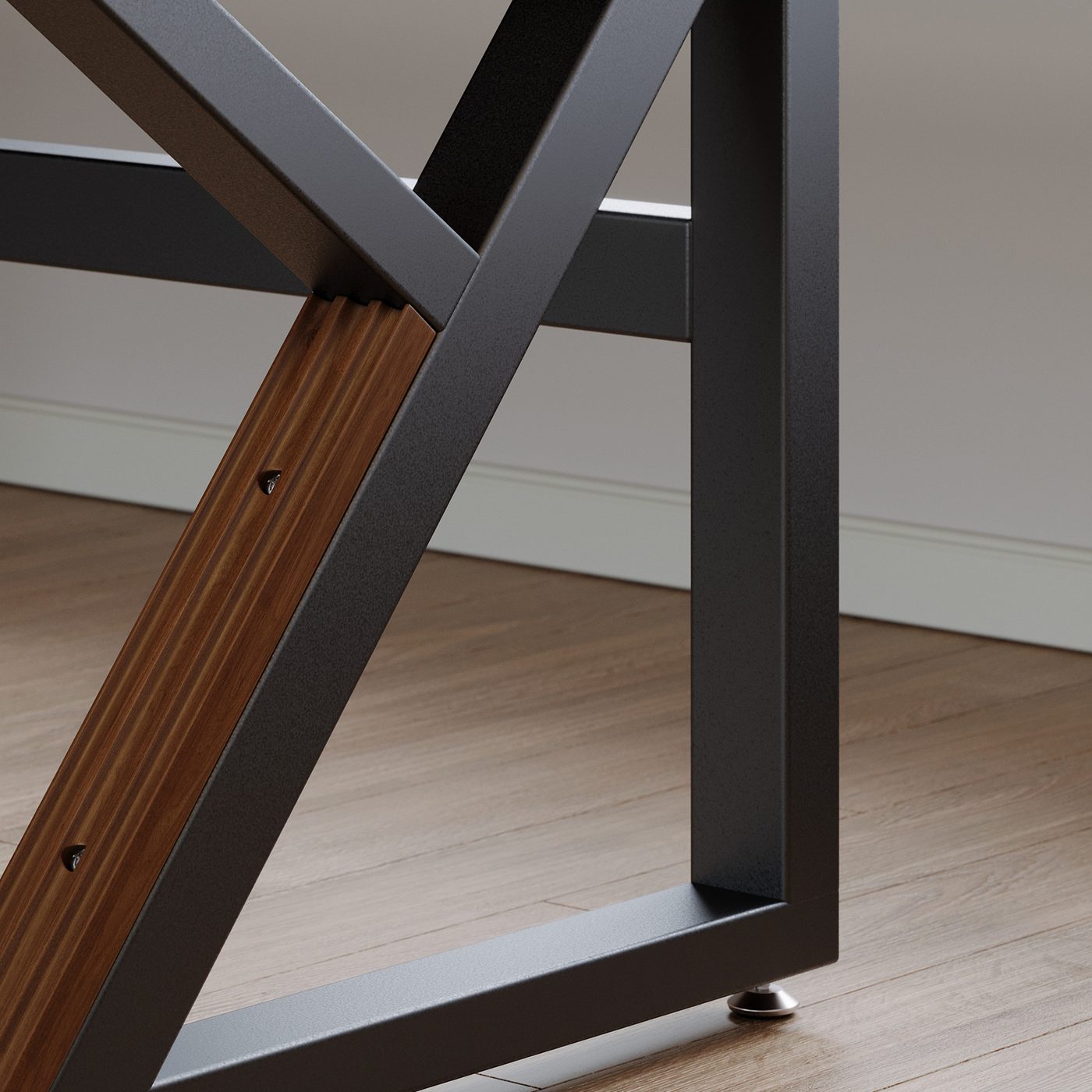
The single top has one structural advantage: both leg frames are at the ends and nothing sits in the middle, so the knee space runs the full span and neither person straddles a support. The 63-inch mid-century desk is also 33 pounds and movable by one person, where the 70-pound double is a two-person lift.
What it does not give you is two heights. One top, one surface, no divider: if one of you is 5’2″ and the other 6’2″, the fixed 29.5-inch height suits one of you and the chair does the rest. Every desk on this page is fixed height.
What the listing will not tell you
No weight capacity is published on either page, so do not assume it will carry a printer, a tower and two monitors. No cable tray is listed either, and there is no per-person specification — 27.5 and 31.5 inches are arithmetic from the overall width, not a manufacturer figure.
The Tables category has the rest of the desk lengths if 55.1 and 63 both miss: the small writing desk is 39.4 inches, which is one seat and a printer, not two seats.
The decision
If both of you sit here on a working day with a screen each, 55.1 inches is the wrong number. Buy 63, or buy two desks and put them against different walls.
If one of you is there two evenings a week with a laptop while the other keeps a notebook and a coffee, 55.1 is enough — and the 7.9 inches you save is wall for a bookcase.
Measure the wall first. The desk cannot be widened later, and 3.95 inches per person is all the extra 7.9 inches buys.
—
Sources
- UBC — *Ergonomics Guidelines for Computer Workstations* (checklist table: desk width preferred ≥60 in, minimum ≥36 in; depth under desk ≥23.5 in for leg clearance) — https://hr.ubc.ca/sites/default/files/documents/Office%20ergo%20design%20guidelines%20and%20checklist.pdf — accessed 2026-11-14
- ergodeskspecs — *Two-Person Desk Setup: The Complete Shared Workstation Guide* (about 35 in / 90 cm per person; 71 in practical minimum; “below about 63 inches total, somebody is working in a compromise they will feel by Thursday”) — https://ergodeskspecs.com/two-person-desk-setup-guide/ — accessed 2026-11-14
- Versa Desk — *How Long Should a Desk Be for 2 People?* (30–36 in per person; 36–48 in clearance behind two chairs; 9–11 in of depth for a monitor on its stand; “Is a 55–60 inch desk big enough for two? It works in a tight room, at about 27–30″ each, but only for laptops or one small monitor each”) — https://versadesk.com/blogs/news/how-long-should-a-desk-be-for-2-people — accessed 2026-11-14