

11.4 inches deep, 16.5 inches high. Two numbers, and they answer two different questions: whether your shoes fit on it, and whether you can sit on it.
The listing leads with 31.5 inches because length photographs well. Length decides how many people can sit at once. Depth and height decide whether the thing works at all.
Depth is a shoe measurement, not a bench measurement
Most shoppers compare the bench depth to their hallway. That’s half the job. The other half is comparing it to the longest shoe in the house.
A bench that’s too deep for the hallway is a walkway problem, and the walkway math is worth doing separately. This bench is 11.4 inches and it still leaves a normal corridor usable, which is the whole reason it exists.
But an 11.4-inch shelf is a tight shelf. Ashdeco, a retailer that publishes its own measurement table, gives shoe lengths by size: women’s 7 at 9.6 inches, women’s 9 at 10.2, men’s 9 at 10.8, men’s 11 at 11.7, men’s 13 at 12.4. Those are their workshop’s reference figures, not an industry standard, and your shoes may differ.
Take them at face value and the fit is easy to see. Up to a men’s 9, shoes sit inside 11.4 inches with about half an inch spare. A men’s 11 sticks out a third of an inch. A men’s 13 sticks out an inch.
One more thing the listing won’t tell you: 11.4 is the outside depth of the frame. The shelves sit inside it, so treat 11.4 as the maximum, not the guaranteed usable shelf.
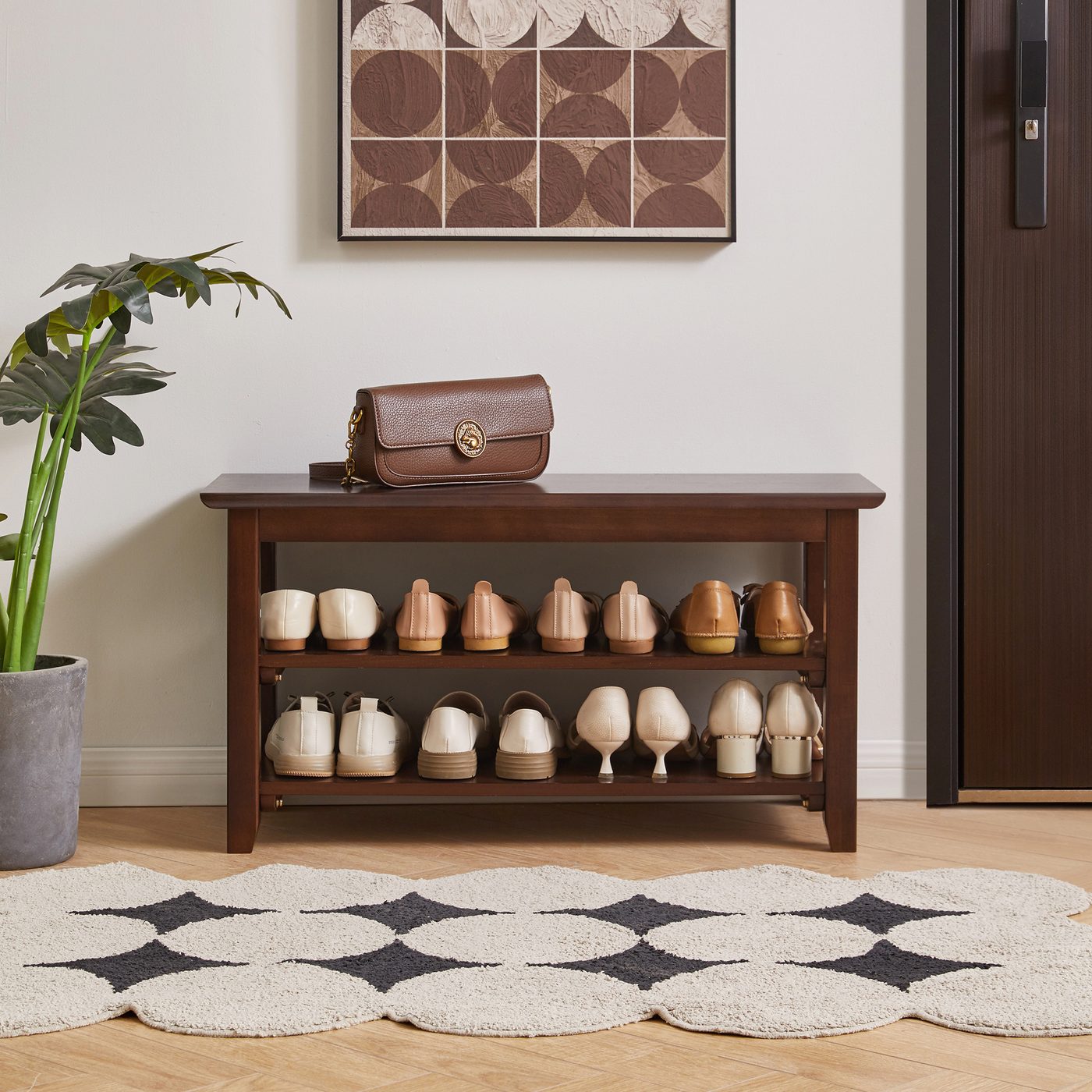
What overhang actually costs
A third of an inch is invisible. An inch is not. In a narrow hall, an inch of heel at shin height in the dark is the thing you catch your ankle on.
There’s no clever fix. Turning the shoes toe-in doesn’t buy depth, it just moves the overhang from the heel to the toe. Storing pairs heel-to-toe, which is how shoe racks fit more pairs, needs more depth than storing them side by side, not less.
If the household runs on women’s sizes and kids’ sneakers, none of this applies. The 11.4-inch shelf has room to spare and you can put a boot in the second row.
Why the advice you’ll read says 12 to 14 inches
Search this and you get a range, then a contradiction.
Ashdeco calls 14 inches the sweet spot for men’s size 12. ShoesFeast recommends at least 12 to 14 inches and notes that most ready-made shelves sit at 10 to 12, which is why so many people end up with toes hanging over the edge. Entryway Storage splits it by shoe type: 12 to 14 inches for sneakers and low shoes, 16 to 18 for men’s 12 and up and for winter boots.
The numbers disagree because two different measurements are being mixed in one conversation. Shelf depth is set by your longest shoe. Seat depth is set by how you sit. A bench you sit back on wants 15 or 16 inches of seat; a bench you perch on for ten seconds doesn’t. A single “ideal depth” can’t be both.
So the question worth asking isn’t how deep a shoe bench should be. It’s how long your longest shoe is, and whether you plan to sit down or lean.
The 16.5-inch seat height
The 2010 ADA Standards put the top of a bench seat surface at 17 inches minimum and 19 inches maximum above the floor, in section 903.5. That standard covers benches in dressing rooms, holding cells, saunas and similar spaces, so it is not a rule for a bench in your hallway. It is still the number accessibility designers use when they want a bench an adult can sit on and stand up from.
This bench’s top surface is 16.5 inches. Half an inch under the bottom of that range.
What that feels like: your knees sit a little high and your thighs get no support at the back. For pulling on boots it’s fine, and most people won’t notice. For sitting down to take a call, or for anyone with knee trouble, it’s the wrong piece of furniture, and no cushion fixes half an inch of frame.
What two open tiers change
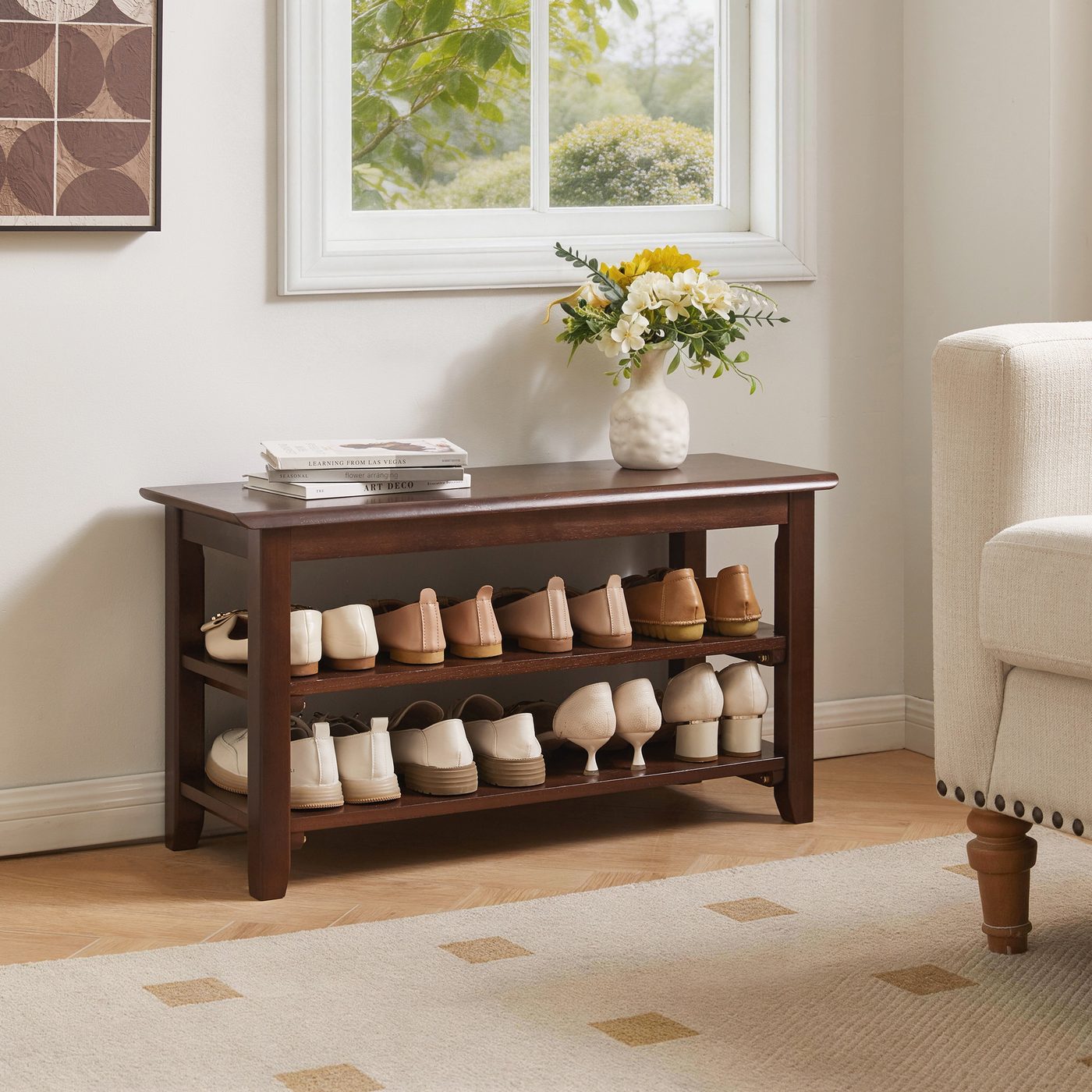
This one has a flat top and two open shelves. No lid, no compartment. Everything is visible from the doorway.
That’s the honest trade. Visible storage means you can find the one pair you want without lifting a seat. It also means a mess has nowhere to hide. If the appeal of a storage bench is closing the lid on the shoes, this isn’t that bench.
The top surface is a shelf too, in practice. Bag, keys, the mail. Which is exactly when you can’t sit on it. A bench with storage under the seat lets you do both at once; this one asks you to choose.
Who it fits
Households in women’s and kids’ sizes, a hall where 11.4 inches is all the depth you can spare, and anyone who wants to see every pair at a glance. In a 31.5-inch length it seats one adult with room, two shoulder to shoulder.
Households with a men’s 12 or 13, anyone storing boots, and anyone who wants to sit properly should look at the 31.5-inch lift-top bench instead. It’s 11.8 inches deep and 16.9 high, so it’s still shallow for big shoes, but the storage closes and the seat is the full top.
If the depth question is the one keeping you up, the walkway math for a narrow entry is worth five minutes before you order either one. The two-tier bench itself is 31.5 × 11.4 × 16.5 inches in solid rubberwood, and it ships from the US warehouse.
Measure two things before you order
Your longest shoe, heel to toe, with a ruler against the shoe rather than your bare foot. Foot length and shoe length are not the same number, and the gap is what decides a 0.3-inch overhang.
Then the depth you actually have, measured from the face of the baseboard rather than the wall. Baseboards hold furniture off the wall, and that gap comes out of your hallway, not the bench.
Sources
- U.S. Access Board — 2010 ADA Standards for Accessible Design, §903.5 Height — https://www.access-board.gov/ada/ — accessed 2026-11-05
- Ashdeco (retailer, competitor) — “Shoe Bench Dimensions: Will It Fit Your Entryway? Every Size Guide” — https://ashdeco.com/blogs/buying-guides/shoe-bench-dimensions-guide — accessed 2026-11-05
- ShoesFeast (blog, competitor) — “How Deep Do Shoe Shelves Need to Be? My Mistakes” — https://shoesfeast.com/how-deep-do-shoe-shelves-need-to-be/ — accessed 2026-11-05