
A standard hardcover is about 9½ inches tall. On one of our two-tier side tables the gap above the lower shelf is 14.8 inches. On another it is 7.9. Both tables are 23.6 inches tall, both are solid rubberwood, and both pages say the same thing about the shelf below the top: it “holds magazines or a basket.”
That sentence is doing more work than it can carry. A 14.8-inch gap and a 7.9-inch gap are not the same shelf, and the difference decides whether your magazines lie flat, stand up, or hang over the edge. All three two-tier tables we sell are 23.6 inches high, so the height tells you nothing about what the shelf will hold. The number that matters is the one almost no listing prints: the space between the shelf surface and the underside of the top.
Headroom, not overall height
Headroom is measured from the top face of the lower shelf straight up to the first thing in the way — usually the apron under the tabletop, sometimes a leg stretcher. It is not the distance between the two shelf surfaces on a drawing, and it is definitely not the height of the table.
The practical reason to care: the standard advice for shelving is 8 to 12 inches of spacing for books, and Better Homes & Gardens puts ordinary books at about 9½ inches tall by 7 inches wide, with art books reaching 15 by 11. Height-based shopping skips that entirely.
Three tables, three different shelves
All three of these are 23.6 inches tall. The shelves are not interchangeable.
| Square Two-Tier End Table | Round Two-Tier Side Table | Two-Tier Solid Wood Side Table | |
|---|---|---|---|
| Top | 19.7 × 19.7 in | 18.9 in diameter | 16.5 in diameter |
| Lower shelf | 19.7 × 19.7 in | 14.6 in diameter | 9.8 in diameter |
| Headroom above shelf | 14.8 in | 9.65 in | 7.87 in |
| Shelf surface off the floor | 7.3 in | 12.6 in | 12.6 in |
| What the shelf takes | hardcovers standing, magazines standing, a 12-inch basket | magazines flat only, paperbacks standing | paperbacks flat, nothing much else |
Where those numbers come from
Each product’s photo gallery ends with a line drawing that carries both centimetres and inches: 50 cm / 19.68 in for the square top, 60 cm / 23.62 in for the height, 37 cm / 14.57 in for the round shelf’s diameter, 25 cm / 9.84 in for the small one.
The two round tables label the headroom outright — 24.5 cm / 9.65 in on the 18.9-inch version, 20 cm / 7.87 in on the 16.5-inch. The square table’s drawing labels the parts instead: a 4 cm / 1.57 in band under the top, a 4 cm / 1.57 in shelf, and 14.5 cm / 5.7 in of floor clearance under the shelf. Subtract those from 60 cm and 37.5 cm (14.8 in) is left between shelf and apron. That last figure is arithmetic on the drawing, not a printed label, and it is the one number here I would confirm with a tape measure after assembly.
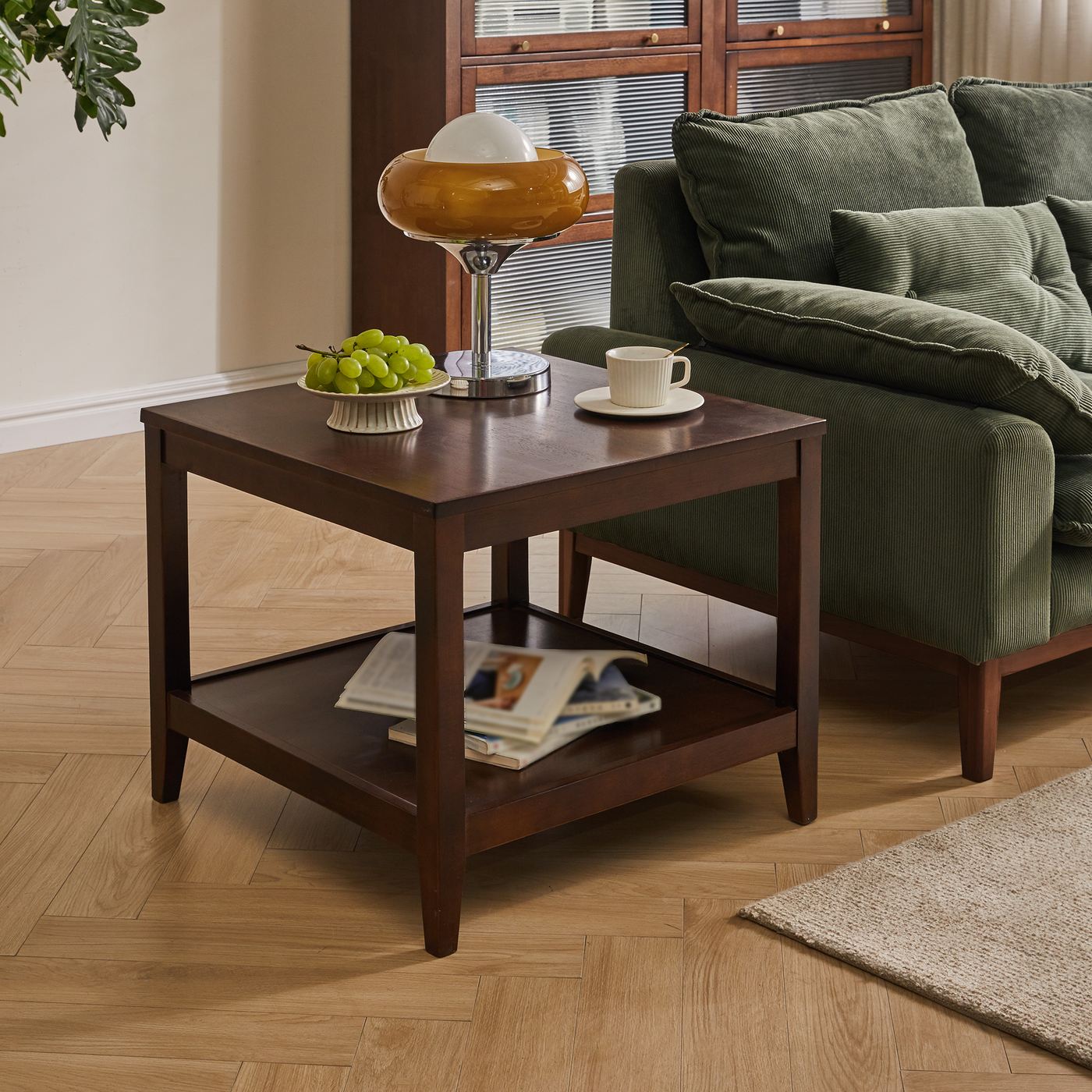
14.8 inches: books stand up
The square two-tier end table is the one that behaves like a small bookcase. A 9½-inch hardcover stands with five inches over its spine, which is more clearance than the 8-to-12-inch spacing guidance assumes. A magazine at 10.875 inches stands too. A 12-inch-tall basket goes in with 2.8 inches to lift it out over the rim, as long as it is no wider than the 19.7-inch shelf.
What does not fit: the 15-inch art books. Standing, they need about 16 inches and there are 14.8. They will sit flat on a 19.7-inch square, but they will not stand.
The shelf is a full square panel, so the usable area is the whole 19.7 inches. The trade-off is the 7.3-inch height off the floor, covered below.
9.65 inches: magazines lie down
On the 18.9-inch round table, the shelf clears 9.65 inches. A magazine trimmed at 8.875 × 10.875 inches — the trim size The New York Times Magazine publishes for its own pages — is 10.875 inches tall. It does not stand. Lying flat, it fits only because the diagonal helps: 14.04 inches across for the magazine against a 14.57-inch shelf, half an inch of slack in each direction, and no room to stack a second one squarely on top.
Paperbacks are the better use. A 5 × 8 book stands at 8 inches with 1.65 inches to spare. A 6 × 9 hardcover stands at 9 inches, clearing by 0.65. Anything taller lies flat.
This is also the table where the shelf is easiest to reach: 12.6 inches off the floor, roughly seat height on a low sofa or the top of a mattress.
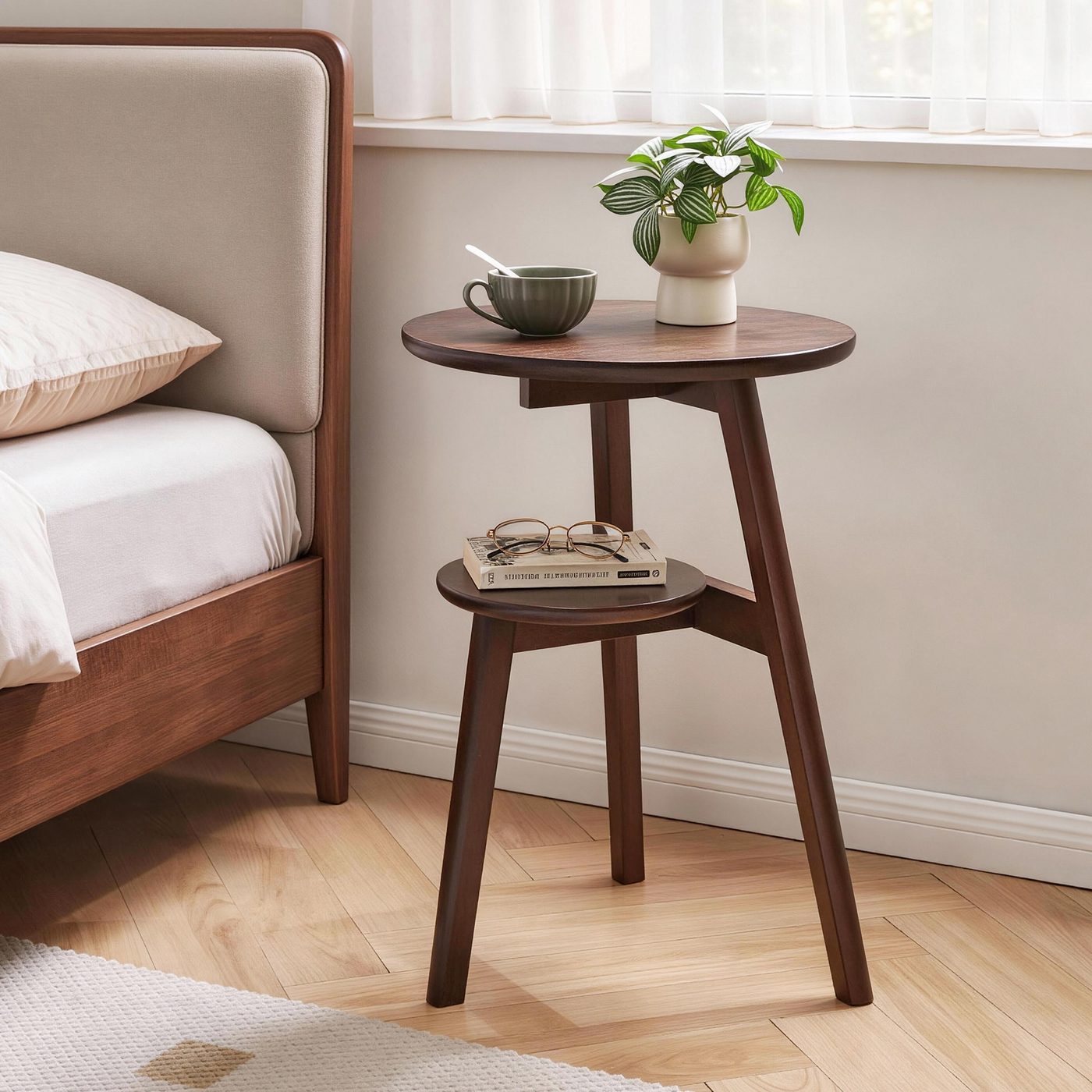
7.87 inches: paperbacks, flat
The 16.5-inch tripod table gives 7.87 inches over a 9.8-inch round shelf, and that combination is tighter than the product photos suggest. Lying flat, an 8.375 × 10.875 magazine needs 13.7 inches corner to corner and will not fit at all. A 6 × 9 hardcover needs 10.8 diagonal inches, so it overhangs by about half an inch on each side. A 5 × 8 paperback needs 9.43 and just clears.
Standing, only books under about 7.8 inches work. In practice this tier takes a paperback, reading glasses, a remote, a small tray — the things you put down rather than store.
The second number: how far the shelf sits off the floor
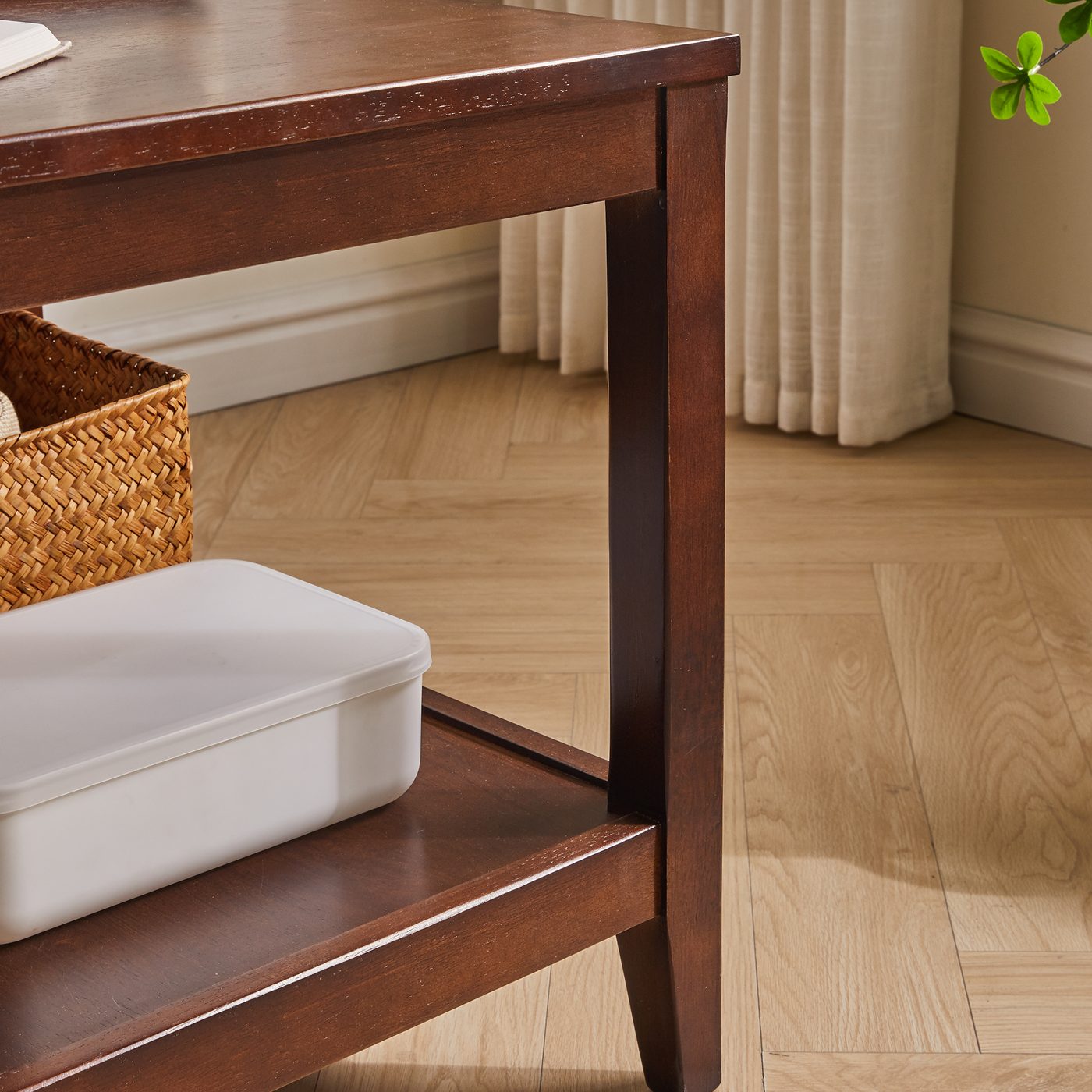
The square table’s shelf tops out at 7.3 inches above the floor, with only 5.7 inches of gap underneath. That gap is the reason the table looks airy in photos and the reason the shelf is awkward in use: nothing slides under it, dust gathers in a 5.7-inch slot you cannot see, and anything on the shelf requires a full bend from standing height. Better Homes & Gardens makes the same point about built-ins — shelves holding frequently used items should not sit too low to reach.
The two round tables put their shelves at 12.6 inches, which is low enough to tuck beside a sofa arm and high enough to reach without kneeling. If the lower tier is going to hold the TV remote and the current book rather than a basket of off-season gloves, that 5.3-inch difference matters more than anything else in this article.
Checking any two-tier table in a minute
- Open the last photo in the listing. If there is a line drawing, look for the gap between shelf and top, not the overall height. If the drawing only gives parts, subtract: total height minus the top band minus the shelf thickness minus floor clearance.
- Measure your tallest item and add an inch. That is the headroom you need; the 8-to-12-inch rule of thumb assumes 9½-inch books, not your art books.
- Check the shelf’s own footprint, not the tabletop’s. A round shelf loses the corners: a rectangular object needs its diagonal to fit, not its width. A 14.57-inch shelf takes a 13.7-inch diagonal, and no more.
- Decide whether the shelf is storage or a landing spot. Under 8 inches of headroom, it is a landing spot.
None of these tables publishes a shelf load rating, so keep the lower tier to books, baskets and the things that live near a sofa. If you need the numbers for a specific piece, the drawings in each gallery are the only place they exist.
Sources
- Better Homes & Gardens, How to Determine Bookshelf Dimensions for Maximum Functionality — standard books about 9½ in tall and 7 in wide, art books up to 15 × 11 in; standard shelf spacing 8–12 in; frequently used items should not sit too low. https://www.bhg.com/home-improvement/remodeling/built-ins/design-standards-for-shelves-and-bookcases/ (accessed 2026-11-12)
- The New York Times Advertising, The New York Times Magazine — Print Specifications — magazine trim size 8.875 × 10.875 in. https://advertising.nytimes.com/formats/nyt-magazine-specifications/ (accessed 2026-11-12)
- Manufacturer dimension drawings in the product galleries: Square Two-Tier End Table (50 cm / 19.68 in top, 60 cm / 23.62 in high, 4 cm top band, 4 cm shelf, 14.5 cm floor clearance); Round Two-Tier Side Table (48 cm top, 37 cm shelf, 24.5 cm headroom, 32 cm shelf height); Two-Tier Solid Wood Side Table (42 cm top, 25 cm shelf, 20 cm headroom, 32 cm shelf height).
- Diagonal and headroom subtractions are our own arithmetic on those labels.