

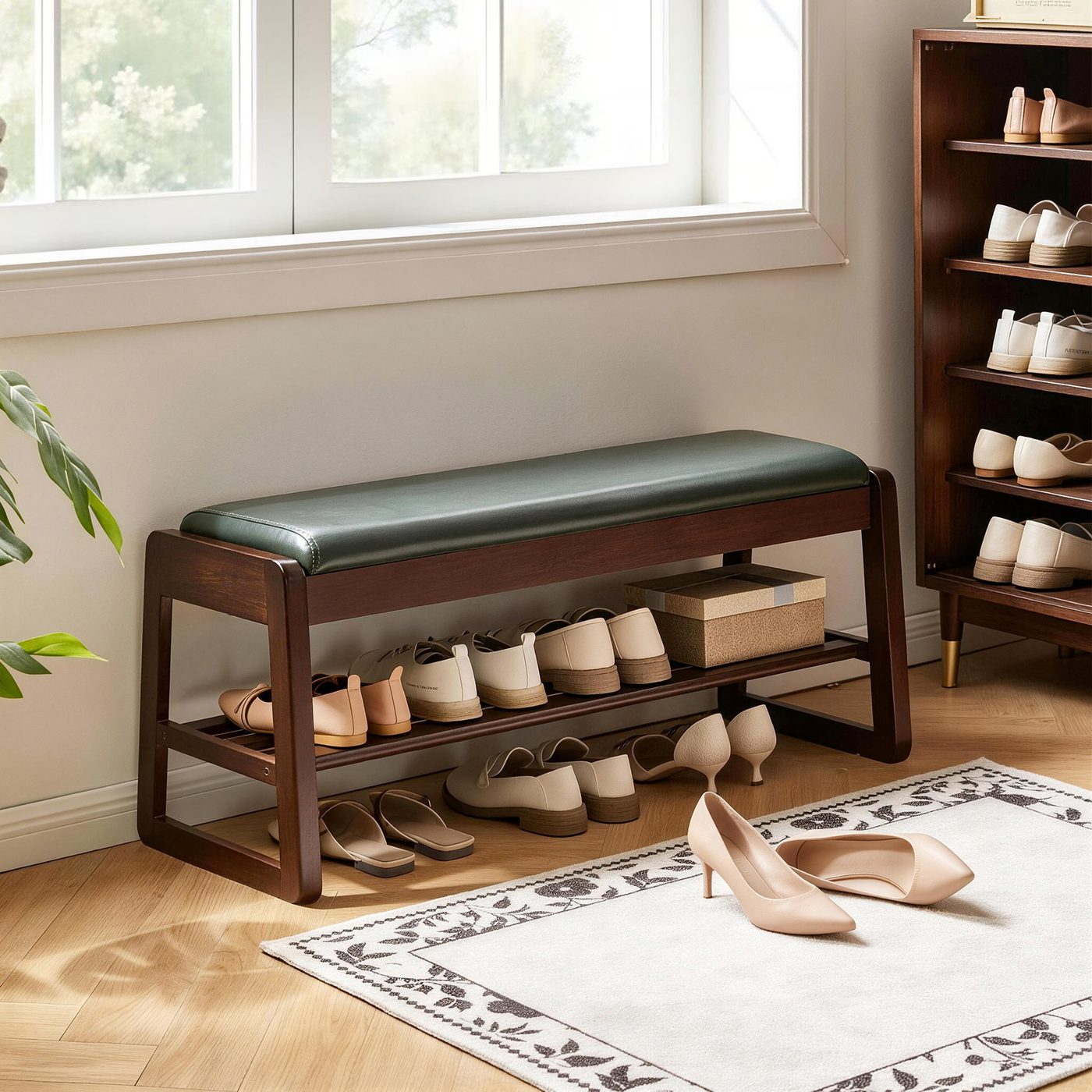
The green bench by the door has one care instruction on its listing: “Wipe the frame and the seat cover with a damp cloth.” That sentence is accurate and it is also all you get. It doesn’t say what the seat cover is, how thick the coating is, or what happens to it in year four.
That’s normal, and not only here. “Vegan leather” and “tech fabric” are the two commonest words on padded furniture, and neither is a material. One is a marketing word for a plastic skin bonded to cloth. The other is a marketing word for a piece of cloth. What separates a cover that shrugs off wet boots from one that flakes at the front edge is three things the listing almost never prints: the polymer, the backing, and an abrasion number — and even that number is quoted on scales that don’t convert.
What “vegan leather” is actually made of
It is a coated fabric, not a hide. A base textile — usually polyester, sometimes cotton or a poly-cotton blend — gets a liquid polymer coating, which is then embossed under heat and pressure with a grain pattern and finished with a topcoat. The strength comes from the backing cloth; the look comes from the coating; the two are held together by adhesion.
Diro Living, a furniture retailer, states the structure plainly: vegan leather “is a flexible polymer skin — almost always polyurethane — bonded to a woven backing cloth, engineered to imitate the grain of animal hide.” They also name the family most furniture buyers meet: polyurethane (PU) is the common one, softer than vinyl and slightly more breathable; PVC is stiffer, cheaper and more water-resistant. Our own green lift-top benches are listed in the supplier data behind them as having a vegan leather seat over a foam fill — the site page itself only says “seat cover,” which is the honest version of the same fact.
Two neighbouring words are traps. Bonded leather is shredded hide scrap pulped with a binder and rolled onto a backing — Diro puts it at “typically 10 to 20 per cent hide by content.” Bicast is a real split hide with a polyurethane layer on top, so what you touch is plastic. Neither is vegan leather.
The label is a naming rule, not a specification
If you want to know why listings use words like “leather-look,” the answer is partly legal. The FTC’s guides for leather and imitation leather products (16 CFR Part 24) treat the unqualified word “leather” as deceptive unless the product “is composed in all substantial parts of leather.” Section 24.2(a) says that where a non-leather material “appears to be leather,” the fact that it isn’t should be disclosed, and offers the approved words: “Not leather; Imitation leather; Simulated leather; Vinyl; Vinyl coated fabric; or Plastic.”
The catch is the scope. Section 24.0(a) lists trunks, suitcases, handbags, wallets, footwear, belts “and similar articles.” Upholstered furniture is not on that list. So the rule that forces a wallet to say “vinyl coated fabric” does not force a bench to say anything at all — which is how you end up with “seat cover” and a damp cloth.
How a coated cover fails
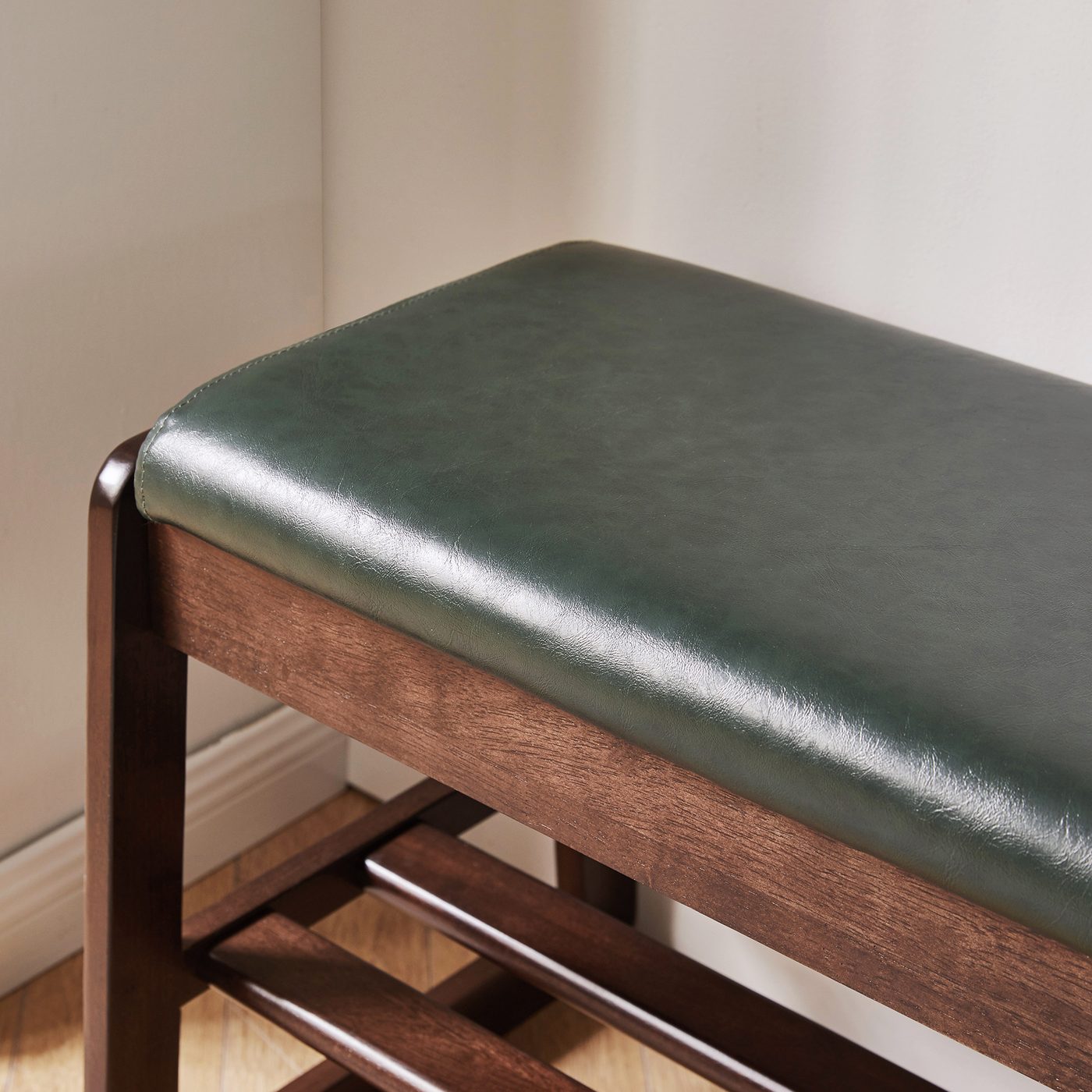
It doesn’t wear through. It delaminates — the coating lifts, cracks and flakes away from the cloth underneath, and it happens where the material is worked hardest: the front edge where the backs of your legs drag every time you sit down, and the seams where the panel is folded and fixed.
Diro Living puts the onset at “somewhere between two and five years” for residential upholstery. That is one retailer’s estimate, not a test result — treat it as a direction, not a date. Two things are worth more than the number: a coated cover cannot be repaired once it starts, and a cover that is a separate, removable piece can be replaced without touching the wood.
The abrasion number doesn’t travel
The industry number for cover durability is double rubs, measured on a Wyzenbeek machine (a weighted abradant dragged back and forth) or a Martindale machine (a figure-of-eight motion counted in cycles). That’s the first reason a number is useless on its own: as upholstery shop Palmetto Upholstery puts it, “the 2 scales do not convert cleanly, so do not try to translate a Martindale number into a Wyzenbeek one.”
The second reason is that the same number carries different labels depending on who prints it.
| Double rubs | What one guide calls it | What another calls it |
|---|---|---|
| 15,000 | “the usual minimum” for furniture (Diro Living) | “Light residential — formal rooms, occasional chairs” (Palmetto Upholstery) |
| 25,000–30,000 | “heavy-duty” (Diro Living) | “Heavy residential — the sofa everybody actually sits on” (Palmetto Upholstery) |
| 50,000+ | — | “Heavy contract and hospitality” (Palmetto Upholstery) |
So “15,000 double rubs” reads as adequate on one page and as barely furniture-grade on another, both quoting the same test. Palmetto draws the limit that matters most by a front door: the test “measures abrasion, nothing else. A fabric can pass 100,000 double rubs and still stain badly, fade in 1 season, or pill.”
The supplier data behind our green benches carries one abrasion field — “medium duty” — with no test method, no number and no scale. That is the whole problem in a single field.
Wet boots: what each cover wants
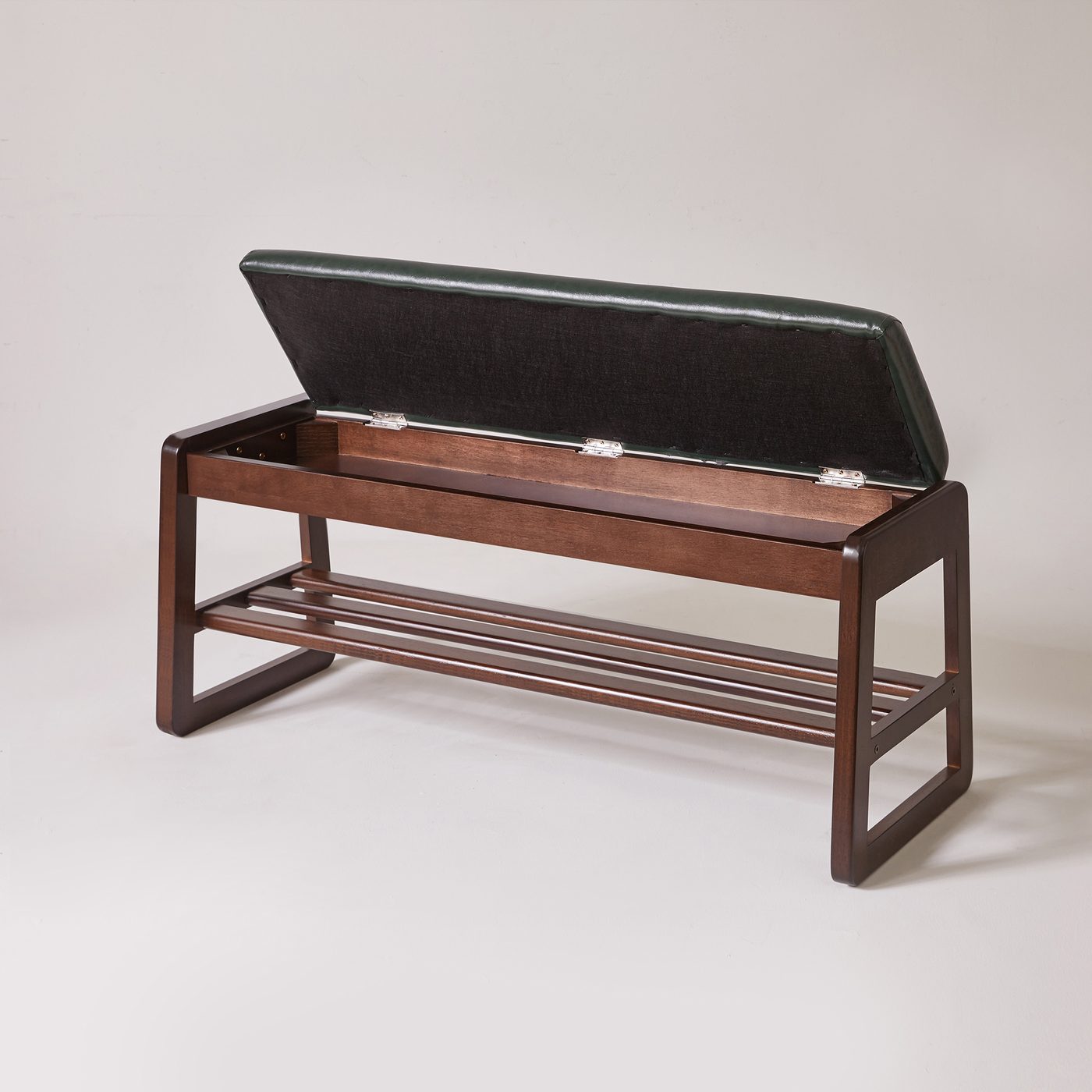
A coated cover has one real advantage: water sits on top. Mud, road salt and slush come off with a damp cloth and nothing soaks in. The care line on the 39-inch green bench and the 31.5-inch version is exactly that, and nothing more.
The trade is breathability. A polymer skin doesn’t breathe the way woven cloth does, so bare legs on a coated seat in July feel different. For two minutes tying shoes that costs you nothing; for an hour after dinner it does.
The farmhouse dining bench with a cushion is the other answer, and its listing is even quieter: “Solid rubberwood frame with a cushion that lifts off,” and “the cushion cover spot-cleans.” No fiber, no backing, no rub count. The removable cushion is the practical part — a cover you can lift off dries flat instead of sitting wet on foam, and foam that stays damp is where a fabric seat starts to smell.
What to ask before you buy
Three questions, in order of how much they change the answer:
- **Is the coating polyurethane or PVC?** PU is softer and marginally more breathable; PVC is stiffer and more water-resistant. The word “vegan leather” covers both.
- **What’s the backing — woven polyester, cotton, or a non-woven?** Adhesion to the backing is the failure point, and a denser multi-layer construction holds up better than a single thin coat.
- **How many double rubs, and on which test?** A number without the method is half a number.
If nobody can answer, assume a thin PU on a woven backing, expect the front edge to go first, and buy the version whose cover you can replace. That’s the honest summary of the category, and it applies to every bench in this price band, including ours.