

Two of these oak chairs at the 55.1-inch double desk sit 22.04 inches apart, seat edge to seat edge, and no arrangement of the two people changes that. The chairs will not touch. What decides whether the pairing works is the vertical number: a 29.5-inch top over a 16.93-inch seat, a drop of 12.57 inches, with neither piece able to move.
The chair page labels the row now — 29.9 H in × 18.1 D in × 16.5 W in (at the seat), then front legs 14.6 in apart at the floor — and the short description gives the seat as 16.5 in wide and 16.9 in high. What it still does not print is seat depth, 16.93 in. Everything in the row reconciles with the measuring drawing the supplier made for the same item: 46, 37 and 76 cm are 18.11, 14.57 and 29.92 in.
What the spec row says, and in what order
The row leads with height, then depth, then seat width, and tacks the floor span on the end. Read in the habit of width first, the 29.9 becomes the width — thirteen inches wider than this chair. And the 14.6, the figure nearest a familiar chair width, is not the width at all: the widest point is the seat at 16.53, and the 14.6 is measured across the front legs where they meet the floor.
| Dimension | Chair page | Supplier drawing, same item |
|---|---|---|
| The three listed dims | 29.9 H × 18.1 D × 16.5 W (seat), front legs 14.6 apart at floor | 46 cm / 18.11 in front to back at the floor; 37 cm / 14.57 in across the front legs at the floor; 76 cm / 29.92 in tall |
| Widest point | 16.5 W at the seat; 14.6 across the front legs | seat, 42 cm / 16.53 in |
| Seat depth | not printed | 43 cm / 16.93 in |
| Seat height | 16.9 in | 43 cm / 16.93 in |
| Weight | 26.2 lb per chair | 26.23 lb |
So: 29.9 tall, 18.1 front to back, 16.5 across the seat, 14.6 between the front legs at the floor. The chair is widest at the seat, 16.53 inches, and narrowest at the floor, 14.57. The row now spells the 14.6 out as a floor span, which is the right fix — but it still sits at the end of a list of three other figures, and it is the one closest to a width. Two chairs on a fixed length of top need the 16.53, not the 14.6, which is the case here.
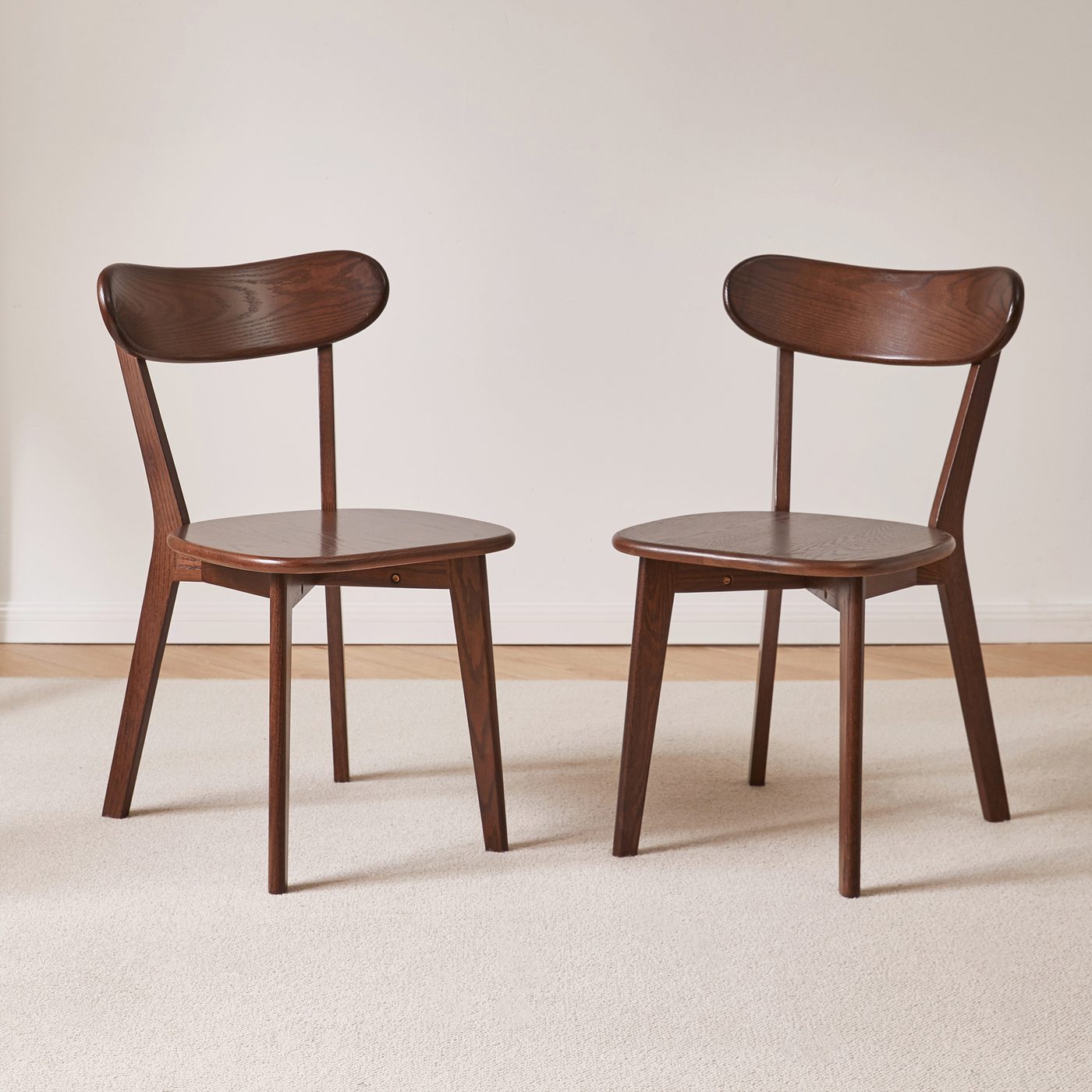
Two chairs, 22.04 inches of air
Use the seat width, not the floor width: 16.53 × 2 = 33.06 inches. Subtract that from 55.1 and 22.04 inches of clear space is left between the two seats, with 11.02 inches from each end of the desk to the outside edge of the outer chair.
Run the same sum with the 14.6 — the floor span, and the figure most likely to be read as the width — and you get 25.9 inches of gap, 3.86 inches more room than the chairs leave. That is the difference between a desk that looks comfortably wide in the drawing and one that feels like a bench when both seats are filled.
What 22.04 inches buys is more than one whole chair of air between two people, so the chair backs are not the collision point unless you slide both chairs toward the middle. If the desk edge each person gets is the worry, that is a different sum, and splitting a 55.1 or a 63-inch top between two people covers it.
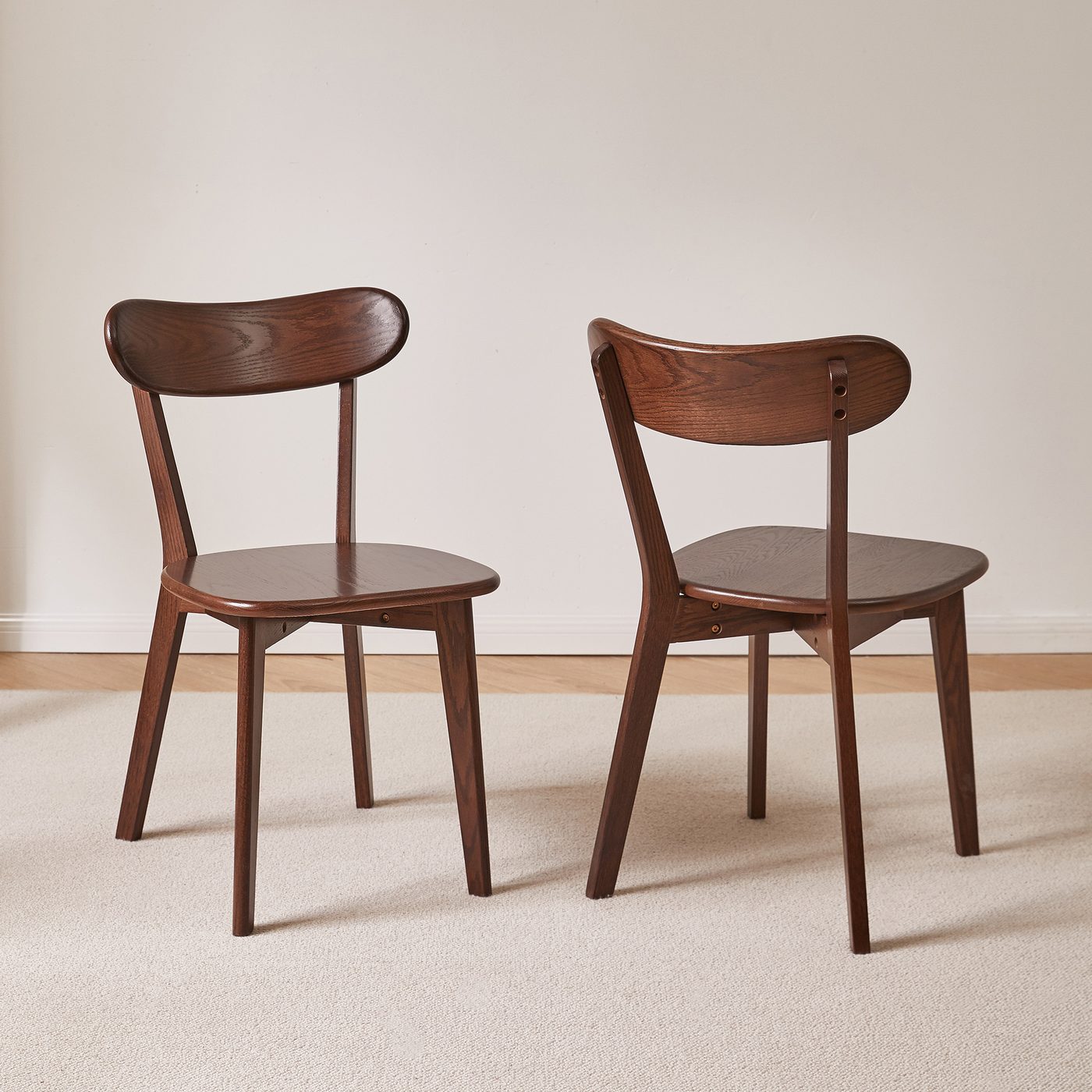
The drop: 29.5 minus 16.93
BEVCO, a seating manufacturer that publishes the rule behind its own seat-height calculator, subtracts 10 inches from the work surface height to find the midpoint of the ideal seat height, then asks for at least 2.5 inches of adjustment either side of it. On a 29.5-inch top the midpoint is 19.5 inches and the bottom of the range is 17.0. The seat at 16.93 lands 0.07 inch under the range and 2.57 inches under the midpoint.
Guides written for dining rooms read the same chair less harshly. DiningFit puts standard dining chair seat height at 18–20 inches, matched to tables 28–30 inches high, with 10–12 inches of legroom between seat and apron. The desk is inside that table range; the 16.93-inch seat is 1.07 inches under the low end of the chair range; and the 12.57-inch drop is 0.57 inch above the legroom window.
They disagree because they price different things. The 18–20 range is about eating: hips at the surface, plate within reach, feet on the floor. The 10-inch drop is about hands: forearms level with a keyboard, which is a lower and more demanding position. A chair that is fine at a 30-inch dining table can still be low at a 29.5-inch work top, and here the error has a direction — elbows below the surface, forearms sloping up toward the keyboard, steeper the further back you sit.
Nothing on this chair moves
No gas spring, no height range, no swivel. It is an oak dining chair, and the fit is decided the moment you unpack it. The leg side passes: OSHA’s test is that a chair height is right when the whole sole rests on the floor with the back of the knee slightly higher than the seat, and on a 16.93-inch seat the knee clears easily. OSHA’s remedy for the opposite problem, a seat too high, is a footrest, which does not help here.
That leaves the arm line, and with both heights fixed the only part with give is the surface you sit on. A cushion thick enough to close all 2.57 inches is not one you would keep; closing the 0.07 inch to the bottom of the range takes almost nothing. If the top stays at 29.5 inches, the workable version is a firm cushion, a keyboard kept at the front edge rather than pushed back, and an honest look at how long you sit. Half an hour of email on a dining chair is normal; six hours a day is a different purchase, which is why the pair sits in the dining and seating lineup rather than in a desk setup.
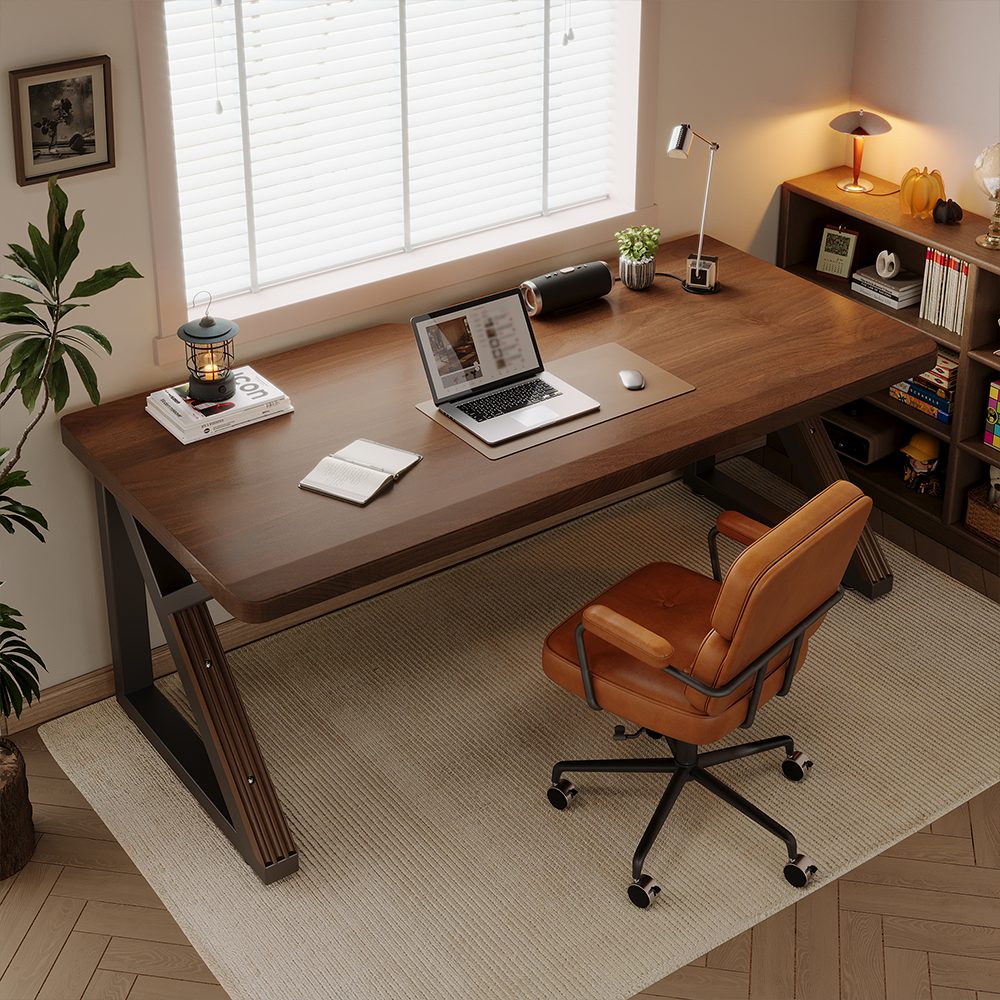
The desk’s half of the fit
The page measures the desk at 55.1 W × 23.6 D × 29.5 H in; the dimension drawing in its gallery marks 55.12 in wide, 23.62 in deep and 29.53 in (75 cm) tall. Same desk, two roundings.
Depth is generous for a chair that is 18.11 inches front to back. With 5.49 inches to spare, the chair goes fully under the top, and the page’s own line explains why: the leg frame sits back from the edges. The seat edge then ends up 5.49 inches behind the desk’s front edge, and that is the space your forearms reach across.
The last mismatch is at the back. The chair stands 29.92 inches, 0.42 inch taller than the desk top, so a sliver of the curved back shows above the surface when the chair is tucked in. The back leans behind the seat, so it never fouls the top. Both pieces arrive flat, the desk with hardware numbered per leg and the chairs with it bagged and numbered, and what a hardware line tells you is where that usually gets decided. If the screen distance is the open question instead, desk depth against monitor distance is the other half.
Sources
- OSHA — eTools: Computer Workstations, Chairs — https://www.osha.gov/etools/computer-workstations/components/chairs — accessed 2026-11-21
- BEVCO — How to Measure Chair Height — https://www.bevco.com/resources/ergonomics/determining-seat-height — accessed 2026-11-21
- DiningFit — Average Chair Height: Standard Seat & Dining Chair Guide — https://www.diningfit.com/average-chair-height — accessed 2026-11-21
- Runva — Solid Oak Dining Chairs, Set of 2 — https://runvaus.com/product/solid-oak-dining-chairs-set-of-2/ — accessed 2026-11-21
- Runva — Solid Wood Double Desk, 55 in — https://runvaus.com/product/solid-wood-double-desk-55-in/ — accessed 2026-11-21