
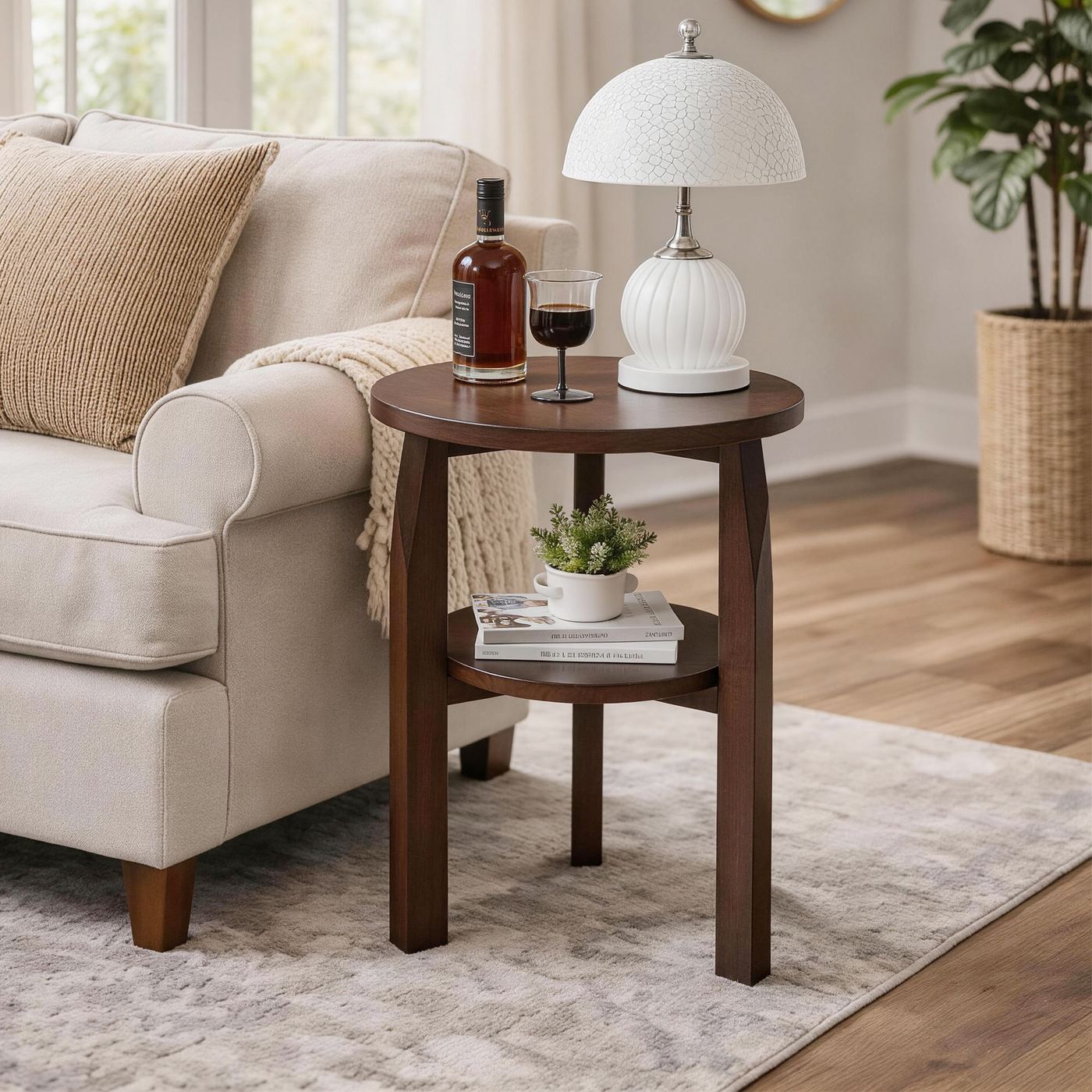
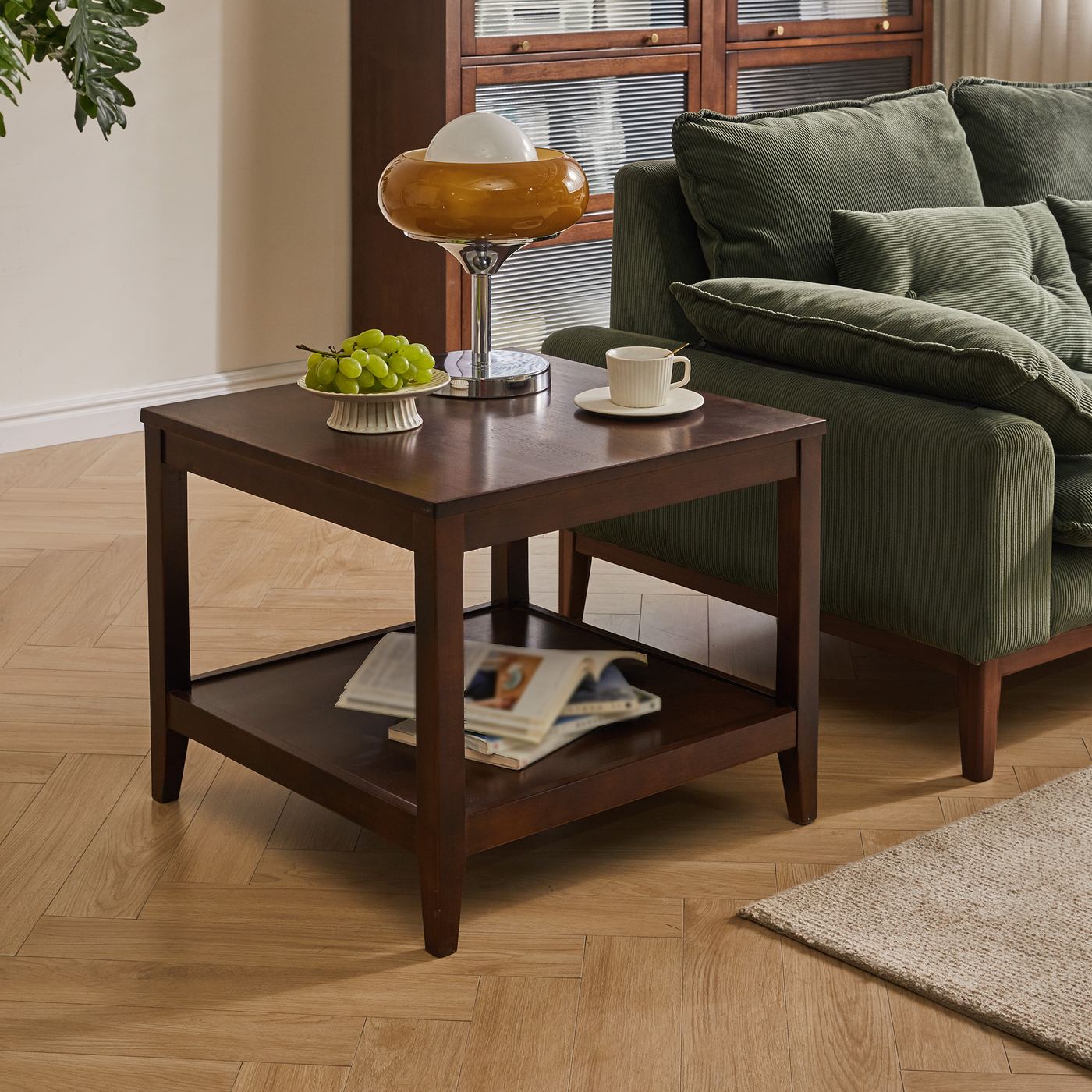
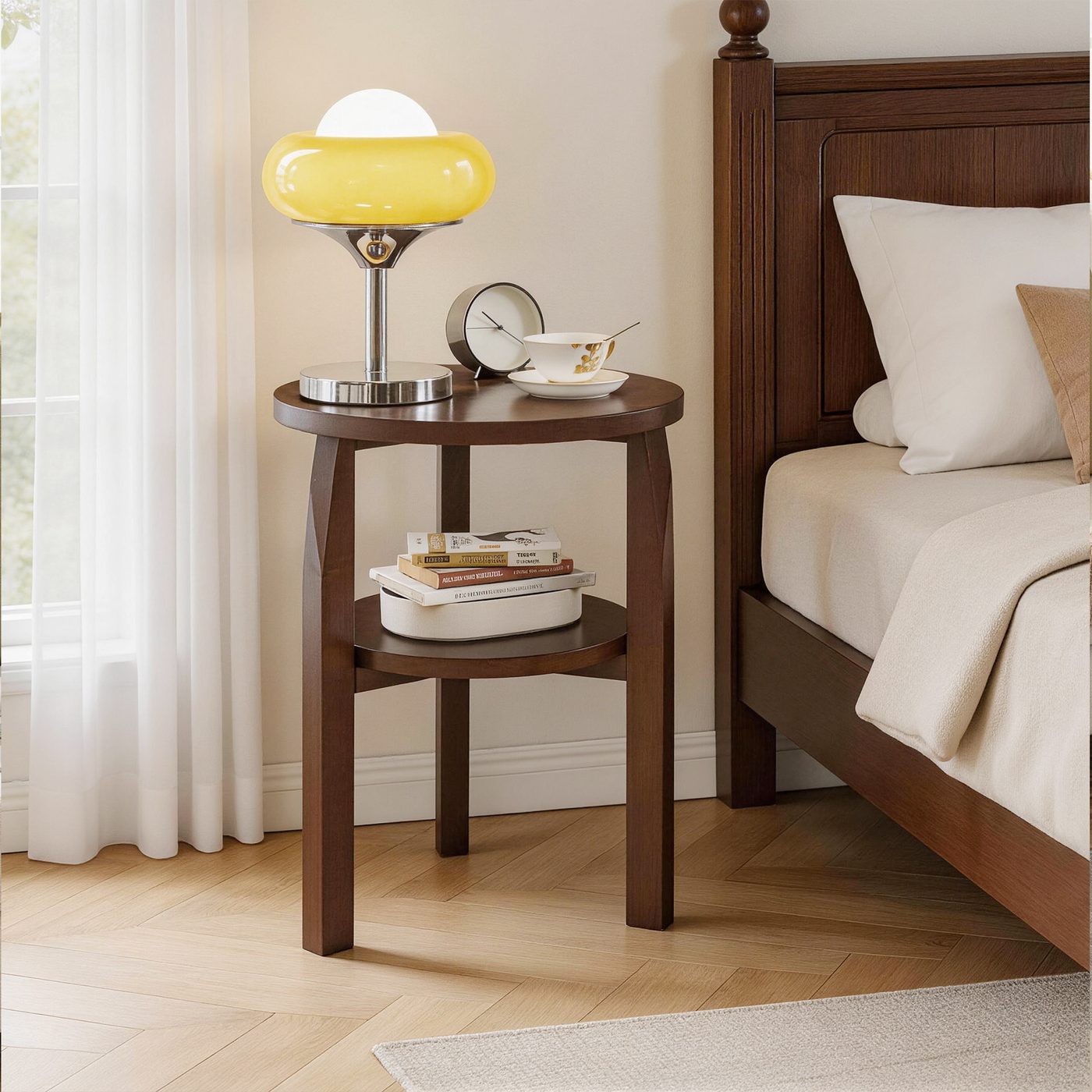
Two of our two-tier side tables are 23.6 inches tall, solid rubberwood, and built the same way: one is 18.9 inches round, the other 19.7 inches square. The width difference is 0.8 inch — less than a finger joint, and the reason nobody notices it on a showroom floor. The longest straight line across the top is where they part: 18.9 inches on the round one, 27.8 inches on the square one.
A side table is not chosen by its width. It is chosen by what your leg meets on the way to the sofa, by how much flat surface is left once the corners are gone, and by what happens in a corner.
The width is the least useful of the three numbers
A round top has one number, and it repeats in every direction. The 18.9-inch table is 18.9 inches across from any angle you approach it, including the one your knee takes on the way past.
A square top has two. Across the flats it is 19.7 inches, which is 0.8 inch more. Across the corners it is 19.68 × √2 = 27.8 inches. So the table that is 0.8 inch wider reaches 8.9 inches further along the diagonal — and the diagonal is the line most apartment walkways actually take, from the door past the sofa to the kitchen.
ArborisWood, a solid wood retailer, describes this in its own buying guide: round end tables “eliminate sharp corners that cause bruised hips in tight spaces.” That is one retailer’s observation about how people move, not an industry standard, and it holds where the path does cross a corner. Where the path runs parallel to the table’s back edge, the square costs you 0.8 inch and nothing more.
A circle keeps 78.5 percent of the top
A circle inscribed in a square always holds π/4 of that square — 78.54 percent. Run it on these two:
18.9-inch round: π × 9.445² = 280 square inches.
19.7-inch square: 19.68² = 387 square inches.
The square carries 107 square inches more — 38 percent more usable top. What the round one gives up is the corners, and the corners are where the wide things go: a serving tray, a spread of magazines, a lamp base with a glass beside it.
The flat test is easy to run. The largest square object that sits fully on the round top is 13.4 inches on a side (18.89 ÷ √2). A 12-inch record sleeve fits. A 14-inch tray does not. Kammika, another furniture retailer, makes the same point with a 14-inch pair: “A 14-inch-diameter circle and a 14 x 14-inch square have the same maximum width, but the square keeps its surface at the corners.”
The second tier repeats the shape, not the size. On the round table the lower shelf is a smaller circle, so it takes a short stack of books or a plant pot. On the square it is a full 19.7-inch square, the same footprint as the top.
What the corner does that the width doesn’t
Push the round table into a 90-degree corner so it touches both walls. Its centre ends up 9.4 inches from each wall, and the floor between its edge and the corner point is 9.445 × (√2 − 1) = 3.9 inches deep at its widest. Nothing useful fits in that wedge; it is a dust trap with a curved wall around it.
The square fills the corner with two straight edges. The price is on the outside: its far corner lands 27.8 inches out from the corner point along the diagonal, against 22.8 inches for the round table’s furthest point. So in a corner the square takes about 5 inches more floor on the diagonal and gives back the 3.9-inch void.
James & James, a furniture retailer, splits the same way in its comparison, under the heading “Square Tables Can Be Easier to Place Against a Wall”: a straight back edge lets the table sit close to a wall, while “Round tables often look better when they have more open space around them.” Against one flat wall with no corner involved, the square’s full 19.7-inch back edge is simply more efficient than a circle that meets the wall at a single tangent point.
Two tables, side by side
| Round two-tier | Square two-tier | |
|---|---|---|
| Top, across the flats | 18.9 in | 19.7 in |
| Top, across the diagonal | 18.9 in | 27.8 in |
| Top surface | 280 sq in | 387 sq in |
| Largest square object that sits flat | 13.4 in | 19.7 in |
| Height | 23.6 in | 23.6 in |
| Weight | 11.1 lb | 16.8 lb |
| Lower shelf | smaller circle | full square |
Both are 23.6 inches tall, near the top of the 20-to-24-inch range ArborisWood works to for its own round tables, so the top has to land near the sofa arm rather than under it. The weight difference, 11.1 lb against 16.8 lb, is small enough that one person can slide either one out to vacuum.
Where each one belongs
Beside a sofa arm with a walkway behind it: round. The 18.9 inches is the same in every direction, so the worst case is the number printed on the spec sheet, and there is no corner at shin height on the way past.
Against a wall, between two chairs, or under a window: square — the end table with the full square shelf. It sits flush, adds 38 percent more flat top, and the lower shelf is wide enough that nothing has to be stacked.
In an actual corner: square if you want the corner filled and the surface; round if that corner sits on a path, where you trade the 3.9-inch wedge for 5 inches less floor on the diagonal.
Measure two things before you order
The clear strip you walk through, measured at table height from the sofa arm to whatever is opposite. Subtract the widest number for the placement you are considering: 18.9 for the round top, which measures 18.9 inches across, or 27.8 if the square’s corner would sit in the path. What is left is your walkway.
The gap between table and sofa decides more than shape does, and we worked through that in what size side table actually fits a sofa. Get it before you fall for a silhouette.
The compromises that don’t make the photos
On the round table, everything has to sit inside a 13.4-inch square of flat surface. A wide tray will overhang and can tip; a lamp, a glass and one book is realistic, while a lamp plus a tray plus a plant is not.
On the square, the corner is 27.8 inches from the opposite one, at shin height, on whatever path you take to the sofa. No photo shows that. Neither page lists a load rating for the top or the shelf, so we won’t quote one — if something heavy is going on the lower tier, ask before you order.
Everything else about these two is nearly identical: same height, same solid rubberwood, same open two-tier layout, a finish that wipes with a damp cloth. Which leaves shape, and shape comes down to two numbers, the diagonal and the walkway. The rest of the range is in the tables collection.
Sources
- ArborisWood — Round vs. Square End Tables: Which Silhouette Actually Fits Beside Your Sofa (a furniture retailer’s buying guide, not an industry standard) — arboriswood.com — accessed 2026-11-26
- James & James — Round vs. Square End Tables: Which Shape Works Best? (retailer comparison) — jamesandjamesfurniture.com — accessed 2026-11-26
- Kammika — Round vs. Square End Tables (retailer guide; the 14-inch circle/square comparison) — kammika.com — accessed 2026-11-26
- Runva — Round Two-Tier Side Table (18.9 W × 18.9 D × 23.6 H in, 11.1 lbs, solid rubberwood) and Square Two-Tier End Table with Shelf (19.7 × 19.7 × 23.6 in, 16.8 lbs, solid rubberwood) — round, square — accessed 2026-11-26. Diagonal, area and corner figures are arithmetic on those published dimensions, not measurements we took.