

A bedroom corner gives you two walls, one seam, and no flat run for a mirror to lean on. Two of the floor mirrors we sell answer that corner in opposite ways: a 63-inch beech mirror on an A-frame that leans against one wall, and a 67.7-inch cabinet on a swivel base that stands in the corner and turns. The difference is not the finish. It is 18.1 inches of width against an 18.9-inch base, and 28 pounds against 48.1.
Which one belongs in your room depends on where the flat surface is. The floor mirror range carries both kinds: mirrors that lean on a flat wall, and mirrors that stand on a base and turn.
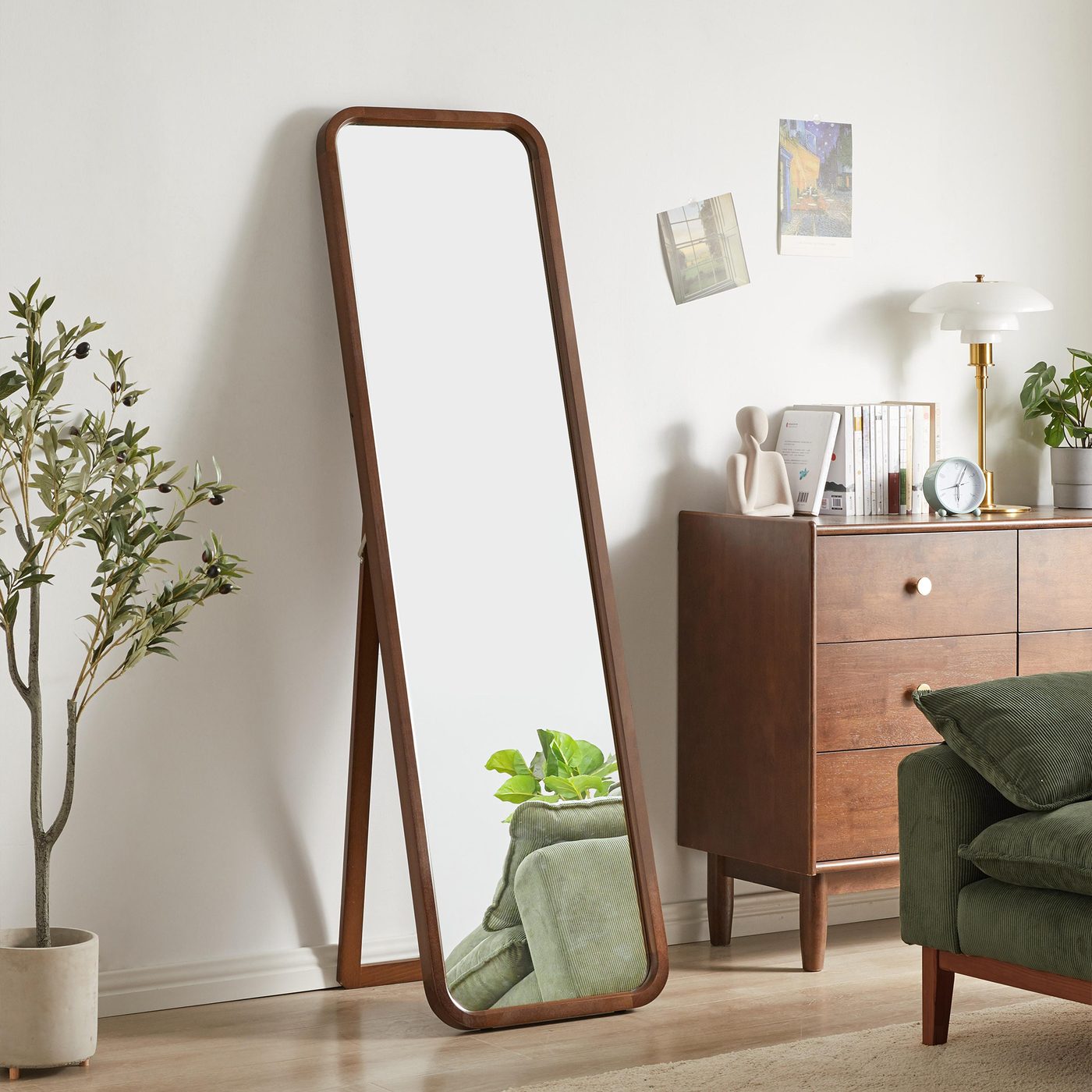
A leaner needs a flat run of wall, and a corner has none
The mirror that stands on its own A-frame legs is 63 inches tall and 18.1 inches wide. Its feet run 20.7 inches front to back, which the page puts plainly: it “needs a strip of floor rather than a wall of it.” The A-frame leans back at an adjustable angle, so you can stand it upright against a wall or tilt it toward the window for better light.
What that frame cannot do is sit in a corner. The back has to lie flat against a wall, and a corner offers a seam, not a plane. Push it as close to the seam as you can and it still leans on one wall only, with 20.7 inches of feet and legs running across the face of the other. The wall behind those legs is now unreachable, and what is left in front is a mirror’s depth plus your standing room, not a corner.
Once it is there, it stays there. Nothing turns, no mechanism needs a level floor, and the piece weighs 28 lb — the page’s own note is that two people should move it, because 28 lb of glass and wood is awkward rather than heavy. It arrives flat with the A-frame to fit on.
One number to keep straight while you plan: retail guides tell you to leave two to four inches between a leaning mirror and the wall. That advice is about a mirror propped against the wall with its bottom edge near the skirting. This mirror’s 20.7 inches is a stand, not a gap, and it is measured on the floor, not at the top of the frame.
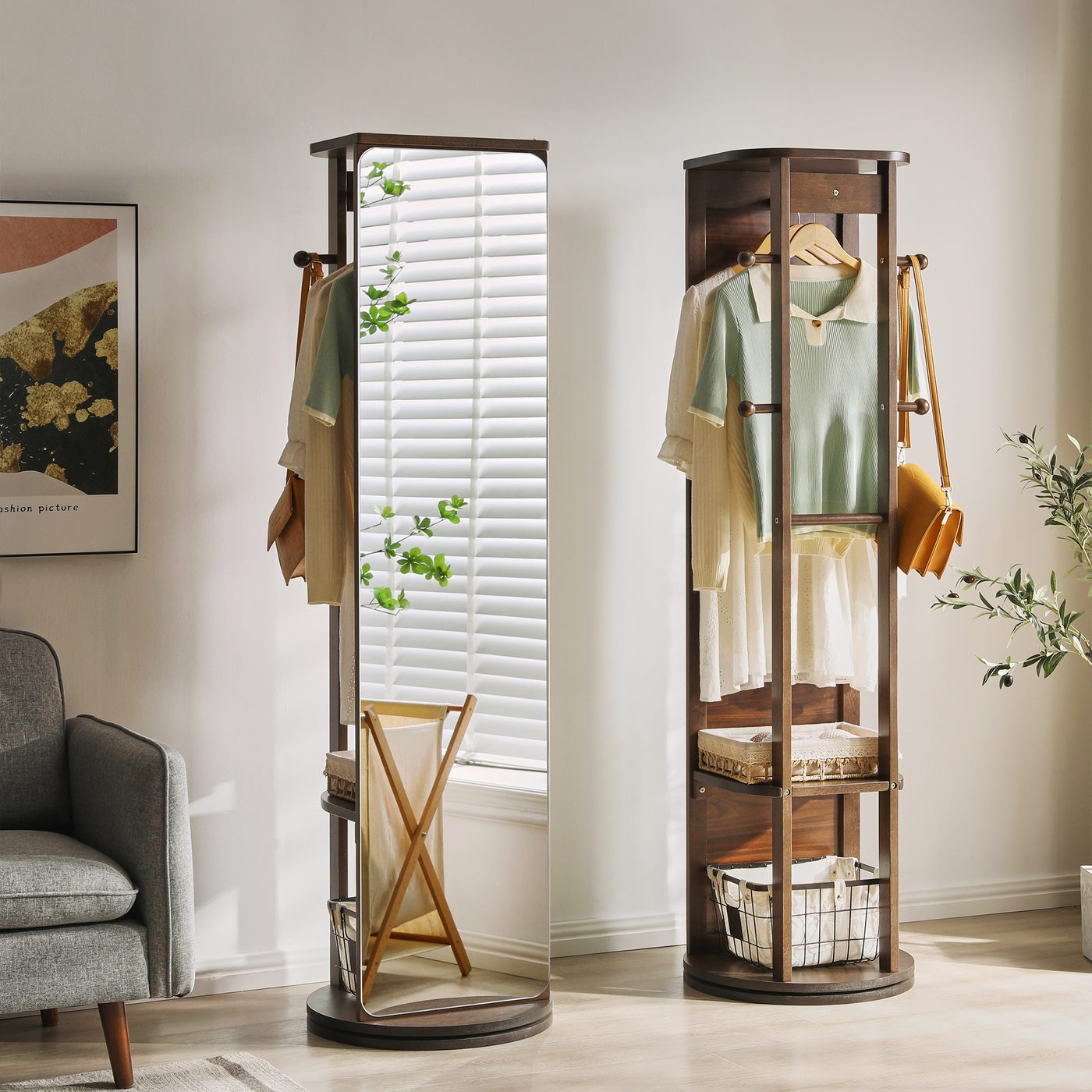
The one that was built for the corner
The swivel cabinet with clothes behind the glass is 67.7 inches tall and stands on an 18.9-inch base. Its page describes what the turn is for: the mirror face turns toward the room when you are dressing, and the cabinet face turns to the wall when you are not, “which is how a mirror this size stops dominating a small bedroom.” Then it states the footprint, in the wording it now uses: “The base is a 18.9 in circle, so a corner takes it without a wall run.”
That is the real argument for a corner. The face you do not need at the moment points at the seam, so the back of a 67.7-inch piece is never the thing you look at from the bed. A leaner has no such option — its back is the wall.
The trade is weight and a mechanism. 48.1 lb against 28, and the page’s setup note is a two-person lift into place. The base turns on the floor itself, so the floor has to be level where it turns; the page says so directly, and it is the one thing you cannot fix after delivery. Keep water off the swivel base and wipe the frame dry, because a base that has to turn is a base that grit will find.
The page’s FAQ adds the line that decides a tight corner: 18.9 inches of base, measure the widest part of the circle rather than the corner it sits in, and add swing room “if you want it to turn freely.” If a bed frame or a dresser edge sits just outside that 18.9-inch patch of floor, you will be nudging the whole cabinet to reach the clothes inside it, not turning it.
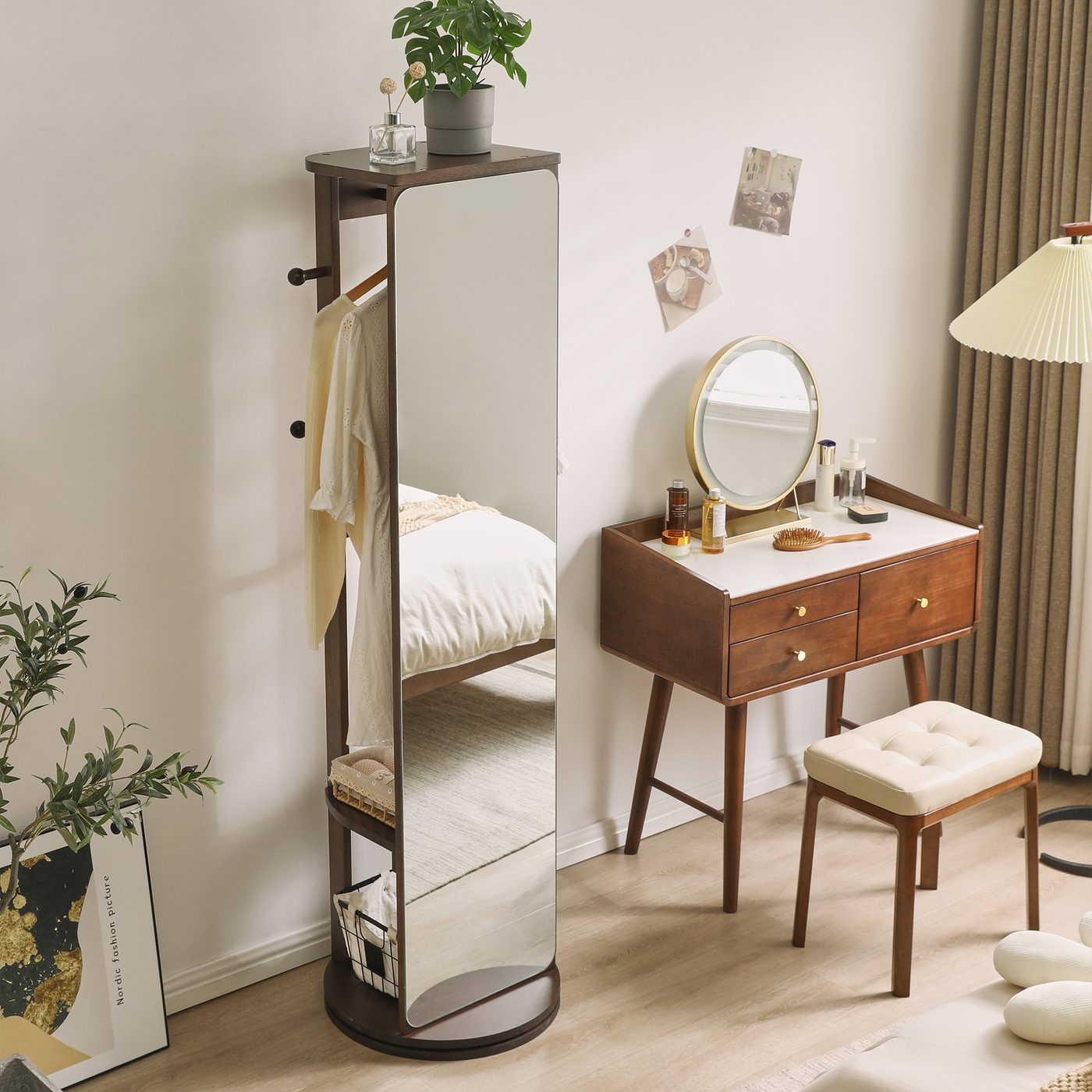
Twenty pounds is the difference, not two inches
| Beech Floor Mirror, Walnut | Rotating Mirror Cabinet | |
|---|---|---|
| Height | 63 in | 67.7 in |
| Floor footprint | 18.1 in wide, feet 20.7 in front to back | 18.9 × 18.9 in |
| Weight | 28 lb | 48.1 lb |
| Frame | solid beech, walnut finish | solid rubberwood, walnut finish |
| Wall required | a flat run of at least 18.1 in | none — freestanding on its base |
| What moves | nothing | the whole piece turns on the base |
The two footprints are within 19 square inches of each other — 375 against 357 — so this is not a decision about floor area. It is a decision about shape and weight. One is a flat panel with legs that has to be aimed at a wall; the other is a column that can be aimed in any direction from the same spot.
The 20.1 lb gap is what you will feel on moving day, and the 4.7 inches of extra height is what decides whether the top of the frame sits above your eye line. That second question has its own arithmetic, and it is worth doing before you pick the taller piece: what a 63-inch mirror actually shows you depends on where your eyes sit, not on the frame height on the listing.
The room in front of either one
Both pieces need the same thing in the direction they face: standing room. Retail guidance puts three to four feet in front of a floor mirror for dressing. Against the cabinet’s 18.9 inches of floor that is 54.9 to 66.9 inches of room depth from the wall; against the leaner’s 20.7 inches it is 56.7 to 68.7. In a bedroom of 100 to 150 square feet, most of one dimension is now spoken for — which is the whole reason the corner is worth arguing about. It is the one spot where the standing room runs diagonally, across floor you were not using.
Doors decide the rest. A 32-inch door does not hand you 32 inches of passage: once the slab and the stops are counted, the clear width is roughly 29-1/2 to 30 inches, and the swing takes more floor than the opening does. A mirror, leaning or turning, parked inside a door’s arc gets hit by the door long before anyone stands in front of it.
Four measurements, in this order
1. The flat run. At least 18.1 inches of wall with nothing on it — no curtain, no radiator, no switch plate — if you are buying the beech mirror.
2. The corner square. 18.9 by 18.9 inches of clear floor, with the base level, if you are buying the rotating cabinet.
3. The standing room. Three to four feet from the glass, measured to whatever is behind you. If a bed or a dresser is inside that distance, the mirror works but the dressing does not.
4. The door arc. Open the door fully and watch where its edge travels. If that arc crosses your corner or your wall run, the mirror moves.
Two pieces, two answers, and both of them are decided by the room rather than by the frame. The corner is the harder one to fill, and it is the only one where the turning cabinet is the answer instead of the compromise.
Sources
- Runva product page — Rotating Mirror Cabinet in Rubberwood (dimensions, 48.1 lb, swivel base, level-floor note, corner footprint) — https://runvaus.com/product/rotating-mirror-cabinet-in-rubberwood/ — accessed 2026-11-27
- Runva product page — Beech Floor Mirror, Walnut (63 in, 18.1 in wide, feet 20.7 in, 28 lb, adjustable A-frame) — https://runvaus.com/product/beech-floor-mirror-walnut/ — accessed 2026-11-27
- LOOMLAN — Complete Floor Mirror Buying Guide (wall clearance 2–4 in for leaning mirrors; movement space 3–4 ft; small-bedroom band 100–150 sq ft, 60–66 in tall, 16–20 in wide) — https://loomlan.com/pages/floor-mirrors-guide — accessed 2026-11-27
- DG Floors — 32 Inch Interior Door: Sizing and Buying Guide (a 32-inch slab yields roughly 29-1/2 to 30 inches clear once slab and stops are counted) — https://dgfloors.com/32-inch-interior-door — accessed 2026-11-27