

A 35.4-inch bookcase with two dividers in it is not one shelf. It is three openings of 11.02 inches, and that difference is why a cube case holds a row of hardbacks without bowing while a single long shelf of the same board starts to dip.
WoodBin’s Sagulator, the deflection calculator woodworkers have passed around for years, states the ratio plainly: double a shelf’s span and it sags eight times as far; cut a span by a fifth and the shelf is roughly twice as stiff. Nothing in that rule mentions oak, rubberwood or MDF. Material sets the starting stiffness; the gap between supports decides the rest.
The gap between supports is the number to find
Shelf span is the clear distance from one support to the next: the inside width of a bay on a bookcase, the shelf between the legs on an end table. The outside dimension tells you where the piece fits in the room. The inside dimension tells you whether it holds what you put on it, and it is the one nobody prints.
Two thresholds from the same calculator matter here. The eye catches about 1/32 in of sag per running foot, which is 3/32 in across a 3-foot shelf. And shelves keep moving after the load goes on: the Sagulator’s rule of thumb is another 50% over time, so it suggests designing to 0.02 in per foot or less. That is how a shelf looks straight in the store and dips two years later with nothing broken.
What a loaded shelf is actually carrying
The calculator puts a fully loaded bookshelf at 20–40 lb per running foot, or 60–120 lb for a 3-foot shelf. It notes that 35 lb per running foot is used for some library shelving, and that a shelf of Fine Woodworking magazines can reach 40 lb per foot. Paperbacks are light; binders, art books and magazine stacks are not. That is the figure to compare against the span.
Thickness buys stiffness. Depth barely does.
Two upgrades look similar on a spec sheet and are not. Double the thickness of the panel and deflection drops to one-eighth. Double the depth and deflection only halves.
Depth adds weight without buying much stiffness: a 12-inch-deep shelf of 3/4-inch stock is no stronger than an 8-inch one. The other trap is nominal sizing: a “1-inch” board measures 3/4 in, and the calculator asks for actual thickness for exactly that reason. Whatever the listing calls the panel, put a ruler on the edge.
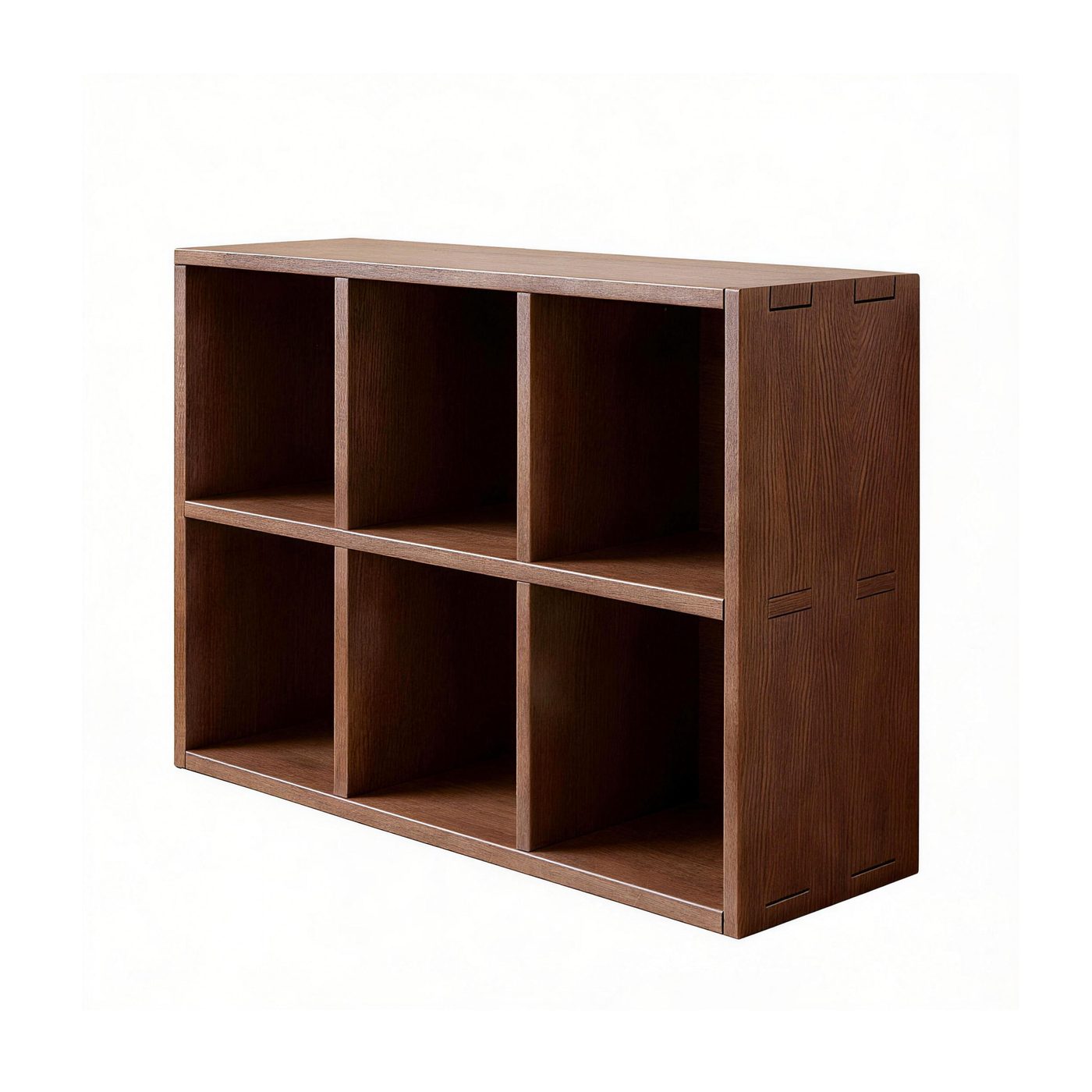
What the six-cube bookcase does differently
The six-cube solid wood bookcase measures 35.4 × 11.8 × 23.6 in and weighs 17.5 lb on its product page. Six openings, two rows of three in the wide layout, and the dimension drawing in the gallery gives each opening as 11.02 in wide.
That changes the question. The longest unsupported run here is 11.02 in, not 35.4 in, about a third of the outside width. Apply the calculator’s own ratio and a panel spanning the full 35.4 in would deflect something like thirty times as far as one broken into 11.02-in bays at equal load (3.21³ ≈ 33). The divider is what turns a 35-inch span into an 11-inch one.
Loaded the way the calculator describes a bookshelf, one bay holds 0.92 running feet of books, roughly 18–37 lb over an 11-inch span. A full case is six of those, each resting on a panel that carries one bay.
What the page does not print is panel thickness, or a load rating. Neither does the rest of the catalog. It does print a claim about the edges: “Solid wood, not a veneered panel, so the edges hold up when things get moved around.” That is a durability statement, not a load statement, and the difference matters when you are deciding whether to stack binders six high. If the material line is what you are trying to read, solid wood versus MDF on a listing covers that separately.
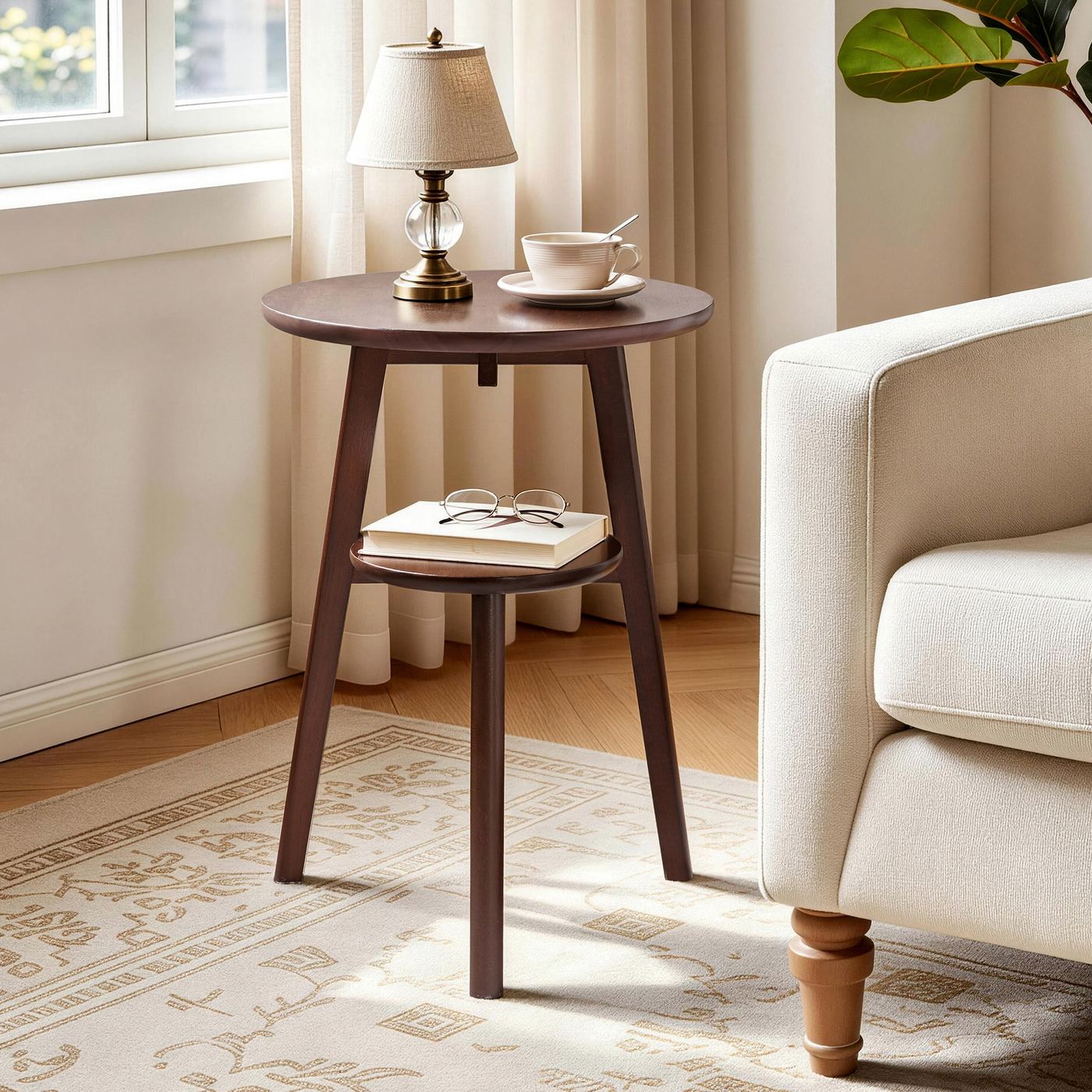
The lower shelf on a two-tier table
The two-tier side tables put a second panel between the legs, and the page names its job: “The top takes a lamp and a glass; the shelf below holds magazines or a basket.”
The two-tier solid wood side table in the tables lineup is 16.5 × 16.5 × 23.6 in, 7.9 lb, solid rubberwood. Its lower shelf is a 9.84-in disc according to the dimension drawing, so the panel spans just under ten inches at its widest run.
The square version is 19.7 × 19.7 × 23.6 in and 16.8 lb, and it is the more interesting piece, because its drawing marks the top panel at 4 cm, or 1.57 in, thick. That is nearly twice the 3/4-in stock most shelving uses, and it is why a 19.7-in panel there needs no middle support. Between two pieces at a similar price, that number on the edge explains more than the word “solid” does.
| Piece | Page dimensions (W × D × H) | Weight on page | Widest shelf run |
|---|---|---|---|
| Six-cube solid wood bookcase | 35.4 × 11.8 × 23.6 in | 17.5 lb | 11.02 in per opening (drawing) |
| Two-tier solid wood side table | 16.5 × 16.5 × 23.6 in | 7.9 lb | 9.84 in shelf (drawing) |
| Square two-tier end table | 19.7 × 19.7 × 23.6 in | 16.8 lb | 19.7 in panel, 1.57 in thick (drawing) |
If you are working out what fits under a shelf rather than what it holds, the clearance measurement is the other half of the same decision.
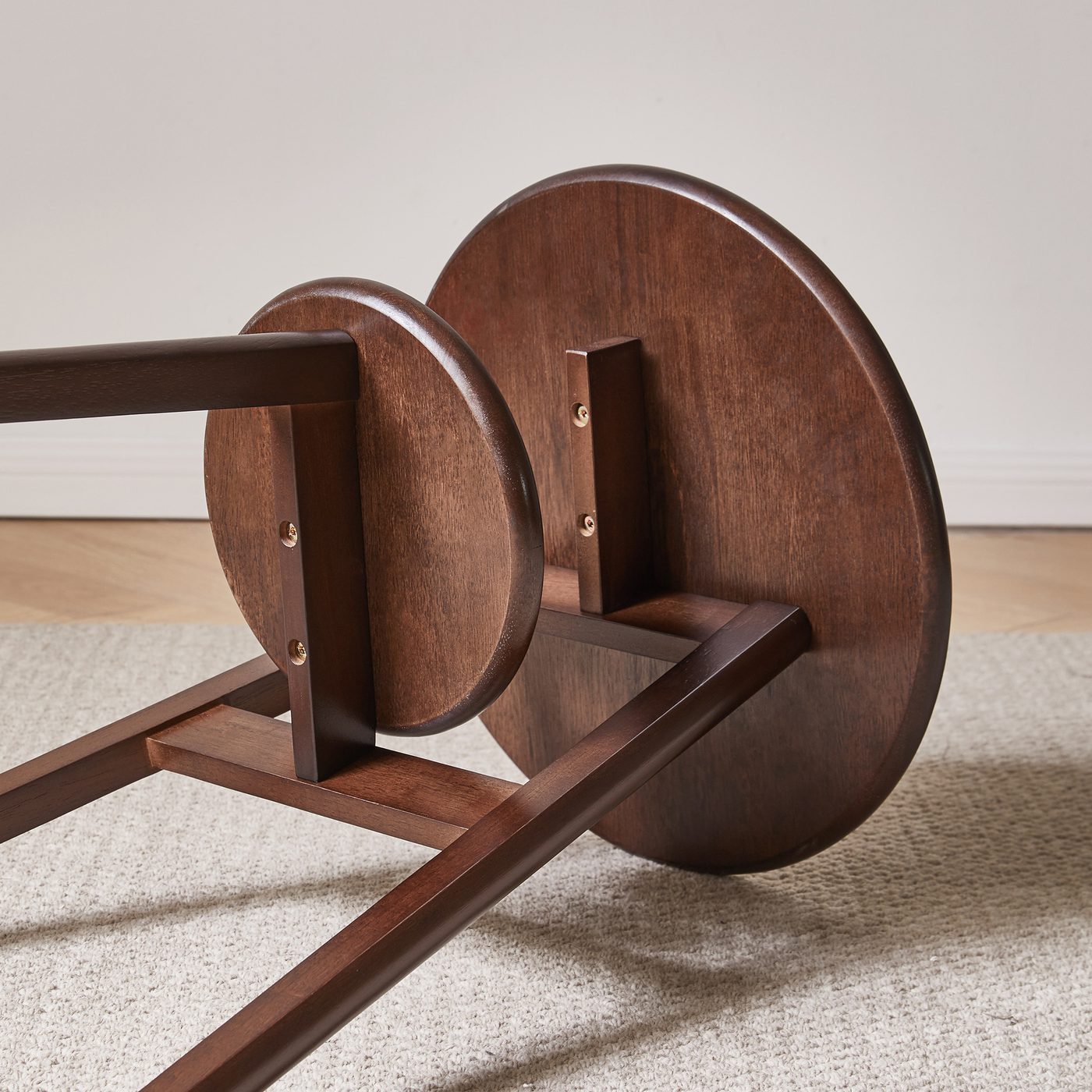
How the shelf is held matters as much as the panel
The underside of the two-tier table shows the arrangement, and it is not a groove. A rail is screwed across the shelf and blocks are screwed to the top, so the panel is fastened rather than let into the legs. When a small shelf starts to sag, the wood is not usually the first thing to fail: the screws at those blocks have loosened, or the panel has crushed around them. Tighten before you replace anything. Flat-packed pieces work the same way, which is why the hardware line on a listing is worth reading before assembly.
What to measure before you buy
- Inside width, not outside width. An 11.02-in opening sits inside a 35.4-in case, and the two numbers answer different questions.
- Panel thickness at the front edge. A ruler settles the nominal-versus-actual question in one look.
- Fixed or adjustable. A shelf on pins is held at four small points; one on cleats or rails is held along its edges.
- What is going on it. Compare against 20–40 lb per running foot; binders and magazines sit at the top of that range.
- Where the weight sits. The same load in the middle deflects more than the same load pushed toward the supports.
If the answer is still not obvious, the honest version is the one the calculator prints itself: real shelves vary from calculated results. Two measurements you can take yourself, the clear opening and the panel edge, decide more than any adjective.
Sources
- WoodBin — The Sagulator — https://woodbin.com/calcs/sagulator/ — accessed 2026-11-20
- Runva — Six-Cube Solid Wood Bookcase — https://runvaus.com/product/six-cube-solid-wood-bookcase/ — accessed 2026-11-20
- Runva — Two-Tier Solid Wood Side Table — https://runvaus.com/product/two-tier-solid-wood-side-table/ — accessed 2026-11-20
- Runva — Square Two-Tier End Table with Shelf — https://runvaus.com/product/square-two-tier-end-table-with-shelf/ — accessed 2026-11-20